
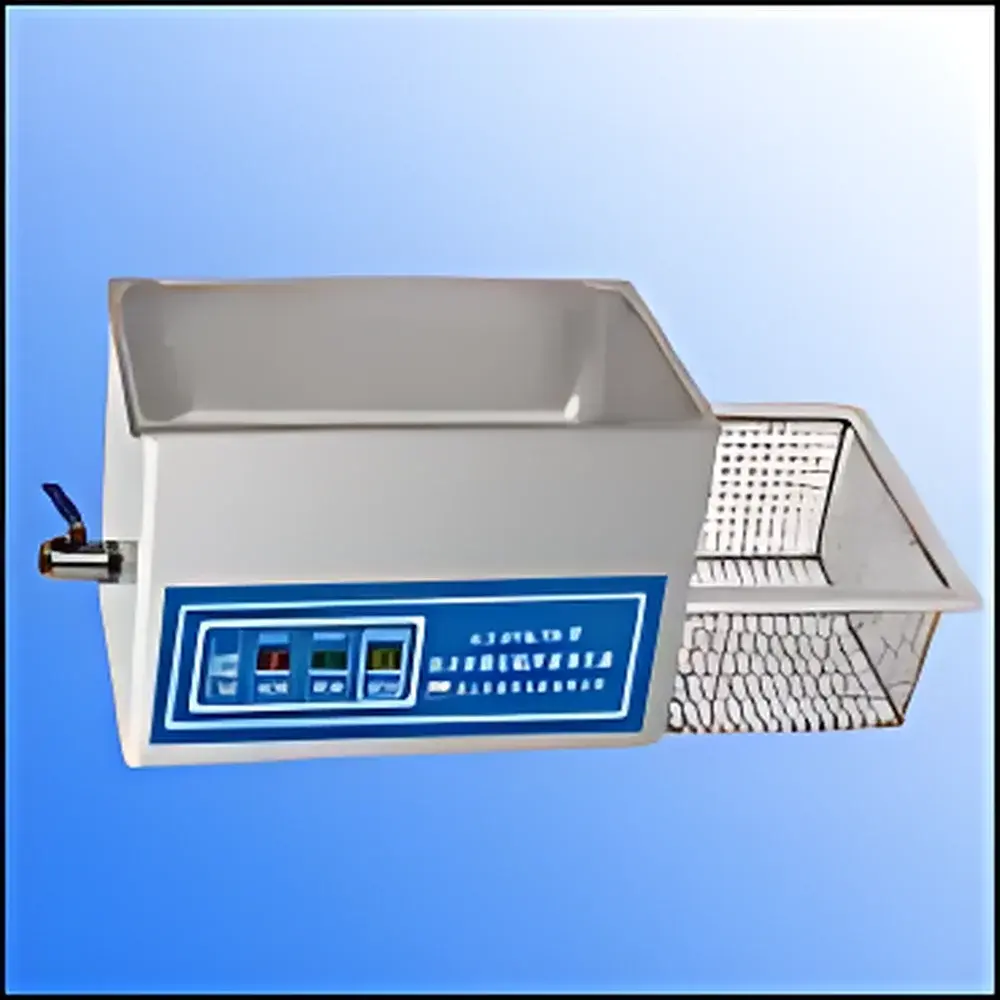
KQ-2200DE Desktop Digital Ultrasonic Cleaner
| Origin | Shanghai, China |
|---|---|
| Manufacturer Type | Authorized Distributor |
| Origin Category | Domestic (China) |
| Model | KQ-2200DE |
| Price | USD 465 (FOB Shanghai) |
| Dimensions (L×W×H) | 260 × 160 × 280 mm |
| Tank Internal Dimensions (L×W×H) | 230 × 140 × 100 mm |
| Tank Capacity | 3 L |
| Ultrasonic Frequency | 40 kHz |
| Ultrasonic Power Output | 100 W |
| Power Adjustment Range | 40–99% |
| Heating Power | 600 W |
| Temperature Control Range | 20–80 °C |
| Timer Range | 1–99 min |
| Stainless Steel Mesh Basket | Included |
| Sound-Dampening Lid | Included |
| Drain Valve | Included |
Overview
The KQ-2200DE Desktop Digital Ultrasonic Cleaner is an integrated benchtop instrument engineered for precision cleaning, degassing, dispersion, emulsification, and cell disruption in laboratory, academic, and light industrial environments. It operates on the principle of piezoelectric ultrasonic cavitation: high-frequency (40 kHz) acoustic energy is transmitted through liquid media via submerged transducers, generating transient microbubbles that collapse violently near surfaces—producing localized shear forces, microstreaming, and thermal effects sufficient to dislodge particulate contaminants, remove organic residues, and accelerate mass transfer without mechanical abrasion or solvent-intensive protocols. Its monolithic design integrates the ultrasonic generator and stainless steel tank into a compact footprint (260 × 160 × 280 mm), making it suitable for shared lab spaces, QC benches, and teaching laboratories where space efficiency and operational reliability are critical.
Key Features
- Digital LED display with real-time monitoring and memory retention for ultrasonic power (%), heating temperature (°C), timer duration (min), and actual tank temperature—enabling repeatable, protocol-driven operation.
- Intelligent safety architecture: automatic shutdown triggered by low liquid level detection, over-temperature (≥85 °C), over-current, or over-voltage conditions—compliant with IEC 61000-6-3 EMC and IEC 61010-1 safety standards for laboratory equipment.
- Two independent 50 W piezoelectric transducers mounted on the tank bottom ensure uniform energy distribution across the full 3 L working volume (230 × 140 × 100 mm internal dimensions).
- Electropolished 304 stainless steel tank and outer housing resist corrosion from aqueous solutions, mild solvents, and alkaline detergents—validated per ASTM A967 for passivation performance.
- Integrated 600 W heating system with ±1 °C temperature stability (PID-controlled) supports temperature-assisted cleaning protocols required for waxy, viscous, or thermally sensitive samples.
- Detachable stainless steel mesh basket (argon-welded construction) prevents direct contact between delicate components and tank walls while permitting full immersion and solution circulation.
- Acoustic attenuation lid reduces ambient noise to ≤55 dB(A) at 1 m distance—meeting ISO 7779 and OSHA 29 CFR 1910.95 workplace exposure guidelines.
- Drain valve positioned at the lowest point of the tank enables complete, residue-free solution removal—critical for cross-contamination prevention in regulated workflows.
- Microcontroller-based firmware logs cumulative operational time (up to 999,999 hours) and retains user-defined parameters across power cycles—supporting GLP-compliant maintenance scheduling and audit readiness.
Sample Compatibility & Compliance
The KQ-2200DE accommodates a broad range of sample formats—including glassware (vials, cuvettes, pipette tips), metal parts (surgical instruments, watch components), printed circuit boards, optical lenses, and biological substrates (tissue culture plates, electrophoresis gels). Its 40 kHz frequency balances penetration depth and cavitation intensity, minimizing erosion risk for soft polymers or fragile ceramics while maintaining efficacy on hardened soils. The unit meets CE marking requirements under the EU Machinery Directive 2006/42/EC and Low Voltage Directive 2014/35/EU. For pharmaceutical applications, its programmable timer and temperature control support validation against USP environmental cleaning requirements and ISO 13485 clause 7.5.10 (cleaning process control). No moving parts or consumables are required beyond standard aqueous or ethanol-based cleaning solutions.
Software & Data Management
This model operates via embedded firmware with no external PC dependency. All operational parameters—including power level, temperature setpoint, timer duration, and real-time status indicators—are stored in non-volatile memory. While it lacks USB or Ethernet connectivity, its digital interface supports traceable manual documentation: users may record timestamped settings and cycle completion in lab notebooks or LIMS entries. The cumulative hour counter serves as a hardware-level usage log for preventive maintenance planning (e.g., transducer performance verification every 5,000 operating hours per manufacturer recommendation). For labs requiring electronic records, integration with third-party data acquisition systems is feasible via optional analog voltage output modules (0–5 V signal mapping to temperature or timer status).
Applications
- Pre-analytical sample preparation: removal of residual proteins, lipids, or salts from HPLC vials, GC autosampler syringes, and ICP-MS nebulizers.
- Electronics manufacturing: flux residue removal from SMT stencils and PCB assemblies prior to AOI inspection.
- Materials science: dispersion of nanomaterials (e.g., graphene oxide, TiO₂ nanoparticles) in aqueous suspensions for rheological or spectroscopic characterization.
- Life sciences: gentle lysis of bacterial cultures (E. coli, Bacillus spp.) and mammalian cells for protein extraction—validated using Bradford assay recovery rates ≥92% vs. sonication probe methods.
- Quality control: cleaning of calibration standards (e.g., NIST-traceable particle size reference materials) to eliminate static charge-induced adhesion artifacts.
- Academic instruction: hands-on demonstration of cavitation physics, acoustic streaming, and surfactant-enhanced cleaning kinetics in undergraduate physical chemistry labs.
FAQ
What is the maximum recommended operating temperature for aqueous cleaning solutions?
The unit is rated for continuous operation up to 80 °C; however, for optimal transducer longevity and consistent cavitation efficiency, we recommend maintaining temperatures between 40–60 °C during routine use.
Can this cleaner be used with flammable solvents such as acetone or IPA?
No. The KQ-2200DE is not explosion-proof and lacks intrinsically safe certification. Only water-based or non-flammable, low-volatility cleaning agents (e.g., Alconox® Liquinox®, Decon® 90) are permitted.
How often should the stainless steel tank be passivated?
Passivation per ASTM A967 is recommended after initial installation and annually thereafter—or immediately following any use with chloride-containing solutions—to maintain corrosion resistance.
Is the drain valve compatible with standard laboratory tubing?
Yes—the 6 mm OD barbed outlet accepts standard silicone or Tygon® tubing (ID 4–6 mm) for gravity-fed waste collection into secondary containment.
Does the unit comply with FDA 21 CFR Part 11 requirements for electronic records?
No. As a standalone instrument without audit trail generation, electronic signature capability, or user access controls, it does not meet Part 11 criteria. However, its parameter memory and hour counter support manual compliance when paired with documented SOPs and paper-based batch records.



