
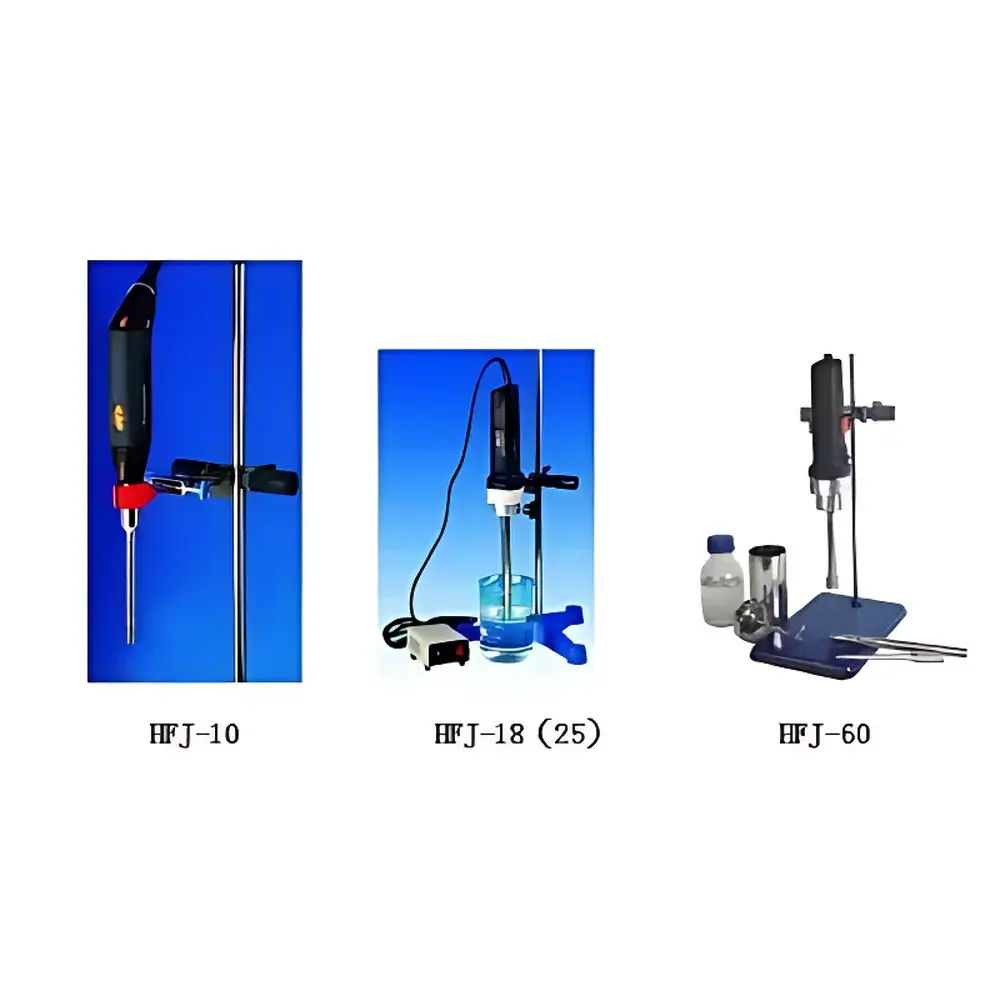
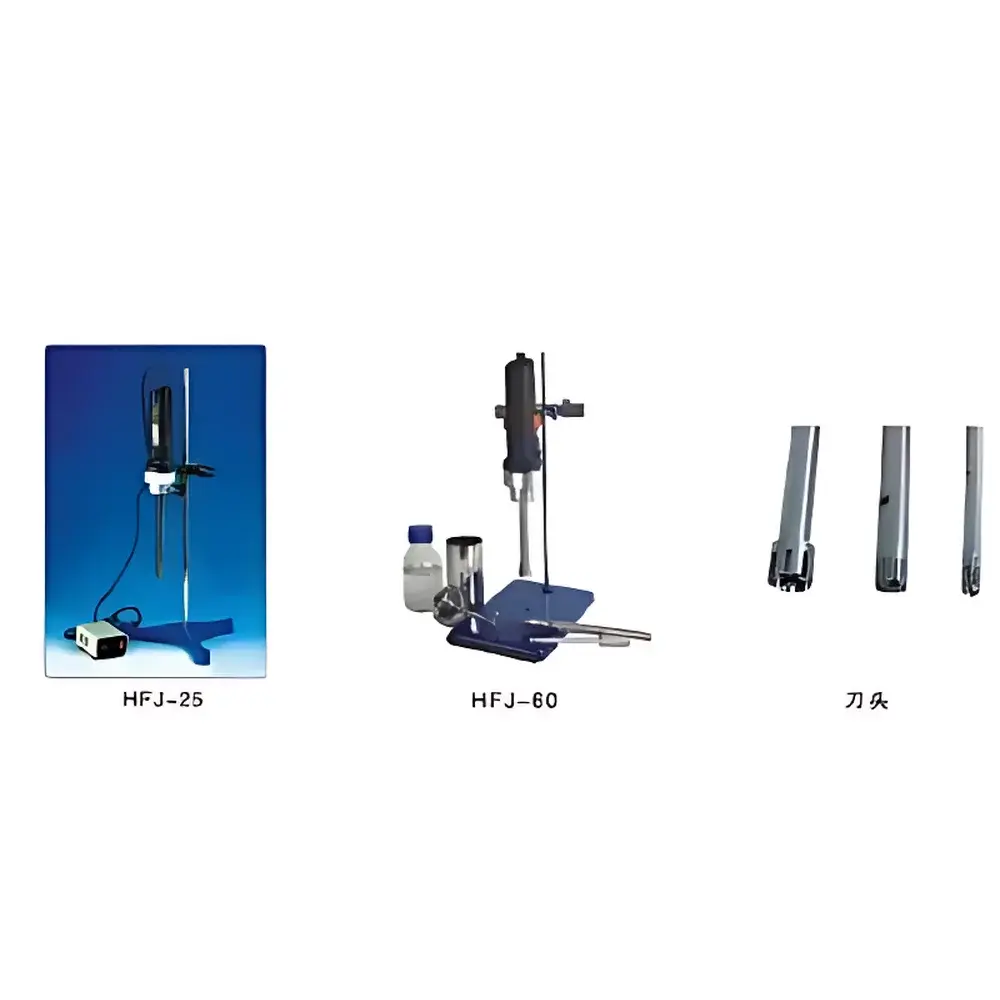
Chu Ding Technology HFJ-25 Benchtop High-Speed Inline Homogenizer
| Brand | Chu Ding Technology |
|---|---|
| Origin | Shanghai, China |
| Model | HFJ-25 |
| Rotational Speed | 31,000 rpm |
| Probe Diameter | 25 mm |
| Power | 500 W |
| Max. Sample Volume (Water) | 5000 mL |
| Material of Wetted Parts | ASTM F899 Grade 316 Stainless Steel |
| Probe Configuration | Interchangeable Rotor-Stator Assembly with Angled Shear Edges |
Overview
The Chu Ding Technology HFJ-25 Benchtop High-Speed Inline Homogenizer is an engineered solution for high-shear mechanical homogenization in research and quality control laboratories. Operating on the principle of rotor-stator fluid shear, the device generates intense hydrodynamic cavitation and turbulent mixing through the rapid relative motion between a rotating inner rotor and a stationary outer stator—both precision-machined with angled cutting edges to maximize localized shear stress. This architecture enables efficient disruption of cellular membranes, emulsification of immiscible phases, and dispersion of particulates across viscous or fibrous matrices. Designed for intermittent duty cycles typical of small-to-medium batch processing (up to 5 L), the HFJ-25 delivers consistent energy input without requiring pressurized circulation systems or external cooling units—making it suitable for routine use in biosafety level 1 (BSL-1) environments and controlled process development workflows.
Key Features
- High-power 500 W brushless motor delivering stable 31,000 rpm operation under load, with electronic speed regulation to maintain rotational consistency across varying sample viscosities.
- Interchangeable probe assembly featuring ASTM F899-compliant 316 stainless steel construction—resistant to corrosion from organic solvents, acidic buffers (pH ≥ 2), and enzymatic reagents commonly used in tissue lysis protocols.
- Optimized rotor-stator geometry with micro-angled shear edges enhances laminar-to-turbulent transition at the probe tip, improving cell disruption efficiency for plant parenchyma, mammalian soft tissues (e.g., liver, spleen), and microbial pellets.
- Quick-lock probe coupling mechanism allows toolhead replacement in <15 seconds without tools—supporting method standardization across multiple sample types via dedicated probe configurations (e.g., narrow-tip for low-volume lysates, wide-bore for fibrous suspensions).
- Benchtop footprint (220 × 180 × 420 mm) with non-slip silicone base and integrated thermal cutoff protection ensures operational safety during extended use; no external chiller required for ≤5 min continuous operation with aqueous samples.
Sample Compatibility & Compliance
The HFJ-25 accommodates heterogeneous biological matrices including fibrous plant tissues (e.g., leaf mesophyll, root xylem), animal organ homogenates (liver, kidney, muscle), bacterial and yeast cell suspensions, and food-grade emulsions (e.g., soy lecithin–water systems). It complies with general laboratory equipment safety standards per IEC 61010-1:2010 and meets material biocompatibility requirements under ISO 10993-5 for short-term contact applications. While not certified for GMP manufacturing environments, its cleanable probe design supports GLP-aligned documentation practices—including traceable probe usage logs and post-use validation via ATP bioluminescence assays (ISO 22000 Annex A.7). All wetted surfaces are autoclavable at 121°C for 20 minutes (EN 285), enabling reuse in multi-user academic or contract research settings.
Software & Data Management
The HFJ-25 operates as a manually controlled analog instrument with no embedded firmware or digital interface. Speed selection is performed via a calibrated rotary dial with tactile feedback and visual RPM indexing. For audit-trail compliance in regulated environments, users may integrate the unit into validated SOPs using external time-stamped video recording (per FDA 21 CFR Part 11 Annex A guidance) or paired with programmable timers (e.g., OMEGA HH309A) logged in electronic lab notebooks (ELNs). Calibration verification is performed annually using a NIST-traceable handheld tachometer (e.g., Extech 461923), with records maintained per ISO/IEC 17025 clause 6.5.3.
Applications
- Pre-analytical sample preparation for downstream nucleic acid extraction—particularly effective for tough plant tissues where bead-beating induces polysaccharide co-precipitation.
- Routine homogenization of rodent organ tissues prior to ELISA or Western blot analysis, minimizing protease-induced degradation through sub-2-minute processing windows.
- Formulation development in food science: stabilization of oil-in-water emulsions (e.g., citrus oil nanoemulsions) and dispersion of insoluble nutraceuticals (curcumin, resveratrol) in aqueous carriers.
- Microbial cell lysis optimization studies—paired with lysozyme or detergent pretreatment—to assess membrane integrity loss kinetics via flow cytometry or LDH release assays.
- Standardized particle size reduction in pharmaceutical suspension development, supporting USP light obscuration testing for subvisible particle counts.
FAQ
What is the maximum recommended operating duration per cycle to prevent thermal denaturation of heat-sensitive biomolecules?
For protein-rich or enzyme-containing samples, limit continuous operation to ≤90 seconds per 10 mL aliquot, with ≥60-second cooling intervals between cycles. Use pre-chilled probes and sample tubes (4°C) to maintain bulk temperature below 25°C.
Can the HFJ-25 be used with corrosive solvents such as chloroform or trifluoroacetic acid?
No. While 316 stainless steel resists mild acids and alcohols, prolonged exposure to halogenated solvents accelerates pitting corrosion. Use only with aqueous buffers, saline solutions, or ethanol/water mixtures (≤70% v/v).
Is rotor-stator alignment adjustable by the user?
No. The rotor and stator are factory-assembled with fixed axial clearance (25 ± 5 µm) and must not be disassembled. Misalignment voids warranty and compromises shear uniformity.
Does the unit support IQ/OQ protocol execution for laboratory qualification?
Yes—performance qualification can be conducted using standardized viscosity standards (e.g., Brookfield RV series oils) and particle size reference materials (e.g., NIST SRM 1980), with acceptance criteria defined per internal SOPs aligned with ISO/IEC 17025 Section 6.4.



