
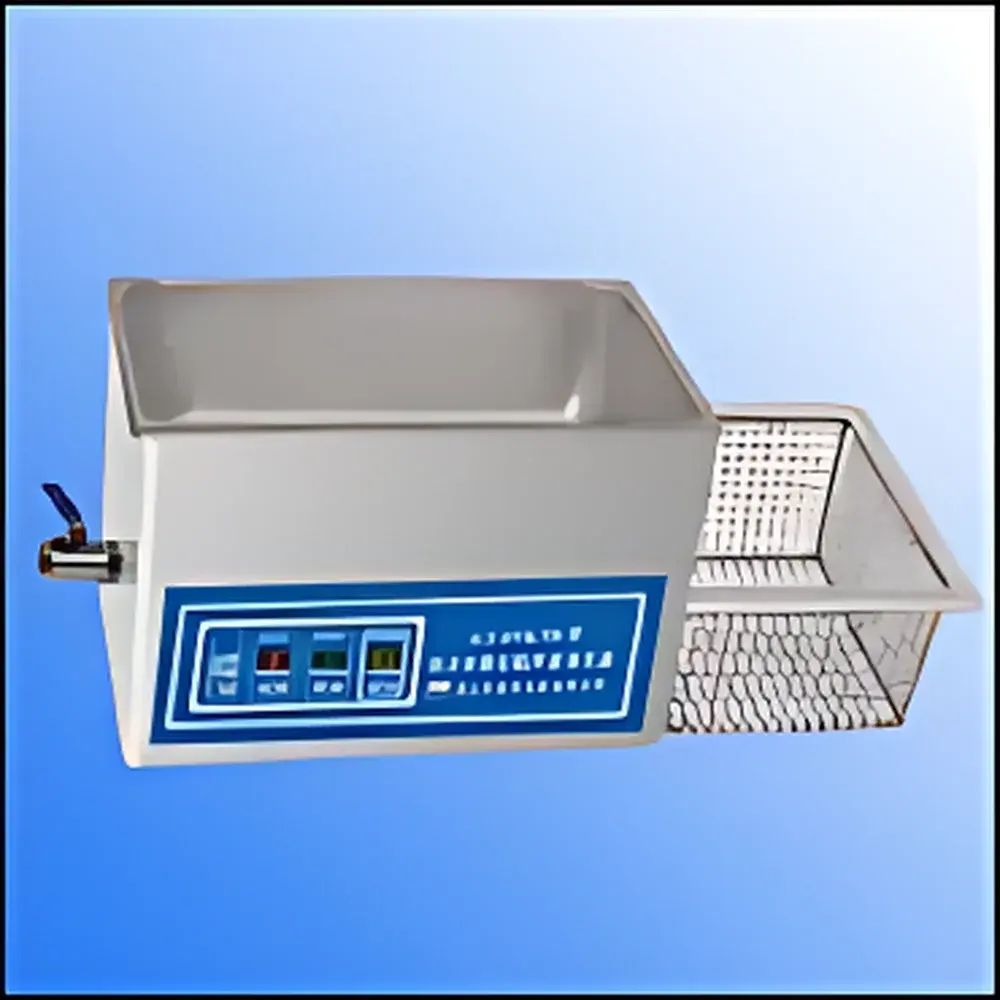
KQ-100DA/KQ-100DB/KQ-100DE/KQ-100DV Benchtop Digital Ultrasonic Cleaner
| Origin | Shanghai, China |
|---|---|
| Manufacturer Type | Authorized Distributor |
| Country of Origin | China |
| Model | KQ-100DA / KQ-100DB / KQ-100DE / KQ-100DV |
| Dimensions (W×D×H) | 320×174×260 mm |
| Tank Internal Dimensions | 300×140×100 mm |
| Tank Capacity | 4 L |
| Ultrasonic Frequency | 40 kHz |
| Ultrasonic Power Output | 100 W (total), 50 W per transducer |
| Temperature Control Range | Ambient to 80 °C (adjustable) |
| Timer Range | 1–99 min (digital preset & memory) |
| Safety Features | Low-level liquid detection, over-temperature/over-voltage/over-current protection, auto-shutdown |
| Construction | Stainless steel tank and exterior (except select models with engineered polymer housing), argon-welded stainless mesh basket |
| Optional Accessories | Drain valve (DA/DB/DE), sound-dampening lid (DE/DV), volatile solvent vapor recovery system (DV model only) |
| Cumulative Operating Time Counter | Up to 999,999 hours |
Overview
The KQ-100DA, KQ-100DB, KQ-100DE, and KQ-100DV are benchtop digital ultrasonic cleaners engineered for precision cleaning, degassing, dispersion, emulsification, and cell lysis in academic, R&D, and quality control laboratories. These units operate on the principle of high-frequency acoustic cavitation—generating microscopic vacuum bubbles in liquid media that rapidly collapse, producing localized shockwaves and microstreaming forces. At a nominal frequency of 40 kHz, this process effectively removes particulate contaminants, organic residues, and biofilms from delicate substrates—including optical components, surgical instruments, microfluidic devices, semiconductor wafers, and analytical sample vials—without mechanical abrasion or thermal degradation.
Key Features
- Digital microcontroller-based interface with non-volatile memory for persistent storage of operating parameters—including timer settings, temperature setpoints, power levels, and cumulative runtime (up to 999,999 hours).
- Real-time digital display of actual and set values for temperature, elapsed time, and ultrasonic power; integrated fault diagnostics with visual indicators for low liquid level, over-temperature, over-voltage, and over-current conditions.
- Stainless steel tank (SUS304) and structural frame ensure chemical resistance, long-term dimensional stability, and compliance with ISO 13485-informed cleanroom handling protocols.
- High-efficiency piezoelectric transducers (50 W each, total 100 W) mounted directly to the tank bottom deliver uniform energy distribution across the 4 L working volume (300 × 140 × 100 mm internal dimensions).
- Optional vapor recovery system (KQ-100DV model) enables safe operation with low-boiling-point solvents (e.g., acetone, isopropanol, ethanol), minimizing atmospheric emissions and supporting OSHA PEL and EPA VOC compliance requirements.
- Sound-dampening lid (standard on KQ-100DE/KQ-100DV) reduces ambient noise to ≤55 dB(A) at 1 m distance, meeting occupational health guidelines for continuous lab use.
- Drain valve integration (KQ-100DA/DB/DE) facilitates rapid solution exchange and residue removal—critical for multi-step cleaning protocols under GLP or ISO/IEC 17025 workflows.
Sample Compatibility & Compliance
These cleaners accommodate a broad range of sample types and containers: glassware (vials, cuvettes, pipette tips), metal parts (stainless steel, titanium), ceramics, silicon wafers, and polymer-based microplates. The 40 kHz frequency balances penetration depth and surface shear force—ideal for sub-micron particle removal without damaging MEMS structures or thin-film coatings. Units conform to IEC 61000-6-3 (EMC emission limits) and IEC 61000-6-2 (immunity standards). While not certified for medical device reprocessing per ANSI/AAMI ST79 or ISO 15883, they are routinely deployed in pre-sterilization cleaning steps aligned with USP and ASTM F2476-22 guidance for critical component preparation.
Software & Data Management
Operation is fully embedded—no external PC or proprietary software required. All parameter logs (start/stop timestamps, temperature profiles, power delivery cycles) are retained in onboard flash memory and accessible via front-panel navigation. For audit-trail compliance in regulated environments (e.g., pharmaceutical QC labs operating under FDA 21 CFR Part 11), optional RS-232 or USB-to-serial adapters enable timestamped data export to LIMS or ELN platforms. Firmware supports user-defined cleaning sequences with up to four programmable stages (time/power/temperature combinations), facilitating SOP-driven reproducibility.
Applications
- Pre-analytical sample preparation: removal of adsorbed proteins from HPLC vials and autosampler needles.
- Microelectronics: cleaning photomasks, bond pads, and etched substrates prior to metrology or deposition.
- Life sciences: gentle cell disruption for intracellular protein extraction (validated for E. coli and CHO lysates at controlled duty cycles).
- Materials science: deagglomeration of nanoparticle suspensions (TiO₂, SiO₂, carbon nanotubes) for DLS and zeta potential analysis.
- Quality assurance: verification of cleaning efficacy per ASTM D3049-20 (residue testing on metallic surfaces) using gravimetric or TOC-based validation.
FAQ
What is the maximum recommended operating temperature for aqueous solutions?
The unit supports heating up to 80 °C; however, sustained operation above 60 °C in water-based media may accelerate transducer aging. For optimal longevity, maintain temperatures between 40–55 °C during routine cleaning.
Can these cleaners be used with flammable solvents?
Only the KQ-100DV model—with its integrated condensate recovery system and sealed transducer housing—is rated for intermittent use with Class I flammable liquids. All other variants (DA/DB/DE) are restricted to aqueous or non-flammable solvent systems.
Is calibration traceable to NIST or other national standards?
While the unit does not include factory-calibrated sensors, temperature and timer functions meet ±1 °C and ±1 s accuracy specifications per internal validation reports. Third-party calibration services can provide ISO/IEC 17025-compliant certificates upon request.
How often should the stainless steel tank be passivated?
Passivation is recommended after initial installation and annually thereafter—or following exposure to chloride-containing solutions—to maintain corrosion resistance per ASTM A967.
Does the unit support continuous operation beyond 99 minutes?
Yes: the timer can be manually reset, and the cumulative hour counter ensures uninterrupted logging across sequential cycles—essential for extended degassing or extraction protocols.



