
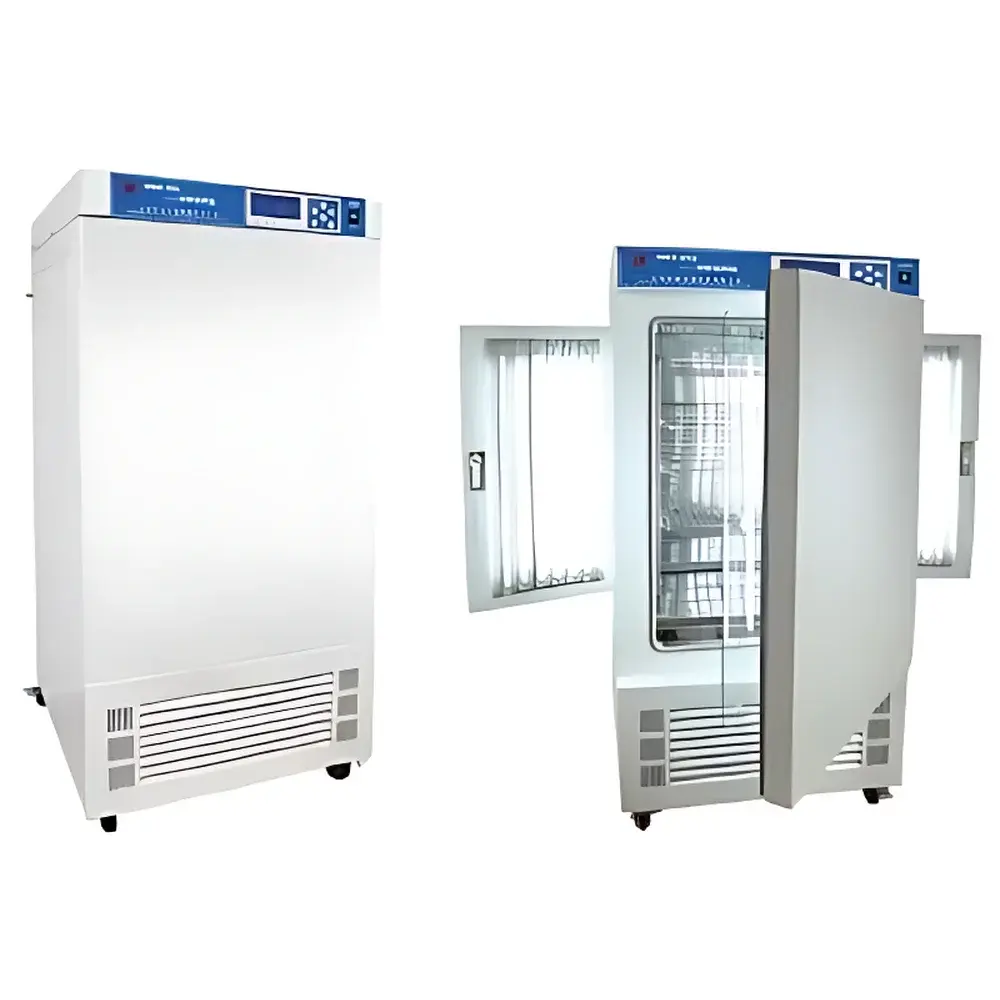
Chu Ding Technology HQH-400 & HQH-250 Plant Growth Chambers (CFC-Free, Large LCD Display)
| Brand | Chu Ding Technology |
|---|---|
| Origin | Shanghai, China |
| Model | HQH-400 / HQH-250 |
| Temperature Range (with light) | 10–50 °C |
| Temperature Range (dark) | 4–50 °C |
| Humidity Range | 50–90 %RH |
| Humidity Deviation | ±5–7 %RH |
| Illumination Intensity | 0–25,000 lx (6-level adjustable, HQH-400) / 0–15,000 lx (HQH-250) |
| Temperature Uniformity | ±1 °C |
| Temperature Resolution | 0.1 °C |
| Power Input | 3200 W (HQH-400) / 2500 W (HQH-250) |
| Chamber Volume | 400 L (HQH-400) / 250 L (HQH-250) |
| Internal Dimensions (W×D×H) | 680×550×1050 mm (HQH-400) / 580×500×850 mm (HQH-250) |
| Refrigerant | R134a / R406a (CFC-free) |
Overview
The Chu Ding Technology HQH-400 and HQH-250 Plant Growth Chambers are precision-engineered environmental simulation systems designed for reproducible, long-term cultivation of photobiological specimens under tightly controlled temperature, humidity, and illumination conditions. These chambers operate on a dual-mode thermal management principle: active refrigeration via hermetically sealed, internationally certified compressors paired with R134a/R406a CFC-free refrigerants, and resistive heating combined with PID-controlled air distribution. The system supports diurnal cycle programming—enabling independent day/night temperature setpoints synchronized with light-on/light-off events—making it suitable for phenotyping studies, seed germination assays, plant stress response analysis, and small-animal acclimation protocols requiring circadian rhythm fidelity. All models comply with ISO 17025-aligned calibration traceability frameworks and are engineered to maintain stable operating conditions over continuous 360-hour runs, as verified under ISO 27668-1 ambient test conditions (20 °C, 50 %RH, no vibration or EMI).
Key Features
- Large backlit LCD interface displaying real-time temperature, humidity, illumination level, and program status—all in a single view with intuitive menu navigation.
- Triple-side T4 fluorescent lighting array delivering uniform irradiance distribution (0–25,000 lx, 6-step intensity control for HQH-400; 0–15,000 lx for HQH-250), minimizing shadow zones and ensuring spectral consistency across growth surfaces.
- Mirror-finish stainless-steel interior with radius-corner construction and adjustable shelf spacing (standard: 3 shelves), facilitating cleaning validation and compatibility with ISO 14644-1 Class 7 cleanroom maintenance routines.
- Dual-compressor redundancy architecture (optional) enabling automatic load balancing and extended service intervals—critical for unattended multi-day experiments in GLP-compliant laboratories.
- Integrated water-reservoir humidification system featuring tubular heating elements and high-stability capacitive RH sensors (certified per IEC 60751 Class B), delivering ±5–7 %RH accuracy across the 50–90 %RH operational band.
- Advanced airflow engineering: JAKEL centrifugal circulation fans coupled with laminar-flow ducting ensure ≤±1 °C temperature uniformity (measured at 9-point grid per ASTM E1652-22 Annex A1).
Sample Compatibility & Compliance
The HQH series accommodates standard tissue culture vessels (e.g., Petri dishes, Magenta boxes, multi-well plates), hydroponic trays, insect rearing cages (up to 20 cm height), and rodent metabolic cages (Type II/III). Internal dimensions support ISO-standard shelving configurations and permit integration with CO2 enrichment modules (optional 1/8″ Swagelok inlet). The chambers meet CE marking requirements for electrical safety (EN 61000-6-3, EN 61000-6-4) and environmental protection (RoHS Directive 2011/65/EU). While not FDA-cleared medical devices, their design aligns with USP environmental monitoring prerequisites and supports 21 CFR Part 11-compliant data integrity when paired with optional RS485/USB logging interfaces and validated third-party software.
Software & Data Management
Onboard microcontroller firmware supports up to 99 programmable cycles, each comprising 30 segments with individual duration (up to 99 h 99 min), temperature/humidity/light setpoints, and ramp rates. Optional USB or RS485 connectivity enables direct export of time-stamped parameter logs (CSV format) to external PCs or thermal printers. When integrated with Chu Ding’s proprietary PC-based monitoring suite (v3.2+), users gain audit-trail functionality—including operator ID tagging, electronic signature prompts, and change-history tracking—meeting ALCOA+ data governance principles. Raw sensor outputs are sampled at 2 Hz and filtered using median + moving-average algorithms to suppress transient noise without phase lag.
Applications
- Controlled-environment phenotyping of Arabidopsis, rice, maize, and legume genotypes under drought, heat, or photoperiod stress.
- Standardized seed viability and germination testing per ISTA Rules (Chapter 6) and OECD Seed Health Scheme protocols.
- Cultivation of phototrophic microalgae (e.g., Chlorella vulgaris, Nannochloropsis oceanica) with tunable PAR delivery and thermal setpoint cycling.
- Pre-acclimation of Drosophila melanogaster and Caenorhabditis elegans prior to behavioral or transcriptomic assays.
- Stability testing of botanical extracts and herbal formulations under ICH Q1A(R2)-recommended storage conditions (e.g., 25 °C/60 %RH).
FAQ
What refrigerants are used, and why are they environmentally compliant?
R134a and R406a are hydrofluorocarbon (HFC) and zeotropic blend alternatives respectively, with zero ozone depletion potential (ODP = 0) and significantly lower global warming potential (GWP) than legacy CFCs or HCFCs—fully compliant with Montreal Protocol Phase-Out schedules and EU F-Gas Regulation (EU) No 517/2014.
Can the chamber operate continuously for extended periods?
Yes—validated for uninterrupted operation exceeding 360 hours under nominal load. Overtemperature cutoff (±3 °C deviation threshold) triggers audible/visual alarms and halts all active conditioning subsystems to preserve sample integrity.
Is humidity control available across the full temperature range?
Humidification is functional between 10–40 °C; below 10 °C, condensation risk limits RH delivery to ≤70 %RH. Dehumidification occurs passively via cold-surface condensation during refrigeration cycles.
How is temperature uniformity verified and maintained?
Uniformity is achieved through asymmetric airfoil ducting, rear-mounted circulation fans, and perimeter-heated chamber walls. Verification follows ASTM E1652-22 methodology using NIST-traceable PT100 probes at nine spatial locations.
Are calibration certificates provided with shipment?
Factory calibration reports (including as-found/as-left data for temperature, humidity, and irradiance sensors) are included. Optional UKAS-accredited calibration (per ISO/IEC 17025) is available upon request.





