
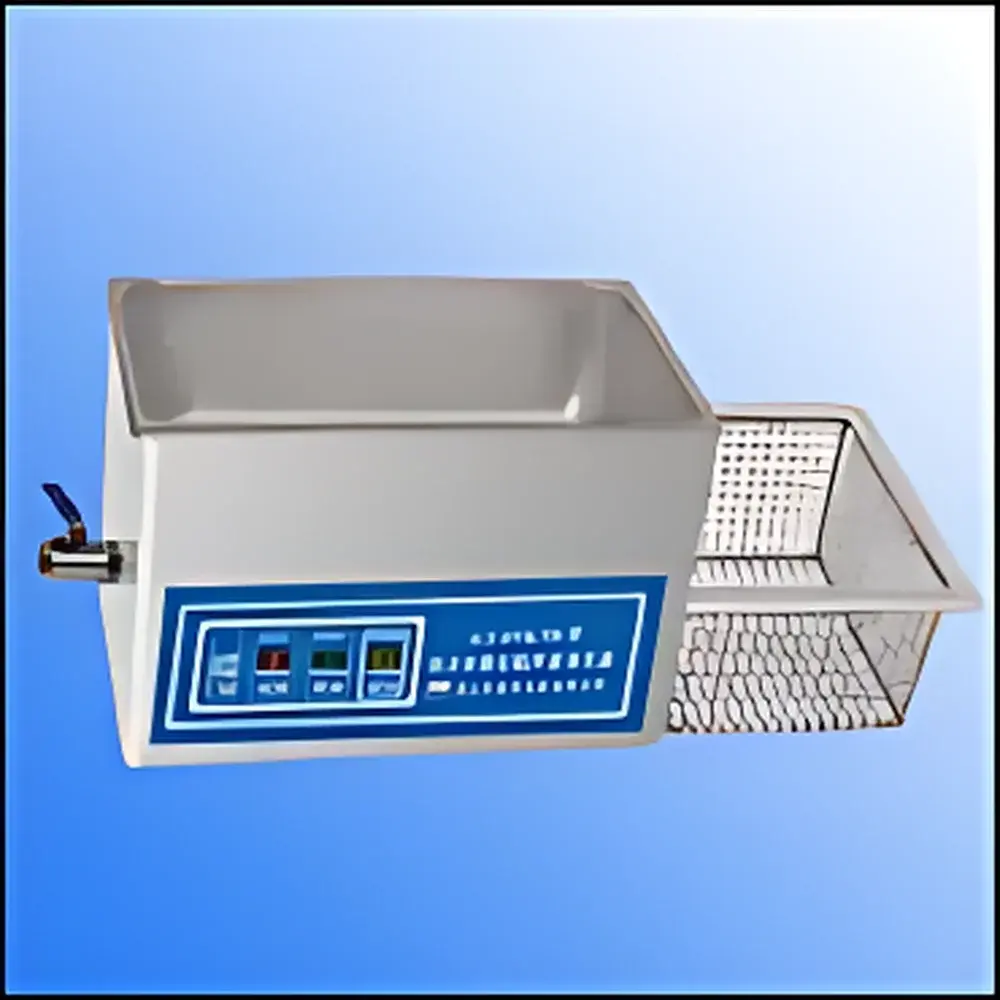
Chu Ding KQ-500DE Digital Benchtop Ultrasonic Cleaner
| Brand | Chu Ding |
|---|---|
| Origin | Shanghai, China |
| Model | KQ-500DE |
| Type | General-purpose ultrasonic cleaner |
| Capacity | 22.5 L |
| Ultrasonic frequency | 40 kHz |
| Ultrasonic power | 500 W |
| Power adjustment range | 40–100% |
| Heating temperature range | 10–80 °C |
| Timer range | 1–480 min |
| Sound-reducing lid | Included |
| Manual drain valve | Yes |
Overview
The Chu Ding KQ-500DE Digital Benchtop Ultrasonic Cleaner is an engineered solution for precision cleaning, degassing, dispersion, emulsification, and cell disruption in laboratory, academic, and light industrial environments. It operates on the principle of piezoelectric ultrasonic cavitation: high-frequency (40 kHz) acoustic energy is transmitted through a liquid medium via transducers bonded to the stainless-steel tank bottom, generating controlled micro-bubbles that collapse violently near surfaces—producing localized shear forces, micro-jets, and transient temperatures sufficient to dislodge particulates, biofilms, and organic residues without mechanical abrasion. Unlike lower-frequency systems, the 40 kHz frequency balances penetration depth and cleaning intensity—ideal for delicate substrates such as optical components, microfluidic devices, surgical instruments, and analytical sample vials. The unit integrates a fully digital control system with real-time monitoring of operational parameters, enabling repeatable, protocol-driven cleaning validated under GLP-compliant workflows.
Key Features
- Digital microprocessor-based controller with LED display showing real-time temperature, elapsed time, set time, power level (%), and actual tank temperature—enabling precise parameter replication across users and shifts.
- Adjustable ultrasonic power output from 40% to 100% of nominal 500 W, allowing optimization for sensitive samples (e.g., biological tissues or coated optics) versus heavily soiled metal parts.
- Programmable heating system (10–80 °C) with ±1 °C stability; integrated overtemperature cutoff prevents solvent boiling or thermal degradation of heat-labile samples.
- Extended timer range (1–480 minutes) supports both rapid surface decontamination and extended extraction protocols (e.g., solid-phase microextraction or nanoparticle dispersion).
- Stainless-steel tank (304 grade) measuring 500 × 300 × 150 mm (L×W×H), with total capacity of 22.5 L—designed for uniform acoustic field distribution and corrosion resistance against aqueous and mild organic solvents.
- Included sound-reducing lid minimizes airborne noise (≤65 dB at 1 m) and suppresses solvent evaporation during heated operation—critical for maintaining bath composition and operator safety in shared lab spaces.
- Manual drain valve located at tank base enables safe, residue-free solution exchange without tilting or lifting the unit—reducing ergonomic risk and spill potential.
- Robust construction: outer chassis fabricated from electropolished stainless steel (except entry-level variants); internal tank and mesh basket formed by TIG-welded 304 stainless steel with smooth, crevice-free geometry to prevent microbial retention.
- Comprehensive safety architecture: automatic shutdown on low-water detection, overcurrent protection, overvoltage regulation, and thermal fuse backup—meeting IEC 61010-1 requirements for laboratory electrical equipment.
Sample Compatibility & Compliance
The KQ-500DE accommodates a broad range of sample formats—including glassware (vials, cuvettes, pipette tips), metal tools (tweezers, forceps, endoscopes), ceramic substrates, silicon wafers, and polymer-based microdevices—provided they are chemically compatible with the selected cleaning solution (e.g., aqueous alkaline detergents, isopropanol, or ethanol/water mixtures). Its non-contact cleaning mechanism avoids surface scratching, making it suitable for ISO 14644-1 Class 5 cleanroom component preparation. While not certified to FDA 21 CFR Part 11 out-of-the-box, the device supports audit-ready documentation when paired with external electronic lab notebooks (ELNs) or LIMS platforms. It complies with CE marking directives (EMC Directive 2014/30/EU and Low Voltage Directive 2014/35/EU) and conforms to ASTM D2603 (Standard Test Method for Sonic Shear Stability of Polymer Solutions) for routine performance verification.
Software & Data Management
The KQ-500DE employs embedded firmware (ROM-based, no external OS dependencies) to ensure deterministic timing and immunity to software corruption. All user-defined parameters—including power level, temperature setpoint, and duration—are stored in non-volatile memory and retained after power cycling. Cumulative operational hours are logged internally up to 999,999 hours—supporting preventive maintenance scheduling per ISO/IEC 17025:2017 Clause 6.4.2. Although the unit lacks USB or Ethernet connectivity, its digital interface enables direct integration into SOP-driven workflows: operators record settings manually in batch records or link to barcode-scanned protocol sheets. For regulated environments, validation documentation (IQ/OQ templates) is available upon request to support GMP/GLP audits.
Applications
- Pre-analytical sample preparation: removal of residual proteins, lipids, or PCR inhibitors from reaction tubes and microcentrifuge vessels prior to HPLC or mass spectrometry analysis.
- Quality control in pharmaceutical manufacturing: cleaning of stainless-steel filter housings, filling needles, and lyophilization trays between batches per USP environmental monitoring guidelines.
- Materials science: dispersion of carbon nanotubes or graphene oxide in surfactant solutions; debubbling of epoxy resins prior to casting.
- Electronics manufacturing: flux residue removal from PCB assemblies prior to conformal coating or AOI inspection.
- Academic research: cell lysis for protein extraction (with ice-bath cooling), homogenization of plant tissue suspensions, and cleaning of AFM cantilevers and TEM grids.
- Maintenance of metrology equipment: contaminant-free cleaning of calibration standards, gauge blocks, and optical flats without altering dimensional integrity.
FAQ
What is the recommended cleaning solution for general laboratory use?
Aqueous alkaline detergent (pH 10–11) at 2–5% concentration is optimal for most organic and particulate soils. Avoid chlorinated solvents or strong acids unless verified compatible with 304 stainless steel and the transducer bonding layer.
Can the KQ-500DE be used for sterilization?
No. Ultrasonic cleaning removes bioburden but does not achieve sterility assurance levels (SAL ≤10⁻⁶). It is a pre-sterilization step only—autoclaving, ethylene oxide, or vaporized hydrogen peroxide must follow for terminal sterilization.
Is degassing functionality built-in?
Yes. Running the unit at 40–60% power for 5–10 minutes before introducing samples effectively removes dissolved air from solvents—critical for eliminating false cavitation nucleation sites and ensuring reproducible cleaning efficiency.
How often should the ultrasonic tank be descaled?
In hard-water areas, descaling with 5% citric acid solution every 2–4 weeks prevents calcium carbonate buildup on transducers and maintains acoustic coupling efficiency.
Does the unit support continuous operation?
Yes—rated for uninterrupted duty cycles up to 8 hours. For extended runs (>4 h), monitor bath temperature and replenish evaporated solvent to maintain consistent cavitation intensity.



