
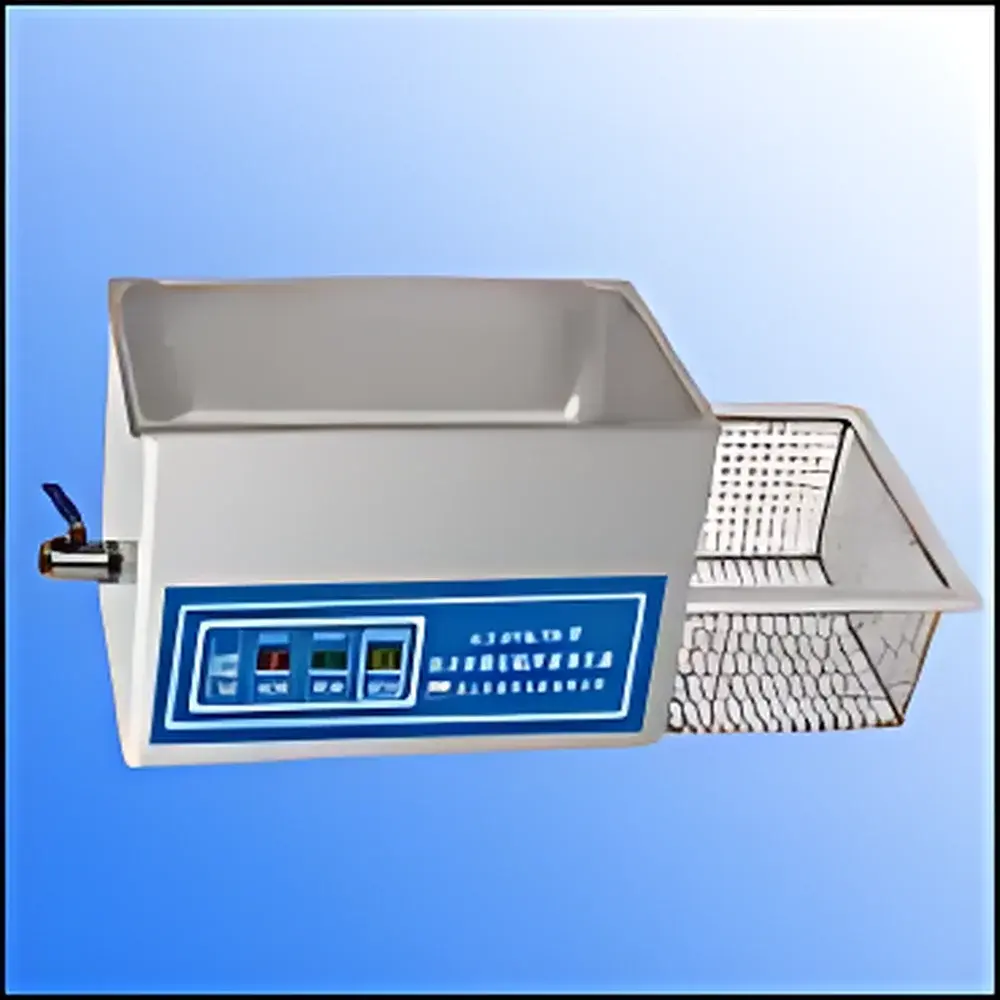
Chu Ding KQ-100TDB / KQ-100TDE / KQ-100TDV Benchtop Ultrasonic Cleaner
| Brand | Chu Ding Technology |
|---|---|
| Origin | Shanghai, China |
| Model | KQ-100TDB / KQ-100TDE / KQ-100TDV |
| Ultrasonic Frequency | 60 kHz |
| Ultrasonic Power | 100 W |
| Power Adjustment Range | 40–100% |
| Heating Power | 600 W |
| Temperature Control Range | 20–80 °C |
| Tank Capacity | 4 L (KQ-100TDB), 4 L (KQ-100TDE), 5.8 L (KQ-100TDV) |
| Internal Tank Dimensions | 300 × 150 × 100 mm (TDB/TDE), 300 × 150 × 130 mm (TDV) |
| External Dimensions | 320 × 174 × 260 mm (TDB), 320 × 174 × 340 mm (TDE), 410 × 260 × 330 mm (TDV) |
| Drain Valve | Yes (TDB/TDV), Optional (TDE) |
| Sound-Dampening Lid | No (TDB), Yes (TDE/TDV) |
| Volatile Solvent Recovery | Not applicable to TDB/TDE |
Overview
The Chu Ding KQ-100TDB, KQ-100TDE, and KQ-100TDV are precision-engineered benchtop ultrasonic cleaners designed for laboratory environments requiring consistent, repeatable, and controllable cleaning performance. These units operate at a fixed frequency of 60 kHz—optimized for high-resolution particle removal from delicate substrates including optical components, microfluidic devices, semiconductor wafers, glassware, and analytical instrumentation parts. Unlike low-frequency systems (e.g., 20–40 kHz), which generate larger cavitation bubbles suited for heavy industrial degreasing, the 60 kHz transducers deliver finer, more densely distributed cavitation activity—enabling effective removal of sub-micron contaminants without surface erosion or acoustic damage. All three models integrate the ultrasonic generator and stainless-steel tank into a single monolithic chassis, eliminating inter-unit signal loss and ensuring stable impedance matching across operational cycles. The system employs piezoelectric transducers mounted directly to the tank bottom, delivering uniform energy distribution and minimizing standing-wave interference.
Key Features
- Microprocessor-controlled digital interface with real-time display of ultrasonic duration, bath temperature, and actual power output
- Programmable time setting (1–99 minutes) with automatic shutdown and audible alert
- Precision temperature regulation via PID-controlled heating element (20–80 °C range, ±1 °C stability)
- Dual-safety thermal cutoff: independent overtemperature protection circuit plus sensor-based thermal lockout
- Low-level liquid detection with visual and audible alarm to prevent dry-run operation
- Overvoltage and overcurrent monitoring with fault-code indication on LCD panel
- Stainless-steel tank (SUS304) formed by deep-drawing process—no weld seams in solution-contact zones
- Adjustable ultrasonic power output (40–100%) enabling optimization for sensitive samples or viscous media
- KQ-100TDV variant includes integrated vapor condensation port compatible with external cold-trap or solvent recovery systems per ISO 14001-aligned lab waste management protocols
Sample Compatibility & Compliance
These cleaners support a broad spectrum of sample types: borosilicate glassware, quartz cuvettes, stainless-steel tools, ceramic substrates, polymer microplates, and MEMS components. They are routinely deployed in QC/QA labs adhering to ASTM D2603 (ultrasonic cleaning validation), ISO 13485 (medical device component cleaning), and USP (cleaning verification for pharmaceutical contact surfaces). While not certified to UL/CSA or CE for standalone medical device reprocessing, the units comply with IEC 61000-6-3 (EMC emissions) and IEC 61000-6-2 (immunity) standards when operated within specified ambient conditions (15–30 °C, <80% RH). For GLP/GMP-regulated workflows, audit trails may be generated externally via RS232 serial output (available on request with firmware v2.3+).
Software & Data Management
The embedded controller supports manual mode and timed-cycle operation only—no proprietary PC software is bundled. However, all models feature an RS232 communication port (DB9 male) compliant with standard Modbus RTU protocol (9600 baud, 8N1), permitting integration into centralized lab automation platforms (e.g., LabVantage, STARLIMS) for automated log capture of cycle start/stop timestamps, setpoints, and fault events. Optional firmware upgrade enables timestamped CSV export of temperature and power history at 1-second intervals—suitable for 21 CFR Part 11-compliant electronic records when paired with validated third-party data acquisition software and user-access controls.
Applications
- Pre-analytical sample preparation: removal of organic residues from HPLC vials, GC injectors, and ICP-MS nebulizers
- Electronics manufacturing: cleaning solder paste residues and flux from PCB test fixtures and probe cards
- Life sciences: decontamination of cell culture flasks, pipette tips, and electrophoresis combs prior to sterilization
- Nanomaterial synthesis: dispersion stabilization of graphene oxide, quantum dots, and metal-organic frameworks in aqueous/organic suspensions
- Materials characterization: debubbling epoxy resins before SEM sample mounting or removing polishing compounds from metallographic specimens
- Forensic labs: trace evidence recovery from firearms components and toolmarks using enzymatic or chelating solutions
FAQ
What is the difference between KQ-100TDB, KQ-100TDE, and KQ-100TDV?
The TDB model has no lid and no drain valve; the TDE adds a sound-dampening lid and drain valve; the TDV includes both features plus a vapor condensation interface for solvent recovery.
Can these units operate with flammable solvents like acetone or ethanol?
No—these are water-bath ultrasonic cleaners rated for aqueous and mild detergent solutions only. Use only in well-ventilated areas and never with Class I flammable liquids unless equipped with explosion-proof certification (not provided).
Is the 60 kHz frequency adjustable?
No—frequency is fixed at 60 kHz. Chu Ding offers separate models with 40 kHz, 80 kHz, and 135 kHz options; frequency selection must be made at time of order.
Does the unit include calibration documentation?
Factory calibration certificates (traceable to NIST standards) are available upon request at time of purchase, covering temperature sensor accuracy and timer deviation (±0.5% full scale).
What maintenance is required?
Monthly inspection of tank integrity, quarterly cleaning of transducer mounting surfaces with isopropyl alcohol, and annual verification of thermal cutoff response time using calibrated thermocouple and stopwatch.



