
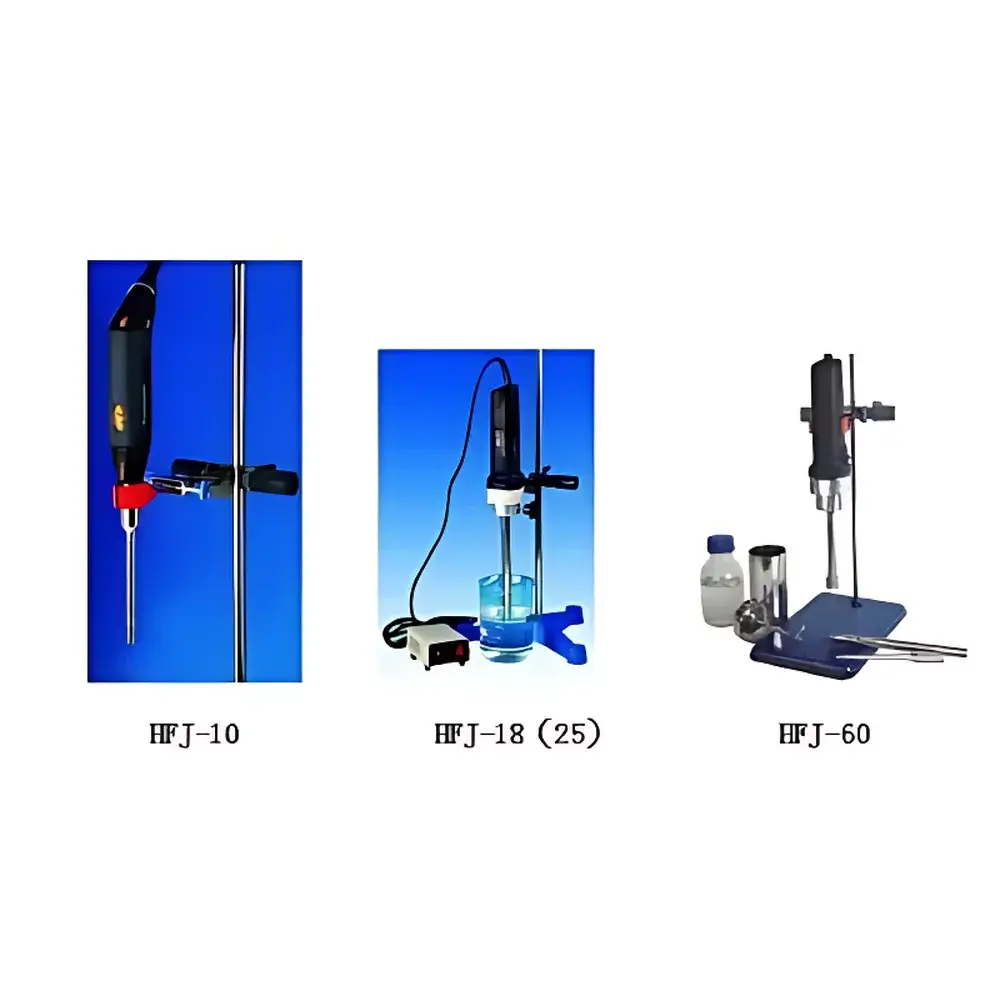
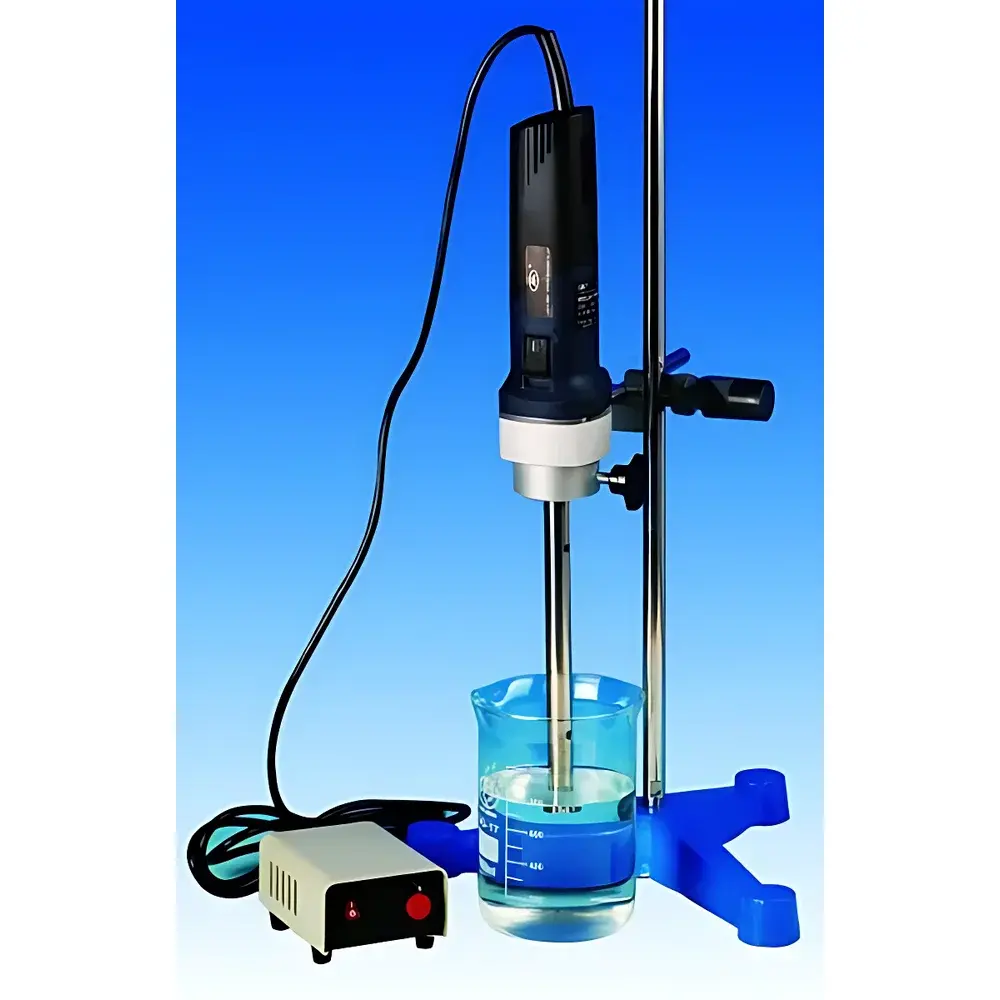
Chu Ding Technology HFJ-10 Handheld High-Shear Homogenizer
| Brand | Chu Ding Technology |
|---|---|
| Origin | Shanghai, China |
| Model | HFJ-10 |
| Speed Range | 5,000–35,000 rpm |
| Shaft Diameter | 10 mm |
| Power | 200 W |
| Max. Sample Volume (Water) | 500 mL |
| Construction Material | 316 Stainless Steel (wetted parts) |
| Drive Type | Integrated High-Speed Micro-Motor |
| Rotor-Stator Geometry | Angled-edge precision-machined stainless steel assembly |
Overview
The Chu Ding Technology HFJ-10 Handheld High-Shear Homogenizer is an engineered solution for rapid, reproducible cell disruption, tissue homogenization, and emulsion formation in small-to-medium volume laboratory workflows. It operates on the principle of high-intensity rotor-stator shear: a precision-machined 316 stainless steel rotor rotates at up to 35,000 rpm within a concentric stator, generating controlled hydrodynamic cavitation and turbulent shear forces. This mechanism enables efficient lysis of mammalian cells, plant tissues with high fibrous content (e.g., root, leaf, or stem), and soft animal organs—including liver, spleen, muscle, and adipose tissue—without requiring cryogenic pre-treatment or prolonged processing. Unlike ultrasonic or bead-beating methods, the HFJ-10 delivers consistent mechanical energy input directly into the sample vessel, minimizing thermal accumulation and preserving labile biomolecules such as enzymes, nucleic acids, and post-translationally modified proteins. Its handheld form factor supports ergonomic operation in biosafety cabinets, cold rooms, and laminar flow hoods, making it suitable for GLP-compliant sample preparation prior to downstream analysis (e.g., Western blotting, qPCR, LC-MS).
Key Features
- Variable-speed digital control (5,000–35,000 rpm) with real-time speed feedback and overload protection circuitry
- Interchangeable rotor-stator tool heads—standard 10 mm diameter configuration optimized for volumes from 0.5 to 500 mL—with optional larger-diameter variants (HFJ-18/25/60) available for scale-up validation
- 316 stainless steel wetted components certified to ISO 8502-3 for extractables testing; fully autoclavable (121°C, 20 min, saturated steam)
- Angled-edge rotor and stator geometry engineered to maximize radial shear gradient and minimize vortexing—reducing air entrapment and foaming during aqueous or viscous suspensions
- Ergonomic, balanced housing with non-slip polymer grip and integrated cable strain relief; IP42-rated for splash resistance in routine lab environments
- No external controller required—integrated motor drive eliminates signal latency and simplifies validation documentation
Sample Compatibility & Compliance
The HFJ-10 accommodates a broad range of biological matrices: fresh/frozen soft tissues, cultured cells in suspension or monolayer (post-trypsinization), plant material (including lignocellulosic samples when combined with enzymatic pretreatment), microbial pellets, and food-grade emulsions (e.g., dairy, nut pastes). It is compatible with standard conical tubes (15–50 mL), glass homogenization vessels (e.g., Kontes-type), and narrow-necked centrifuge bottles. All contact surfaces comply with USP Class VI biocompatibility requirements and meet EN ISO 10993-5 cytotoxicity standards. While not intrinsically 21 CFR Part 11 compliant (as it lacks electronic audit trail functionality), its mechanical design supports IQ/OQ protocols per ASTM E2500-13 and aligns with ISO/IEC 17025:2017 clause 6.4.3 for equipment suitability verification in accredited testing laboratories.
Software & Data Management
The HFJ-10 operates as a standalone instrument without embedded firmware or connectivity interfaces. Speed settings are manually selected via rotary dial with tactile detents and LED confirmation—ensuring operational simplicity and eliminating software-related validation overhead. For laboratories requiring traceability, users may document operating parameters (speed, duration, tool head ID, sample ID) in paper-based or LIMS-linked electronic batch records. The absence of digital logs does not impede GMP-aligned process definition: validated SOPs specify fixed speed/time combinations per sample type (e.g., 28,000 rpm × 45 s for murine liver homogenization), enabling full procedural reproducibility across shifts and operators.
Applications
- Pre-analytical sample prep for proteomics: rapid cytoplasmic/nuclear fractionation with minimal protein degradation
- RNA isolation from fibrous plant tissues where mortar-and-pestle methods yield inconsistent yields
- Homogenization of vaccine antigen suspensions (e.g., whole-inactivated virus particles) to ensure uniform particle size distribution prior to filtration sterilization
- Development of nanoemulsions in food science research (e.g., curcumin-in-oil systems stabilized by lecithin)
- Disruption of biofilm-coated clinical isolates for antimicrobial susceptibility testing per CLSI M27/M38 guidelines
- Preparation of standardized reference suspensions for particle size analyzer calibration (ISO 13320)
FAQ
What is the maximum continuous run time before thermal buildup affects sample integrity?
Under standard ambient conditions (22 ± 2°C), continuous operation is limited to 90 seconds per cycle. For heat-sensitive samples (e.g., kinase assays), we recommend 3 × 30-second pulses with 60-second cooling intervals using chilled vessels.
Can the HFJ-10 be used with organic solvents such as chloroform or ethanol?
Yes—316 stainless steel construction resists corrosion from common polar solvents; however, prolonged exposure to halogenated hydrocarbons requires post-use rinsing with isopropanol followed by deionized water to prevent passive layer compromise.
Is rotor-stator alignment adjustable or serviceable by the end user?
No—rotor and stator are factory-assembled as a matched pair with sub-5 µm concentricity tolerance. Replacement must be performed as a single calibrated unit to maintain shear consistency.
Does the device meet CE marking requirements for laboratory equipment?
Yes—it complies with EU Directive 2014/30/EU (EMC) and 2014/35/EU (LVD); Declaration of Conformity is supplied with each unit.
How is calibration verified during routine use?
Speed accuracy is confirmed annually using a NIST-traceable optical tachometer (±0.5% full-scale error); no torque or shear stress calibration is required due to the device’s fixed-geometry, constant-power electromechanical design.



