
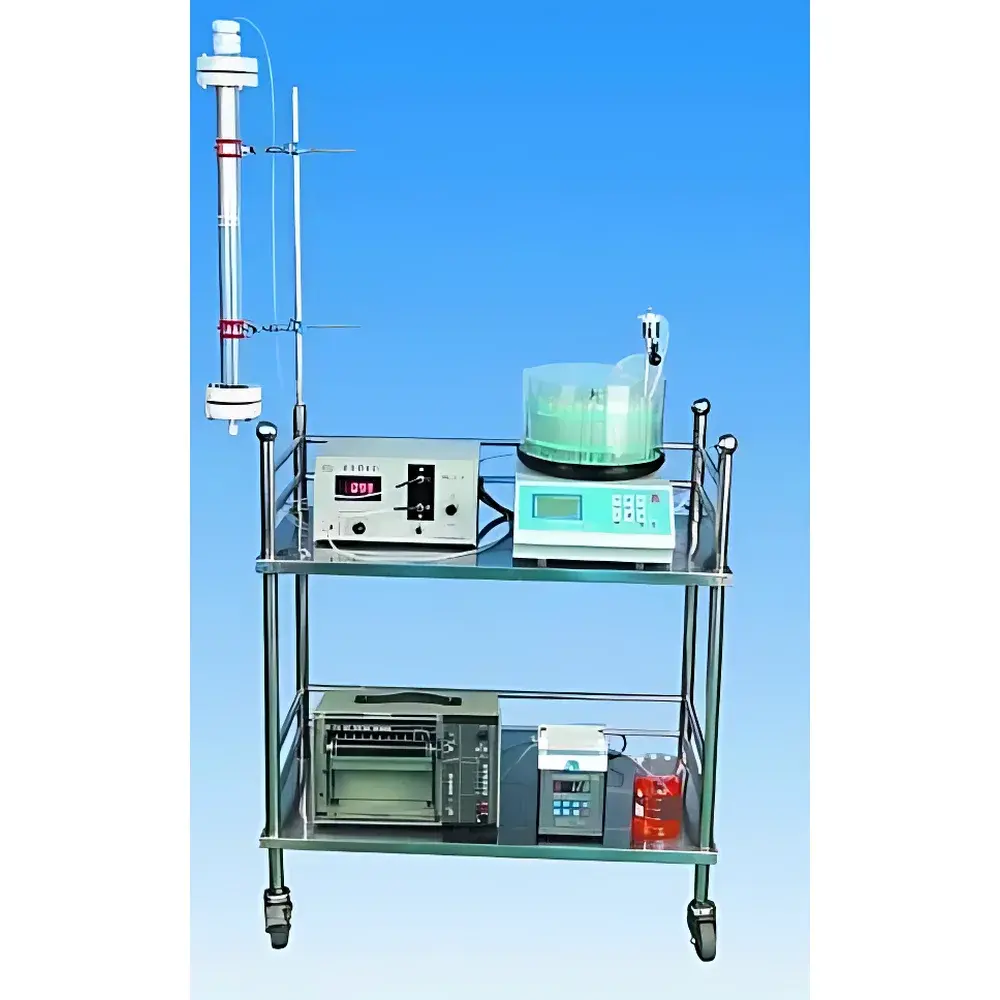
Chu Ding MF99-2 Standard Six-Component Automated Liquid Chromatography Fractionation System with UV-Vis Detector and PC
| Origin | Shanghai, China |
|---|---|
| Manufacturer Type | Authorized Distributor |
| Regional Origin | Domestic (China) |
| Model | MF99-2 |
| Price | USD 5,400 (approx.) |
| Detection Wavelengths | 220, 254, 280, 340 nm |
| Fraction Collection Capacity | 12 mL × 100 tubes |
| Flow Rate Range | 0.1–10 mL/min |
| Gradient Volume | 1000 mL (linear profile) |
| Timer Resolution | 1 s to 9999 s / 1 min to 9999 min |
| Programmable Methods | 10 stored protocols |
| Column Set | Φ1.0×40 cm, Φ1.6×50 cm, Φ2.5×60 cm |
| System Weight | 105 kg |
| Data Acquisition | Real-time A/T% monitoring, digital plotting, parameter calculation, spectral archiving |
Overview
The Chu Ding MF99-2 Standard Six-Component Automated Liquid Chromatography Fractionation System is a benchtop preparative chromatography platform engineered for reproducible biomolecule separation in academic, biotech, and QC laboratory environments. It implements classical low-pressure liquid chromatography (LPLC) principles—utilizing gravity- or pump-driven mobile phase delivery through packed glass columns—to resolve proteins, nucleic acids, and other UV-absorbing macromolecules based on differential partitioning between stationary and mobile phases. The system integrates four core hardware modules—UV-Vis absorbance detection, programmable fraction collection, constant-flow pumping, and linear gradient generation—into a synchronized, PC-controlled workflow. Its fixed-wavelength photometric detection at 220 nm (peptide bond), 254 nm (nucleic acid backbone), 280 nm (aromatic amino acids), and 340 nm (background reference) enables quantitative tracking of elution profiles without spectral scanning. Designed for routine purification of milligram-scale samples, the MF99-2 supports both isocratic and linear binary gradient elution, making it suitable for desalting, buffer exchange, size-exclusion pre-purification, and affinity capture follow-up steps.
Key Features
- Modular six-component architecture: HD-5 UV-Vis detector with dual-channel analog output, CBS-A programmable fraction collector (100-position rack, 12 mL per tube), HL-2S constant-flow peristaltic pump (0.1–10 mL/min, pulse-dampened), TH-500A gradient mixer (1000 mL capacity, linear ramp only), standardized column set (three diameters/lengths), and pre-configured branded desktop PC.
- Dual-mode fraction triggering: Time-based collection (1 s–9999 min resolution) and peak-threshold detection (via analog voltage threshold from detector output), ensuring alignment with retention time windows or absorbance thresholds.
- Real-time data acquisition and visualization: PC-based software captures absorbance (A) and transmittance (T%) signals at user-defined sampling intervals; overlays chromatograms with gradient profiles; and supports baseline correction, peak integration, and retention time annotation.
- Robust mechanical design: All fluidic components are chemically resistant to common aqueous buffers (pH 2–12); pump tubing is silicone-based for compatibility with low-concentration organic modifiers (e.g., ≤10% acetonitrile or methanol).
- Regulatory-ready operation: Software logs acquisition timestamps, method parameters, and operator ID (where configured); raw data files are saved in proprietary but exportable ASCII/CSV formats for audit trail reconstruction under GLP-compliant workflows.
Sample Compatibility & Compliance
The MF99-2 accommodates biological samples including purified recombinant proteins, plasmid DNA, oligonucleotides, polysaccharides, and small-molecule natural products dissolved in volatile or non-volatile aqueous buffers. Columns support packing with Sephadex G-25, DEAE-cellulose, CM-Sepharose, or custom silica-based media (max. particle size 100 µm). While not validated for FDA 21 CFR Part 11 compliance out-of-the-box, the system meets foundational requirements for analytical traceability: all chromatograms retain embedded acquisition metadata (date/time, wavelength, flow rate, collection trigger mode), and software enforces write-once archival of raw signal files. It aligns with ISO/IEC 17025 clause 7.7 (data control) and ASTM E2500-12 (verification of analytical instrument systems) when deployed with documented IQ/OQ protocols.
Software & Data Management
The bundled Windows-based application provides native control of all hardware units via USB/RS-232 interfaces. Functions include method creation (gradient slope, flow rate, collection logic), real-time dual-axis plotting (mV vs. time + %B vs. time), automatic peak detection (first-derivative thresholding), area normalization, and export to Excel-compatible formats (.csv, .txt). Data integrity is preserved through immutable file naming (YYYYMMDD_HHMMSS_[method]_[sample]), and no cloud upload or remote telemetry is enabled by default. Users may configure electronic signatures and audit trails via third-party LIMS integration using standard OPC UA or TCP/IP socket communication.
Applications
- Preliminary purification of His-tagged proteins prior to HPLC analysis
- Desalting of enzymatic digests before MALDI-TOF MS
- Removal of free nucleotides from labeled oligonucleotide preparations
- Buffer exchange of antibody fragments into formulation buffers
- Fractionation of plant extract fractions for bioactivity screening
- Teaching chromatographic principles in undergraduate biochemistry laboratories
FAQ
What column dimensions are included with the MF99-2 system?
The standard configuration includes three glass columns: Φ1.0 × 40 cm, Φ1.6 × 50 cm, and Φ2.5 × 60 cm—optimized for flow rates between 0.5 and 5 mL/min and typical sample loads of 0.1–5 mg.
Is the system compatible with organic solvents such as acetonitrile or methanol?
The HL-2S pump and TH-500A mixer tolerate ≤10% (v/v) miscible organic modifiers in aqueous mobile phases; prolonged exposure to >20% organics is not recommended due to elastomer compatibility limits.
Can the software generate reports compliant with GLP documentation standards?
Yes—the software records full acquisition metadata, allows manual entry of sample IDs and operator names, and saves raw data in timestamped, non-editable files; supplementary validation documentation must be developed per institutional SOPs.
Does the HD-5 detector support wavelength scanning or only fixed-wavelength operation?
It operates exclusively at four preset wavelengths (220, 254, 280, 340 nm); no monochromator or scanning capability is integrated.
What is the maximum gradient volume supported by the TH-500A mixer?
The mixer holds up to 1000 mL total solvent volume and generates linear gradients only; nonlinear (concave/convex) profiles require external programming or manual solvent blending.




