
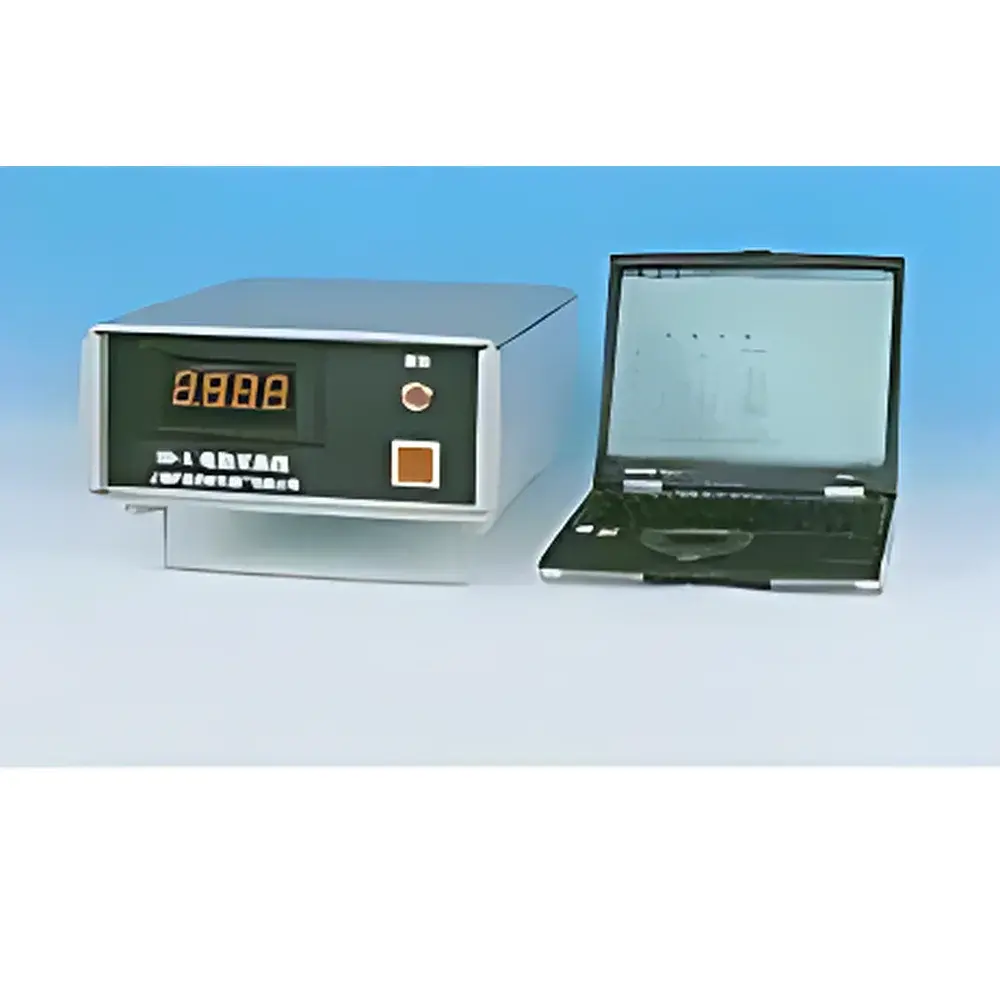
HD-A Computer Data Acquisition Unit (Shanghai)
| Origin | Shanghai, China |
|---|---|
| Manufacturer Type | Distributor |
| Product Origin | Domestic (China) |
| Model | HD-A |
| Price | USD 735 (approx.) |
| Dimensions (L×W×H) | 200×200×100 mm |
| Input Range | 0–10 mV |
| Interface | RS-232C serial port |
| Channel | Single-channel |
| Weight | 1 kg |
Overview
The HD-A Computer Data Acquisition Unit is a dedicated analog-to-digital signal interface designed for integration with HD-series UV/blue light transilluminators and gel imaging systems used in molecular biology laboratories. Engineered for precision electrophoretic band quantification, the HD-A digitizes low-level analog voltage signals—typically derived from photodiode or CCD-based detection modules in transilluminators—enabling real-time capture, visualization, and post-acquisition analysis of nucleic acid or protein bands under UV (254/302 nm) or blue-light (470 nm) excitation. Its core function rests on stable 12-bit ADC conversion of microvolt- to millivolt-range output signals from detector circuits, synchronized via hardware-triggered sampling through an RS-232C interface. Designed for compatibility with legacy Windows-based lab workstations (Windows 95 through XP), the unit serves as a cost-effective bridge between analog gel documentation hardware and standard PC-based analysis environments—particularly where modern USB-based acquisition systems are incompatible with older instrument firmware or regulatory-controlled legacy workflows.
Key Features
- Single-channel analog input optimized for photometric signal acquisition from UV/blue transilluminator detectors
- Input sensitivity range: 0–10 mV full-scale, supporting high-resolution detection of weak fluorescence or chemiluminescent signals
- RS-232C serial interface ensures deterministic communication timing and broad OS compatibility without driver dependencies
- Compact, fanless aluminum enclosure (200 × 200 × 100 mm; 1 kg) suitable for benchtop integration within electrophoresis hoods or imaging cabinets
- No internal power supply—derives operating power via RS-232 handshake lines, eliminating need for external adapters or grounding loops
- Designed for deterministic latency and minimal signal drift over extended acquisition sessions (e.g., time-course Western blot densitometry)
Sample Compatibility & Compliance
The HD-A unit interfaces exclusively with HD-series transilluminators and gel cutters manufactured for the Chinese domestic market, including models equipped with built-in UV-safe viewing shields, adjustable intensity controls, and integrated blade guides. It supports qualitative and semi-quantitative analysis of ethidium bromide-, SYBR® Safe-, or GelRed®-stained DNA gels, as well as Coomassie- or silver-stained SDS-PAGE gels. While not certified to IEC 61010-1 or EN 61326-1, its electrical design conforms to basic SELV (Safety Extra-Low Voltage) principles per GB 4793.1–2007 (Chinese equivalent of IEC 61010-1). For GLP-compliant environments, users must validate the entire acquisition chain—including software version, calibration procedure, and audit trail implementation—per ISO/IEC 17025:2017 clause 7.7 and FDA 21 CFR Part 11 if electronic records are retained for regulatory submission.
Software & Data Management
The HD-A operates with vendor-supplied Windows-native acquisition software (v2.1.x), which provides real-time waveform display, manual baseline correction, peak integration, molecular weight estimation via standard curve fitting, and export to CSV or BMP formats. Raw data files include embedded metadata: acquisition timestamp, input gain setting, and system ID. The software does not support multi-user permissions or electronic signatures natively; however, it permits configuration of file write-protection and directory-level access control when deployed on domain-joined Windows XP Professional systems. For long-term archival, users are advised to pair acquired datasets with instrument logbooks and calibration certificates in accordance with ISO 15189:2022 section 5.9.2 (data integrity requirements).
Applications
- Densitometric analysis of agarose and polyacrylamide gel electrophoresis (AGE/PAGE) bands
- Relative quantification of PCR products, restriction digests, and RNA integrity assays
- Validation of CRISPR editing efficiency via T7E1 or Surveyor nuclease assays
- Documentation and measurement of protein ladder migration patterns in Western blot transfer verification
- Supporting teaching laboratories requiring reproducible, low-cost digital capture of electrophoretic separations
FAQ
Is the HD-A compatible with modern Windows 10 or 11 systems?
No—official support ends at Windows XP. Operation on newer OS versions requires virtualized Windows XP environments or third-party RS-232-to-USB adapter firmware validated for deterministic timing.
Does the HD-A provide calibrated optical density (OD) units?
No. It outputs arbitrary digital units proportional to input voltage; absolute OD calibration requires concurrent use of NIST-traceable neutral density filters and user-defined gain mapping.
Can multiple HD-A units be daisy-chained?
No. The RS-232C interface is point-to-point only; multiplexed acquisition requires external hardware multiplexers or replacement with USB-based multi-channel DAQ systems.
What maintenance is required?
Annual verification of input linearity using precision mV sources and oscilloscope cross-check is recommended per ISO/IEC 17025 internal calibration schedules.
Is technical documentation available in English?
Yes—English-language operation manuals, interface protocol specifications, and software API references are provided upon request for qualified institutional purchasers.




