
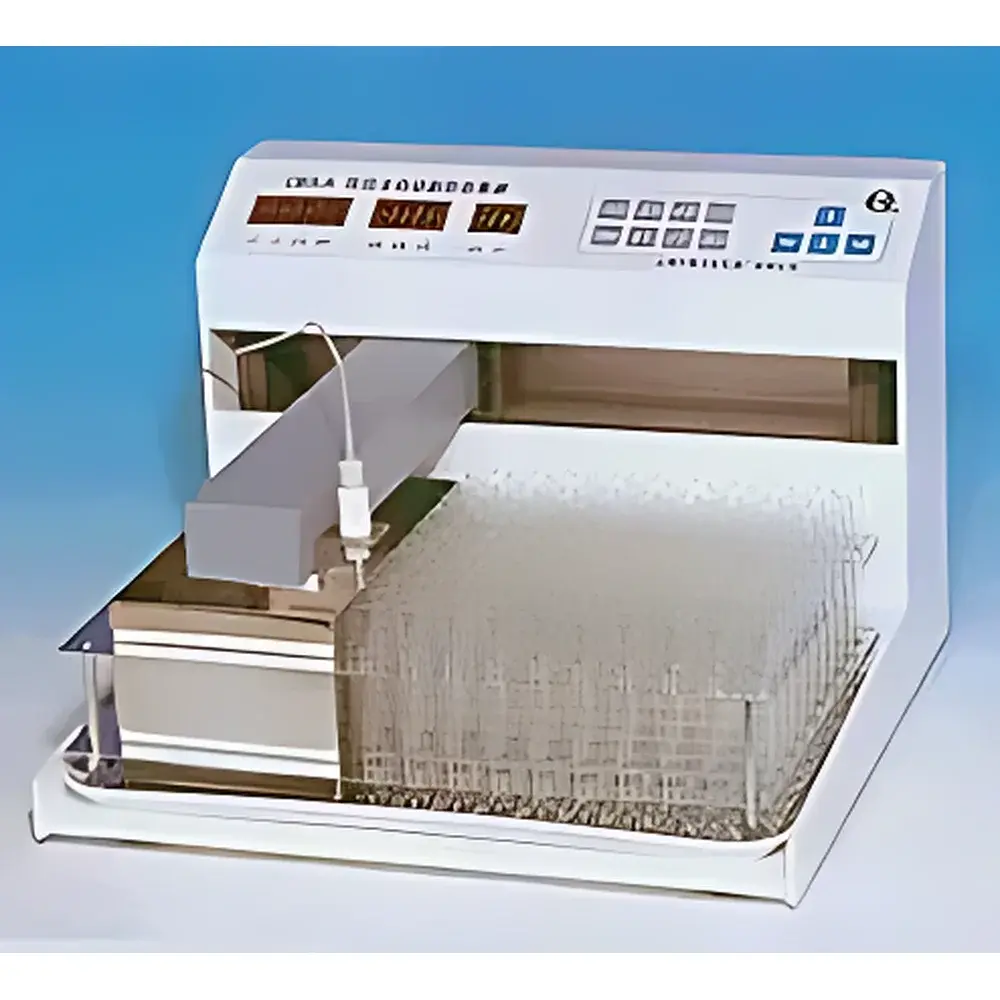
Chu Ding Technology CBS-A / CBS-B / CBS-C Programmable Fraction Collector Series
| Brand | Chu Ding Technology |
|---|---|
| Origin | Shanghai, China |
| Model | CBS-A / CBS-B / CBS-C |
| Tube Capacity | 100 × 12 mL |
| Timing Range | 1 s – 9999 s or 1 min – 9999 min |
| Droplet Counting Range | 1–9999 drops (CBS-B & CBS-C) |
| Peak Trigger Range | 0–1000 mV (CBS-B & CBS-C) |
| Programmable Programs | 10 |
| Movement | X-Y programmable positioning with auto-tube alignment |
| Display | High-precision blue LCD screen |
| Interface | RS232C serial port (CBS-C) |
| Data Retention | 10 years after power loss |
| Dimensions | 358 × 345 × 250 mm |
| Weight | 10 kg |
| Tube Tray Options | 16 / 36 / 100 / 169 positions (A-type tray solvent-resistant |
| Compliance | Designed for aqueous and organic solvent compatibility (e.g., acetonitrile, methanol, chloroform, THF) |
Overview
The Chu Ding Technology CBS-A / CBS-B / CBS-C Programmable Fraction Collector Series is an engineered solution for precise, reproducible fraction collection in preparative chromatography workflows. These devices operate on a robust X-Y Cartesian coordinate system, enabling accurate spatial positioning of collection tubes beneath the column effluent outlet. Unlike rotary or linear collectors, the square-format design minimizes footprint while maximizing tube array flexibility and alignment repeatability. The CBS series integrates analog signal processing for real-time peak detection (0–1000 mV input range), synchronized with programmable timing and droplet counting logic—enabling three independent triggering modes: time-based, volume-equivalent (via drop counting), and UV/ELSD/RI detector-responsive peak collection. This architecture ensures compatibility with both low-pressure gravity-fed systems and high-performance preparative HPLC or flash chromatography setups operating at flow rates up to 20 mL/min. All models include an integrated waste trough for solvent-safe disposal, supporting routine use with water-miscible and common organic solvents including methanol, acetonitrile, dichloromethane, and tetrahydrofuran.
Key Features
- X-Y programmable motion control with sub-millimeter positional accuracy and automatic tube centering
- Triple-mode collection logic: programmable timer (1 s–9999 min), droplet counter (1–9999 drops), and analog peak threshold trigger (0–1000 mV)
- Blue-backlit LCD interface with full Chinese menu navigation—no English localization required for local lab operation
- 10-user-defined collection protocols stored in non-volatile memory with 10-year data retention post-power loss
- Modular tube tray system supporting interchangeable configurations: 16-, 36-, 100-, and 169-position trays
- Solvent-resistant A-series trays rated for continuous exposure to polar and non-polar organics
- CBS-C model includes RS232C serial interface for bidirectional communication with external PCs and third-party chromatography data systems
- Integrated waste channel with sloped trough geometry to prevent cross-contamination and facilitate cleaning
Sample Compatibility & Compliance
The CBS series is validated for use with aqueous buffers, acidic/basic mobile phases, and standard organic solvents employed in reversed-phase, normal-phase, and size-exclusion chromatography. Tube trays are constructed from chemically inert polypropylene (A-type) or reinforced polycarbonate (L/SP-36L), ensuring mechanical stability under repeated solvent exposure. While not certified to ISO/IEC 17025 or FDA 21 CFR Part 11 out-of-the-box, the CBS-C’s RS232 interface supports integration into GLP/GMP-compliant environments when paired with validated acquisition software that provides audit trails, electronic signatures, and secure user access controls. The device meets CE marking requirements for electromagnetic compatibility (EN 61326-1) and low-voltage safety (EN 61010-1), and complies with RoHS Directive 2011/65/EU for hazardous substance restriction.
Software & Data Management
The CBS-C variant ships with Windows-compatible configuration software enabling remote setup, protocol upload/download, real-time status monitoring, and event logging. Collected fraction metadata—including trigger type, timestamp, elapsed time, detected peak amplitude, and assigned tube index—is exported in CSV format for traceability and downstream analysis in Excel or LIMS platforms. Software-generated logs include operator ID fields, session start/stop timestamps, and checksum-verified program files to support basic ALCOA+ principles (Attributable, Legible, Contemporaneous, Original, Accurate). No cloud connectivity or proprietary cloud services are embedded—data remains fully on-premise unless explicitly exported by the user.
Applications
- Preparative HPLC fractionation of natural products, synthetic intermediates, and peptide libraries
- Flash chromatography purification in medicinal chemistry and process development labs
- Size-exclusion chromatography (SEC) of proteins and polymers requiring timed or peak-aligned collection
- Ion-exchange purification of monoclonal antibodies and vaccine components
- Multi-step gradient elution workflows where fraction pooling must align with UV absorbance maxima
- Automated solvent exchange protocols involving sequential collection into dry-down vials
FAQ
What types of detectors can be connected to the CBS-B and CBS-C for peak-triggered collection?
Any analog-output detector delivering a 0–1000 mV signal—such as UV-Vis absorbance detectors, refractive index (RI) detectors, or evaporative light scattering detectors (ELSD)—can be directly interfaced via the rear-panel BNC input.
Is the CBS series compatible with aggressive solvents like DMSO or DMF?
Yes—the A-type tube trays and internal fluid-path components are chemically resistant to DMSO, DMF, NMP, and other high-boiling polar aprotic solvents; however, extended exposure may require more frequent tray replacement per manufacturer guidelines.
Can I upgrade a CBS-B unit to CBS-C functionality?
No—CBS-C includes dedicated firmware, RS232 hardware circuitry, and software licensing not present in CBS-A/B units; retrofitting is not supported.
Does the device support custom tube geometries beyond the listed tray options?
Only standardized tray footprints (16/36/100/169) are mechanically and firmware-supported; custom inserts or third-party trays are not guaranteed for positional accuracy or software recognition.
How is calibration performed for droplet counting accuracy?
Droplet calibration is user-executed via a built-in setup mode: users dispense a known volume (e.g., 1 mL) at a fixed flow rate, count actual drops via visual or automated means, then input the observed count to update the internal drop-volume coefficient.



