
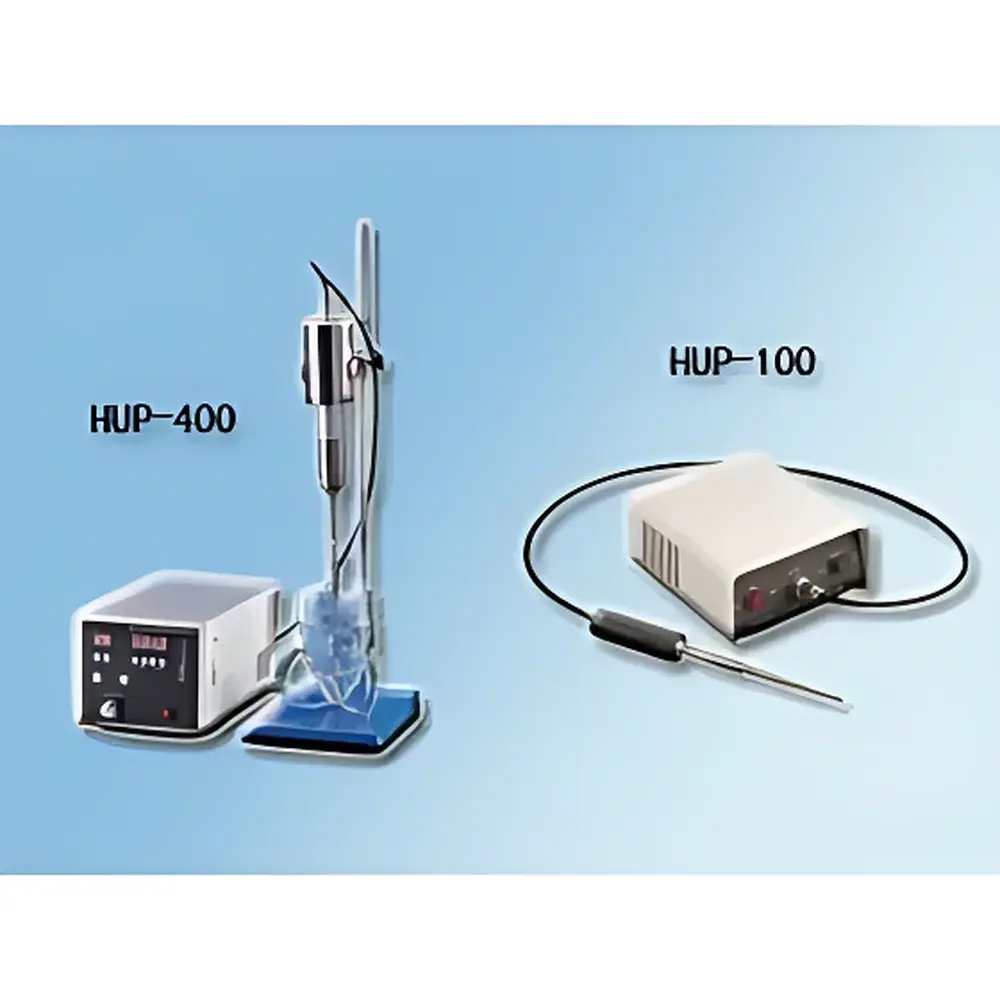
Chu Ding Technology HUP-100 Handheld Ultrasonic Cell Disruptor
| Brand | Chu Ding Technology |
|---|---|
| Origin | Shanghai, China |
| Manufacturer Type | Authorized Distributor |
| Country of Origin | China |
| Model | HUP-100 |
| Output Power | 80 W |
| Probe Options | 1/4" (6.4 mm) and 1/8" (3.2 mm) titanium alloy sonotrodes |
| Sample Volume Range | 150 µL – 100 mL |
| Duty Cycle Adjustment | 20% – 99% |
| Timer Range | 1 – 99 minutes |
| Programmable Presets | 5 user-defined protocols |
| Operation Modes | Continuous and Pulsed (independent pulse width & interval control) |
| Display | Digital LED timer with real-time energy output bar graph (0–100% linear scale) |
Overview
The Chu Ding Technology HUP-100 Handheld Ultrasonic Cell Disruptor is an engineered solution for rapid, reproducible lysis of biological cells and homogenization of viscous or heterogeneous samples in low-volume applications. It operates on the principle of high-intensity ultrasonic cavitation: an electromechanical transducer converts electrical energy into longitudinal mechanical vibrations at a nominal frequency of 20 kHz. These vibrations are amplified through interchangeable titanium alloy sonotrodes (1/8″ or 1/4″ diameter), generating localized pressure differentials in the liquid medium that induce transient microcavities. Upon collapse, these cavities release intense shear forces, shockwaves, and microstreaming—mechanisms sufficient to disrupt cellular membranes, disintegrate subcellular structures, and promote emulsification or dispersion of immiscible phases. Unlike rotor-stator homogenizers or bead-beating systems, the HUP-100 delivers direct energy coupling without cross-contamination risk or thermal overload when operated under pulsed conditions—making it particularly suitable for heat-sensitive biomolecules including enzymes, nucleic acids, and labile proteins.
Key Features
- Five programmable memory presets for repeatable protocol execution across users and shifts
- Digital LED timer with 1–99 minute resolution and automatic standby transition upon completion
- Real-time visual feedback via 10-segment energy output bar graph (0–100% linear scaling)
- Adjustable duty cycle (20–99%) with independent control of pulse duration and rest interval for precise thermal management
- Ergonomic handheld design with lightweight aluminum housing and integrated safety trigger switch
- Interchangeable titanium sonotrodes (3.2 mm and 6.4 mm tip diameters) optimized for sample volumes from 150 µL to 100 mL
- No external cooling required for short-duration processing; compatible with ice-water baths for extended runs
Sample Compatibility & Compliance
The HUP-100 is validated for use with mammalian and insect cell suspensions, bacterial cultures (including Gram-negative strains such as E. coli), yeast, plant tissues, viral particles, and synthetic colloids. Its non-invasive energy delivery supports downstream compatibility with proteomic, genomic, and metabolomic workflows—including SDS-PAGE, Western blotting, qPCR, and LC-MS analysis. While not certified to ISO 13485 or FDA 21 CFR Part 11 out-of-the-box, the device’s deterministic operation parameters (time, amplitude, duty cycle) enable full traceability when integrated into GLP-compliant laboratory notebooks or electronic lab notebook (ELN) systems. Routine verification per ASTM E2810-11 (Standard Practice for Verification of Ultrasonic Disruptors) is recommended prior to critical batch processing.
Software & Data Management
The HUP-100 operates as a standalone instrument with no embedded firmware or connectivity ports. All operational parameters—including elapsed time, selected preset, active sonotrode size, and real-time amplitude setting—are retained locally during power cycling. For audit-ready documentation, users are advised to log settings manually or integrate the device into a validated digital workflow using barcode-scanned protocol cards or LIMS-assigned run IDs. The absence of wireless interfaces or cloud synchronization ensures data sovereignty and eliminates cybersecurity exposure vectors common in networked lab equipment.
Applications
- Rapid lysis of E. coli, S. cerevisiae, and HeLa cells for plasmid DNA isolation and protein extraction
- Preparation of subcellular fractions (e.g., mitochondrial or nuclear isolates) requiring minimal mechanical stress
- Enhancement of phytochemical extraction efficiency from dried herbal matrices (e.g., Ginseng, Scutellaria) by accelerating solvent penetration
- Stabilization of oil-in-water nanoemulsions for topical pharmaceutical formulations and cosmetic actives
- Dispersion of carbon nanotubes, graphene oxide, and metal-organic frameworks (MOFs) in aqueous or organic media
- Deagglomeration of nanoparticle suspensions prior to DLS or TEM characterization
FAQ
What is the recommended maintenance schedule for the HUP-100 transducer and sonotrodes?
Inspect sonotrode tips before each use for pitting or erosion; replace if surface irregularities exceed 0.1 mm depth. Clean with isopropanol after contact with biological residues. Store vertically in dry environment. Transducer performance should be verified quarterly using calibrated hydrophone measurements per IEC 61847.
Can the HUP-100 be used with corrosive solvents such as chloroform or concentrated acids?
Titanium alloy probes resist mild organic solvents but are not compatible with halogenated hydrocarbons, strong oxidizers (e.g., nitric acid), or fluoride-containing solutions. Use only with water-miscible buffers, alcohols, or low-concentration acetic/formic acid solutions.
Is there a documented maximum temperature rise during continuous operation?
At 100% amplitude and 100% duty cycle in 10 mL aqueous buffer, bulk temperature increase is typically ≤12°C over 2 minutes. Pulsed operation (e.g., 50% duty cycle) reduces net heating by >60%, enabling nucleic acid–preserving protocols.
Does the HUP-100 comply with electromagnetic compatibility (EMC) standards for laboratory environments?
The unit meets EN 61326-1:2013 Class A requirements for electromagnetic emissions and immunity in industrial and laboratory settings. It is not intended for use in clinical diagnostic or life-support environments.
How does probe geometry affect cavitation intensity and sample processing efficiency?
Smaller-diameter probes (3.2 mm) generate higher tip velocity and localized energy density—ideal for small-volume, high-viscosity samples. Larger probes (6.4 mm) provide broader energy distribution suited for volumes >10 mL and lower-viscosity suspensions, reducing localized overheating and foaming.





