
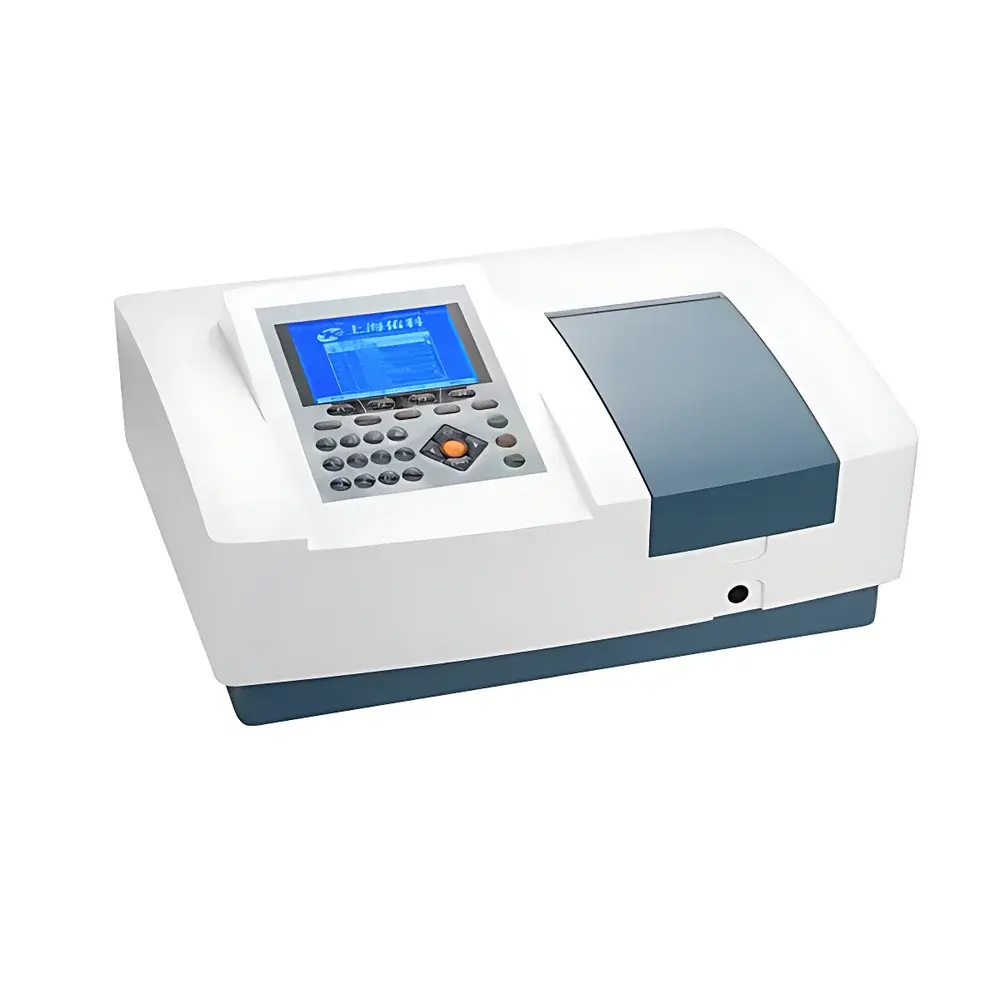
Chu Ding Technology V729 Scanning Visible Spectrophotometer
| Brand | Chu Ding Technology |
|---|---|
| Origin | Shanghai, China |
| Model | V729 |
| Optical System | Single-beam |
| Detector Type | Photodiode Array (PDA) |
| Wavelength Range | 320–1100 nm |
| Wavelength Accuracy | ±0.5 nm |
| Spectral Bandwidth | 2 nm |
| Stray Light | ≤0.05% T |
| Wavelength Repeatability | ≤0.2 nm |
| Photometric Accuracy | ≤±0.3% T |
| Photometric Repeatability | ≤±0.1% T |
| Baseline Linearity | ±0.002 A |
| Noise | 0.001 A (at 500 nm) |
| Drift | ±0.001 A/h (at 500 nm) |
| Sample Compartment | Accepts Cuvettes from 5 mm to 100 mm Pathlength |
| Display | 320 × 240 Pixel High-Brightness LCD |
| Data Interface | USB 2.0 |
| Lamp Sources | Imported Tungsten and Deuterium Lamps |
| Power Supply | AC 220 V/50 Hz or AC 110 V/60 Hz |
| Net Weight | 16 kg |
Overview
The Chu Ding Technology V729 Scanning Visible Spectrophotometer is a single-beam, microprocessor-controlled analytical instrument engineered for routine and research-grade absorbance and transmittance measurements across the visible and near-UV spectral region (320–1100 nm). It operates on the principle of Beer–Lambert law-based absorption spectroscopy, utilizing a high-efficiency 1200 lines/mm holographic grating and a thermally stabilized photodiode array detector to deliver high-fidelity spectral acquisition with consistent photometric integrity. Designed for laboratory environments requiring robustness, ease of operation, and regulatory-compliant data handling, the V729 integrates ARM-based embedded architecture with dual-language (English/Chinese) firmware—enabling seamless deployment in multinational academic, quality control, and industrial R&D settings without language barriers.
Key Features
- Embedded ARM processor with dual-language (English/Chinese) operating system, supporting real-time parameter configuration and onboard method storage
- High-resolution 320 × 240 pixel backlit LCD display enabling direct visualization of full-spectrum scans, kinetic time courses, and multi-wavelength overlays
- Optimized optical path design featuring imported tungsten and deuterium lamps with plug-in socket mounting—eliminating post-replacement optical alignment
- 2 nm nominal spectral bandwidth with ±0.5 nm wavelength accuracy and ≤0.2 nm wavelength repeatability—meeting ISO 8579-1 and ASTM E275 verification criteria for spectrophotometer performance
- 24-bit high-speed analog-to-digital conversion ensuring low-noise signal acquisition (0.001 A at 500 nm) and baseline stability of ±0.001 A/h
- Wide sample compartment accommodating standard rectangular cuvettes (5–100 mm pathlength), including compatibility with optional patented rotating 8-position auto-sampler (Patent No. ZL 2010 2 0562307.8)
- USB 2.0 interface for secure data export, firmware updates, and direct connection to external printers or PCs running YuKe Spectral Analysis Software
Sample Compatibility & Compliance
The V729 accommodates standard quartz, glass, or plastic cuvettes with optical path lengths from 5 mm to 100 mm, supporting liquid-phase analysis of aqueous and organic solutions, colloidal suspensions, and diluted biological macromolecules. Its ≤0.05% T stray light specification ensures reliable quantification of highly absorbing samples (e.g., concentrated dyes or nucleic acid preparations) without significant deviation from linearity. The instrument meets core performance requirements outlined in ISO 6060 (water quality—determination of chemical oxygen demand), USP (Spectrophotometry and Light-Scattering), and CLSI EP10-A3 (Preliminary Evaluation of Quantitative Clinical Laboratory Measurement Procedures). While not FDA 21 CFR Part 11–certified out-of-the-box, audit trails, user access logs, and electronic signature support can be implemented via validated third-party LIMS integration.
Software & Data Management
The V729 operates natively via its embedded interface but is fully compatible with YuKe Spectral Analysis Software—a Windows-based application enabling advanced spectral processing, calibration curve generation (linear, quadratic, cubic), kinetic modeling, DNA/protein concentration calculation (using 260/280 nm ratios), and GLP-compliant report generation. All measurement data—including raw absorbance values, time-stamped metadata, operator ID, and instrument configuration—are stored in CSV or XML format. USB transfer preserves full traceability; no proprietary binary formats are used. Firmware supports firmware version logging and automatic timestamping of all critical events (lamp ignition, wavelength scan initiation, zero calibration), facilitating internal QA audits.
Applications
The V729 is routinely deployed in environmental testing labs for nitrate, phosphate, and heavy metal ion quantification (e.g., Cr(VI) at 540 nm); in pharmaceutical QC for assay validation of active ingredients per USP monographs; in food science for colorant concentration and antioxidant capacity assays (e.g., DPPH radical scavenging); and in academic teaching labs for fundamental spectroscopy experiments including bandgap estimation of semiconductors and ligand-field transition analysis. Its multi-function capability—supporting fixed-wavelength photometry, time-resolved kinetics (up to 100 points/sec), full-spectrum scanning (0.1–5 nm/s), and simultaneous multi-wavelength monitoring—reduces need for dedicated instrumentation across undergraduate through applied research workflows.
FAQ
Does the V729 support GLP-compliant data integrity?
Yes—when paired with validated YuKe software and configured with user authentication, electronic signatures, and audit-trail-enabled data export, it fulfills core ALCOA+ principles (Attributable, Legible, Contemporaneous, Original, Accurate) required by ISO/IEC 17025 and GMP-aligned laboratories.
Can the instrument perform DNA/RNA quantification without external calculation?
Yes—the embedded firmware includes pre-programmed A260/A280 and A260/A230 algorithms compliant with standard nucleic acid extinction coefficients; results are displayed directly with purity assessment flags.
Is the 8-position auto-sampler compatible with all cuvette types?
The patented rotating auto-sampler is optimized for 10 mm square quartz or glass cuvettes; custom adapters are available for 5 mm or 50 mm pathlength cells upon request.
What maintenance is required for long-term wavelength accuracy?
Annual verification using NIST-traceable holmium oxide and didymium filters is recommended; no user-accessible optical recalibration is needed due to factory-sealed grating and detector alignment.
Is the deuterium lamp replaceable in the field?
Yes—both tungsten and deuterium lamps feature hot-swap socket design; replacement requires no optical realignment or service technician intervention.
Related Products




