
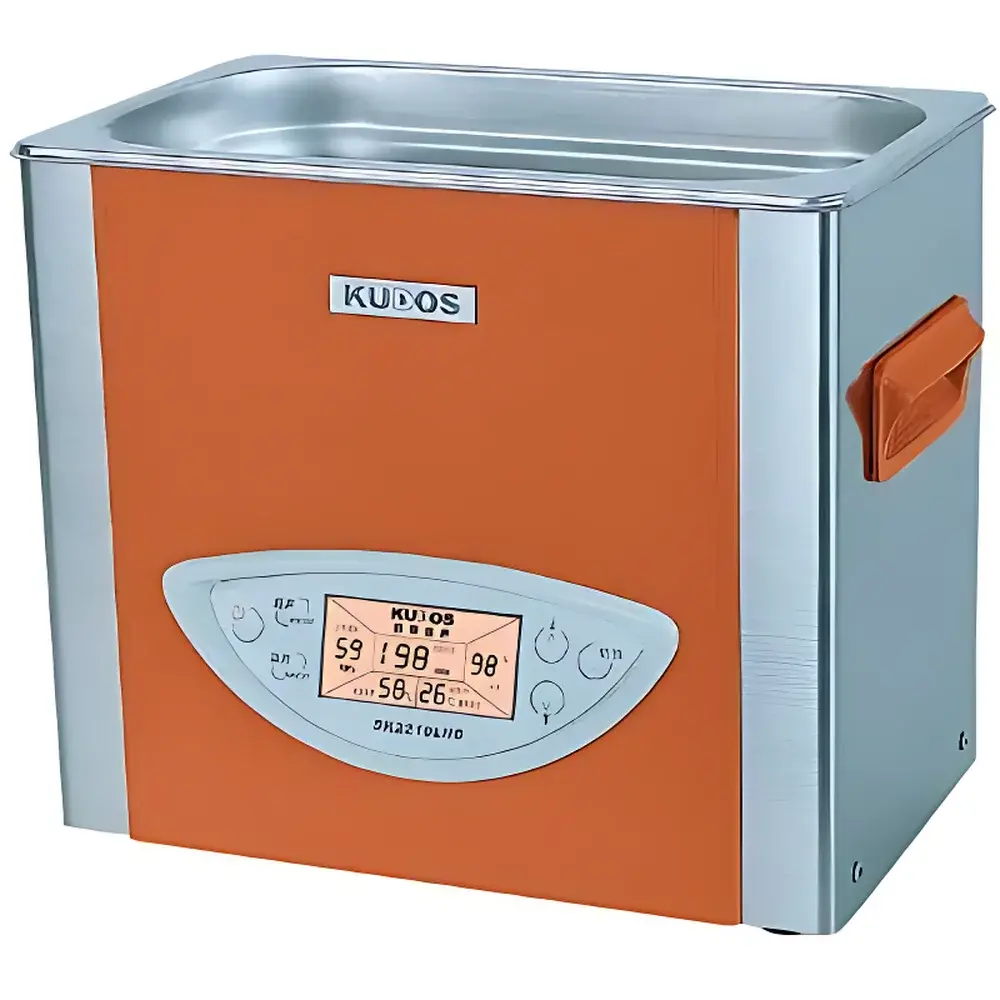
SK2210LHC Dual-Frequency Digital Ultrasonic Cleaner
| Frequency | 35 kHz & 53 kHz |
|---|---|
| Power Output | 100 W (40–100% adjustable in 1% increments) |
| Heating Power | 75 W |
| Temperature Range | 20–60 °C |
| Tank Capacity | 3 L |
| Internal Dimensions | 24 × 14 × 10 cm |
| External Dimensions | 27 × 16 × 24 cm |
| Digital Timer | 1–199 min |
| Power Supply | 220 V / 50 Hz |
| Display | Backlit LCD with on-screen menu navigation |
| Standard Accessories | Stainless Steel Rack & Sound-Dampening Lid |
| Safety Features | Dry-run detection with audible/visual alarm |
| Memory Function | Power-off parameter retention |
Overview
The SK2210LHC Dual-Frequency Digital Ultrasonic Cleaner is an engineered solution for precision cleaning of delicate laboratory components, analytical instrumentation parts, optical elements, and small-volume sample preparation vessels. Utilizing high-frequency cavitation physics—where alternating pressure waves generate microscopic vacuum bubbles that implode near solid surfaces—the device delivers consistent mechanical energy transfer to remove particulate contaminants, organic residues, and thin film deposits without abrasive contact. Its dual-frequency architecture (35 kHz and 53 kHz) enables selective optimization: lower frequency enhances macro-cleaning efficiency for robust particulates, while higher frequency improves micro-cleaning resolution for fine geometries and sensitive substrates such as quartz cuvettes, HPLC injection needles, or MEMS devices. Designed for integration into ISO/IEC 17025-compliant laboratories and GLP-regulated workflows, the SK2210LHC supports repeatable, traceable cleaning protocols essential for analytical reproducibility.
Key Features
- Dual-frequency operation (35 kHz / 53 kHz) with manual switching via front-panel interface for application-specific optimization
- Digitally controlled ultrasonic power output (100 W nominal), adjustable from 40% to 100% in precise 1% increments for process fine-tuning
- Integrated heating system (75 W) with PID-controlled temperature regulation across a 20–60 °C range; real-time display of both setpoint and actual bath temperature
- Backlit LCD interface featuring intuitive on-screen menu navigation, parameter confirmation prompts, and status icons
- Digital timer with 1–199 minute programmable duration, supporting unattended operation and protocol standardization
- Dry-run protection circuitry that halts heating and triggers visual/audible alert if liquid level falls below operational threshold
- Power-loss memory function retains all user-defined parameters—including frequency selection, power level, temperature setpoint, and timer value—after unexpected shutdown
- Stainless steel tank (24 × 14 × 10 cm internal) with corrosion-resistant finish; sound-dampening lid and support rack included as standard equipment
Sample Compatibility & Compliance
The SK2210LHC accommodates a broad range of laboratory consumables and instrumentation components, including but not limited to glassware (vials, pipette tips, syringe filters), metal parts (chromatography column fittings, sensor housings), ceramic substrates, and polymer-based microfluidic chips. Its 3 L capacity and compact footprint make it suitable for benchtop deployment in QC labs, R&D facilities, and clinical diagnostics environments. The unit complies with IEC 61000-6-3 (EMC emission standards) and IEC 61000-6-2 (immunity requirements). While not certified for sterile processing per ISO 13485 or EN 13060, its consistent cavitation performance supports cleaning validation studies aligned with ASTM D4295 (Standard Practice for Cleaning Validation in Pharmaceutical Manufacturing) when paired with appropriate residue detection methods.
Software & Data Management
As a standalone benchtop instrument, the SK2210LHC does not feature external software connectivity or data export capabilities. All operational parameters are managed locally via the embedded microcontroller and displayed in real time on the LCD screen. However, its deterministic behavior—repeatable timing, stable temperature control, and fixed-frequency output—enables full documentation within laboratory notebooks or electronic lab notebooks (ELNs) for audit readiness. The power-off memory function ensures procedural continuity during scheduled maintenance or facility-wide outages, reducing risk of protocol deviation. For regulated environments requiring FDA 21 CFR Part 11 compliance, users may implement manual log entries synchronized with timestamped digital imaging of the display prior to and after each cleaning cycle.
Applications
- Cleaning of HPLC and GC autosampler vials, injection ports, and needle assemblies prior to quantitative analysis
- Preparation of electron microscopy grids and TEM specimen holders to eliminate carbon contamination
- Removal of solder flux and particulate debris from PCB-based analytical sensors and detector modules
- Routine decontamination of reusable pipette tips, centrifuge tubes, and electrophoresis combs in molecular biology labs
- Supporting ASTM E1495 (Standard Guide for Cleaning Validation in Semiconductor Manufacturing) for low-particulate surface preparation
- Assisting USP Analytical Instrument Qualification by enabling documented, repeatable cleaning steps within OQ/PQ protocols
FAQ
Does the SK2210LHC support USB or RS-232 connectivity for remote control or data logging?
No. It operates as a fully self-contained unit with no external communication interfaces.
Is the heating function active during ultrasonic operation only, or can it run independently?
Heating operates concurrently with ultrasonic activation; there is no standalone heater mode.
What materials are compatible with prolonged exposure to the 53 kHz frequency setting?
Glass, stainless steel, titanium, and fused silica are fully compatible; avoid extended use with soft polymers (e.g., PDMS, polycarbonate) at maximum power due to potential surface erosion.
Can the unit be used with solvents other than water?
Yes—provided the solvent is non-flammable, non-corrosive to stainless steel, and has a vapor pressure compatible with the sealed tank design. Always consult material safety data sheets and perform compatibility testing before routine use.
Is calibration required, and does the manufacturer provide a calibration certificate?
No formal calibration is specified by design; however, users may verify temperature accuracy using NIST-traceable thermometers and timer accuracy with certified stopwatches as part of periodic verification per ISO/IEC 17025 Clause 7.7.
Related Products



