
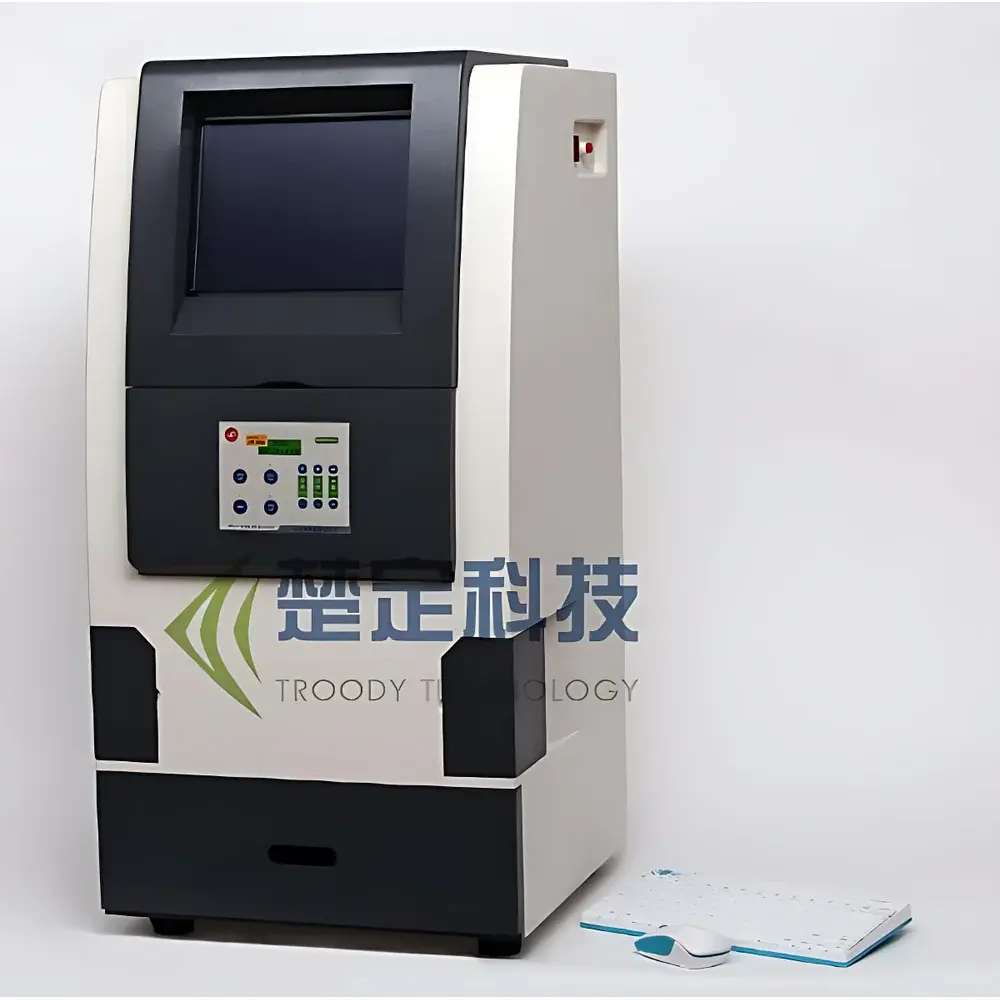
Chu Ding ZF-368 Fully Automated Gel Documentation and Analysis System
| Brand | Chu Ding Technology |
|---|---|
| Origin | Shanghai, China |
| Model | ZF-368 |
| Instrument Type | Standard Gel Imaging System |
| CCD Resolution | 1.33 MP (1280 × 1024) |
| Bit Depth | 16-bit |
| Dynamic Range | >3 orders of magnitude |
| CCD Sensor Size | 1/4" |
| Detection Sensitivity | <20 pg DNA (Ethidium Bromide-stained) |
| Signal-to-Noise Ratio | ≥56 dB |
| Lens | Motorized Zoom Lens (Computar, f/1.2, 8–48 mm) |
| Illumination Modes | Transmitted UV (300 nm), Transmitted White Light, Reflected White Light (optional transmitted blue light, reflected UV 254/365 nm) |
| Filter | Standard 590 nm emission filter |
| Imaging Area | UV: 200 × 250 mm |
| White Light | 210 × 260 mm |
| Integrated Touchscreen | 10.4" LCD with embedded PC |
| Software | Dual-language (English/Chinese) 1D Gel Analysis Suite (2D optional) |
| Compliance | Designed for GLP-compliant documentation workflows |
Overview
The Chu Ding ZF-368 Fully Automated Gel Documentation and Analysis System is an integrated, darkroom-based imaging platform engineered for reproducible, quantitative capture and analysis of nucleic acid and protein electrophoresis gels, blot membranes, autoradiograms, microplates, and thin-layer chromatography (TLC) plates. It operates on the principle of fluorescence or chemiluminescence excitation followed by high-fidelity digital acquisition using a cooled, low-noise scientific-grade CCD sensor. The system employs trans-illumination (UV at 300 nm, white light, or optional 470 nm blue light) and epi-illumination (reflected white or UV at 254/365 nm) to accommodate diverse detection chemistries—including ethidium bromide, SYBR® dyes, GoldView™, Fluorescein, Texas Red, Pro-Q Diamond®, Deep Purple™, and chemiluminescent substrates. Its sealed dark chamber minimizes ambient light interference and operator UV exposure, while the motorized zoom lens and programmable exposure control ensure consistent focus, illumination uniformity, and dynamic range optimization across sample types.
Key Features
- Fully integrated design with embedded industrial PC and 10.4-inch capacitive touchscreen—enabling real-time image preview, acquisition, and basic processing without external computer dependency.
- Scientific-grade 16-bit CCD camera (1280 × 1024 active pixels, 1.33 MP resolution) with ≥56 dB signal-to-noise ratio and >3 orders of magnitude dynamic range—optimized for detecting faint bands in low-abundance samples.
- Motorized Computar f/1.2 zoom lens (8–48 mm) with automatic focus, aperture, and exposure control—ensuring repeatable optical alignment and minimal photobleaching during time-series imaging.
- Dual-mode illumination architecture: standardized 300 nm UV trans-illuminator (200 × 250 mm), adjustable white-light trans- and epi-illuminators, plus optional 254/365 nm UV reflectors and 470 nm blue-light trans-illuminator—compatible with modern safer nucleic acid stains.
- UV safety engineering: automatic lamp shutoff after 10-minute inactivity; interlocked drawer mechanism that cuts power to UV sources upon opening; dedicated UV-protective observation and precision gel-cutting windows (60 × 125 mm and 100 × 125 mm respectively).
- Thermally managed dual-fan cooling system within the drawer-style light box—maintaining stable CCD operating temperature and reducing thermal noise during long exposures.
Sample Compatibility & Compliance
The ZF-368 accommodates standard slab gels (up to 25 × 20 cm), Western/Northern/Southern blots, slot/dot blots, autoradiographic films, ELISA/microtiter plates, TLC plates, and bacterial colony arrays. It supports regulatory documentation requirements through timestamped image metadata (including exposure parameters, lens settings, illumination mode, and user ID), exportable in TIFF/PNG formats with embedded EXIF tags. While not pre-certified for FDA 21 CFR Part 11, the software architecture permits configuration of role-based access control, electronic signatures (via optional third-party integration), and audit-trail generation—aligning with GLP and internal QA/QC protocols for academic, clinical, and contract research laboratories.
Software & Data Management
The bundled dual-language (English/Chinese) analysis suite provides unified control for image acquisition and quantitative analysis. Core functions include automatic lane and band detection, background subtraction, molecular weight calibration via ladder interpolation (linear, quadratic, or cubic fitting), relative quantification (integrated density, % volume, normalized intensity), and comparative analysis across multiple gels. Advanced modules support spot detection on 2D gels (optional), colony counting with size/threshold filtering, and dot-blot densitometry. All images retain full 16-bit depth throughout processing; results export to CSV, Excel, or PDF with customizable report templates. USB 2.0 interface ensures direct transfer to external storage or network drives; compatible with Windows 7 through Windows 11 (32/64-bit).
Applications
- Nucleic acid analysis: Quantitative detection of DNA/RNA fragments stained with EtBr, SYBR Safe/Gold/Green, GelStar™, or fluorescent probes—supporting PCR validation, restriction digest verification, and RNA integrity assessment.
- Protein characterization: Imaging of Coomassie- and silver-stained SDS-PAGE gels, as well as fluorescently labeled membranes (e.g., Sypro Ruby, Deep Purple) and chemiluminescent Western blots (ECL, DAB).
- Hybridization assays: Digital capture and densitometric analysis of Southern, Northern, and dot/slot blots—enabling transcript abundance estimation and probe specificity evaluation.
- Functional assays: Colony enumeration from transformation or antibiotic selection plates; semi-quantitative analysis of enzyme activity zones on zymograms; visualization of metabolite separation on TLC plates.
- Documentation archiving: Generation of publication-ready figures with embedded scale bars, annotations, and metadata—meeting journal submission standards for life science journals.
FAQ
Is the ZF-368 compliant with FDA 21 CFR Part 11?
The system does not ship with out-of-the-box Part 11 compliance but supports configurable user authentication, electronic signature workflows, and audit-trail logging when deployed within validated IT infrastructure.
Can the software perform 2D gel analysis?
Yes—the base package includes 1D analysis; optional 2D module enables spot detection, matching, and differential expression profiling across replicate gels.
What is the minimum detectable DNA mass under standard EtBr staining?
The system reliably detects double-stranded DNA bands containing less than 20 picograms, assuming optimal staining, UV exposure, and background subtraction.
Does the system support chemiluminescent detection?
Yes—when equipped with the optional high-sensitivity chemiluminescence mode and appropriate emission filters, it captures ECL signals from Western blots with sub-second integration times.
Is remote operation possible?
While the embedded PC enables standalone use, the system also supports tethered operation via USB connection to a host Windows workstation for centralized lab deployment and data management.
Related Products



