
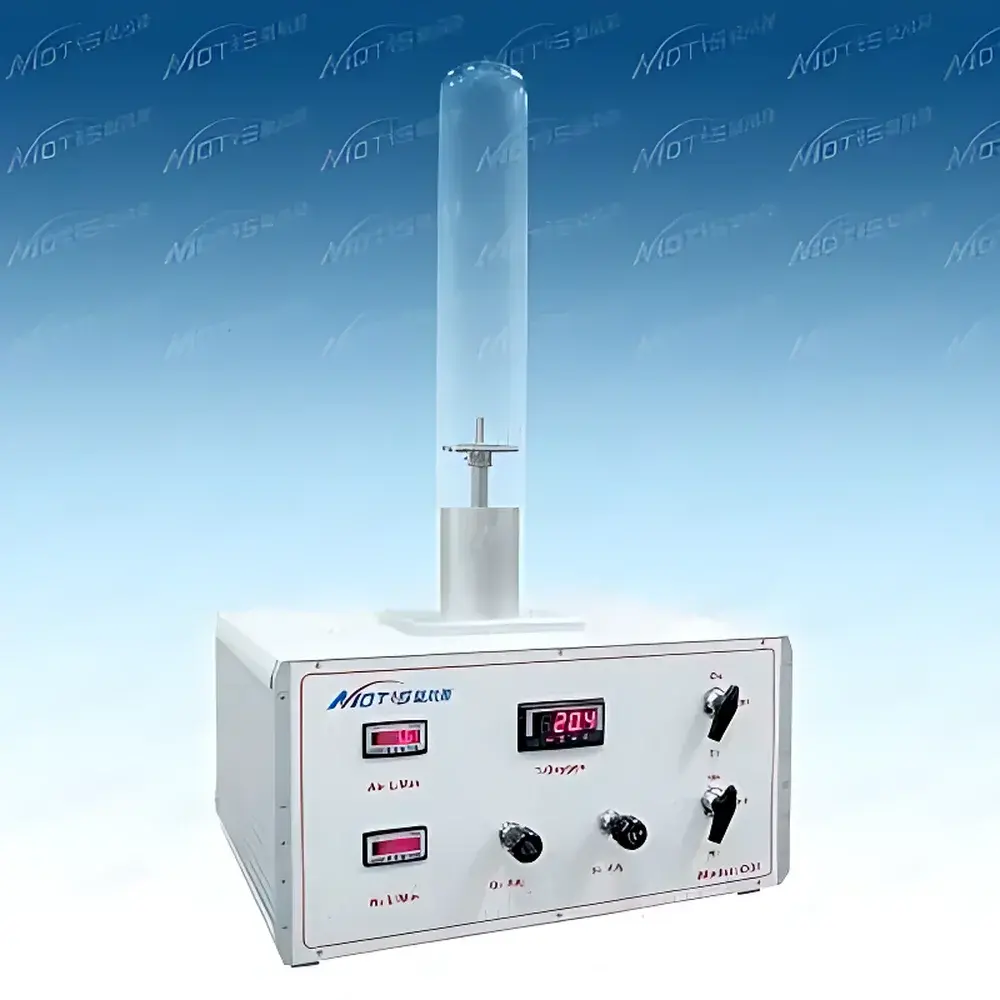
MOTIS COI Digital Oxygen Index Tester
| Brand | MOTIS |
|---|---|
| Origin | Shanghai, China |
| Model | COI |
| Oxygen Sensor Type | Ultrasonic |
| Gas Flow Control | Precision Mass Flow Valves |
| Total Gas Flow Rate | 10.6 L/min (adjustable ±0.1 L/min) |
| O₂ Concentration Resolution | 0.1% vol |
| O₂ Concentration Range | 10–100% vol |
| Quartz Combustion Tube | High-Temperature Resistant (up to 800 °C) |
| Ignition System | Adjustable Flame Gas Igniter with Cut-off Function |
| Sample Holder Options | Self-Supporting & Non-Self-Supporting Fixtures |
| Compliance | ISO 4589-2, ASTM D2863, GB/T 2406.2 |
Overview
The MOTIS COI Digital Oxygen Index Tester is a precision benchtop instrument engineered for the quantitative determination of the Limiting Oxygen Index (LOI) — defined as the minimum volume percentage of oxygen in an oxygen–nitrogen mixture required to support candle-like combustion of a vertically oriented solid material under specified test conditions. Based on the fundamental principle of controlled atmospheric combustion, the COI employs a standardized vertical specimen configuration within a thermally stable quartz combustion column, where ignition is initiated at the top surface and flame propagation behavior is observed over a 300-second (or 600-second per ISO 4589-2 Annex A) evaluation period. The system operates in accordance with the internationally recognized gravimetric and volumetric gas mixing methodology, ensuring traceable, repeatable LOI values essential for material flammability classification, regulatory documentation, and fire safety engineering assessments.
Key Features
- Ultrasonic oxygen sensing technology delivering long-term stability (>2 years typical service life), eliminating frequent recalibration or sensor replacement associated with electrochemical alternatives.
- Dual-channel mass flow control architecture enabling independent, high-resolution regulation of O₂ and N₂ streams; total combined flow maintained at 10.6 L/min ±0.05 L/min per ISO 4589-2 requirements.
- Digital real-time display of three critical parameters: oxygen concentration (% vol), nitrogen flow rate (L/min), and total mixed gas flow rate (L/min), all synchronized to a common timebase.
- High-purity fused quartz combustion tube rated for continuous operation up to 800 °C, resistant to thermal shock and halogen-induced corrosion during testing of PVC, polyolefins, and halogenated flame-retardant polymers.
- Integrated adjustable gas igniter with flame-length control and automatic fuel shutoff, minimizing operator exposure and improving ignition reproducibility across repetitive test cycles.
- Modular sample holder system accommodating both self-supporting (e.g., rigid plastics, laminates) and non-self-supporting (e.g., foams, thin films, textiles) configurations per ISO 4589-2 Clause 6 and ASTM D2863 Section 7.
Sample Compatibility & Compliance
The COI supports standardized test specimens measuring 150 mm × 10 mm × thickness (typically 3–10.5 mm), cut parallel to the direction of intended flame spread. It accommodates thermoplastics, thermosets, elastomers, composites, and coated substrates — provided dimensional tolerances and surface finish comply with ISO 4589-2 Section 5. All hardware components—including quartz tube, gas manifolds, and flow sensors—meet ISO/IEC 17025 traceability requirements when calibrated using NIST-traceable gas standards. The instrument satisfies functional compliance with ISO 4589-2:2017, ASTM D2863–22, GB/T 2406.2–2009, and UL 94 pre-screening protocols. Optional audit-ready calibration logs and user-accessible calibration certificates are available upon request for GLP/GMP-regulated environments.
Software & Data Management
While the COI operates as a stand-alone analog-digital hybrid instrument, its front-panel interface includes non-volatile memory for storing up to 99 test records, each timestamped and tagged with O₂ setpoint, observed burn time, char length, and pass/fail status. Optional RS-232 or USB-C digital output enables integration with laboratory information management systems (LIMS) or custom data acquisition platforms. Raw flow and concentration data can be exported in CSV format for statistical process control (SPC) analysis, trend monitoring, or submission to regulatory authorities. The firmware supports user-defined pass/fail thresholds aligned with internal quality specifications or industry benchmarks such as UL 94 V-0 (LOI ≥ 28%) or EN 13501-1 B-s1,d0 classification criteria.
Applications
The COI is routinely deployed in polymer R&D laboratories for comparative flammability screening of flame-retardant additives (e.g., phosphinates, metal hydroxides, intumescents); in quality assurance departments for incoming raw material verification and batch release testing; and in third-party certification labs supporting CE marking, CPR (Construction Products Regulation), and FAA TSO compliance documentation. Its robust mechanical design and consistent gas mixing performance make it suitable for routine use in ISO 17025-accredited facilities conducting fire reaction testing per ISO 5660 (cone calorimeter correlation studies) or evaluating afterglow behavior in low-smoke zero-halogen (LSZH) cable compounds.
FAQ
What standards does the COI fully support?
ISO 4589-2:2017, ASTM D2863–22, GB/T 2406.2–2009, and UL 94 pre-screening protocols.
Is the quartz combustion tube replaceable, and what is its expected lifetime?
Yes — the fused quartz tube is a field-replaceable consumable; typical service life exceeds 500 test cycles under standard operating conditions (≤500 °C average exposure).
Can the COI be used for elevated-temperature LOI testing?
Yes — the quartz tube and thermal shielding allow validated operation up to 800 °C; high-temperature LOI testing requires optional thermocouple integration and modified ignition procedures per ISO 4589-3.
Does the instrument meet FDA 21 CFR Part 11 requirements?
Out-of-the-box, the COI is not Part 11 compliant; however, optional software modules with electronic signatures, audit trails, and role-based access control are available for regulated pharmaceutical packaging validation.
How often must the ultrasonic oxygen sensor be calibrated?
Initial calibration is performed at factory; field recalibration is recommended annually using certified 21% O₂/N₂ and 100% N₂ reference gases, traceable to NIST SRM 1620.



