
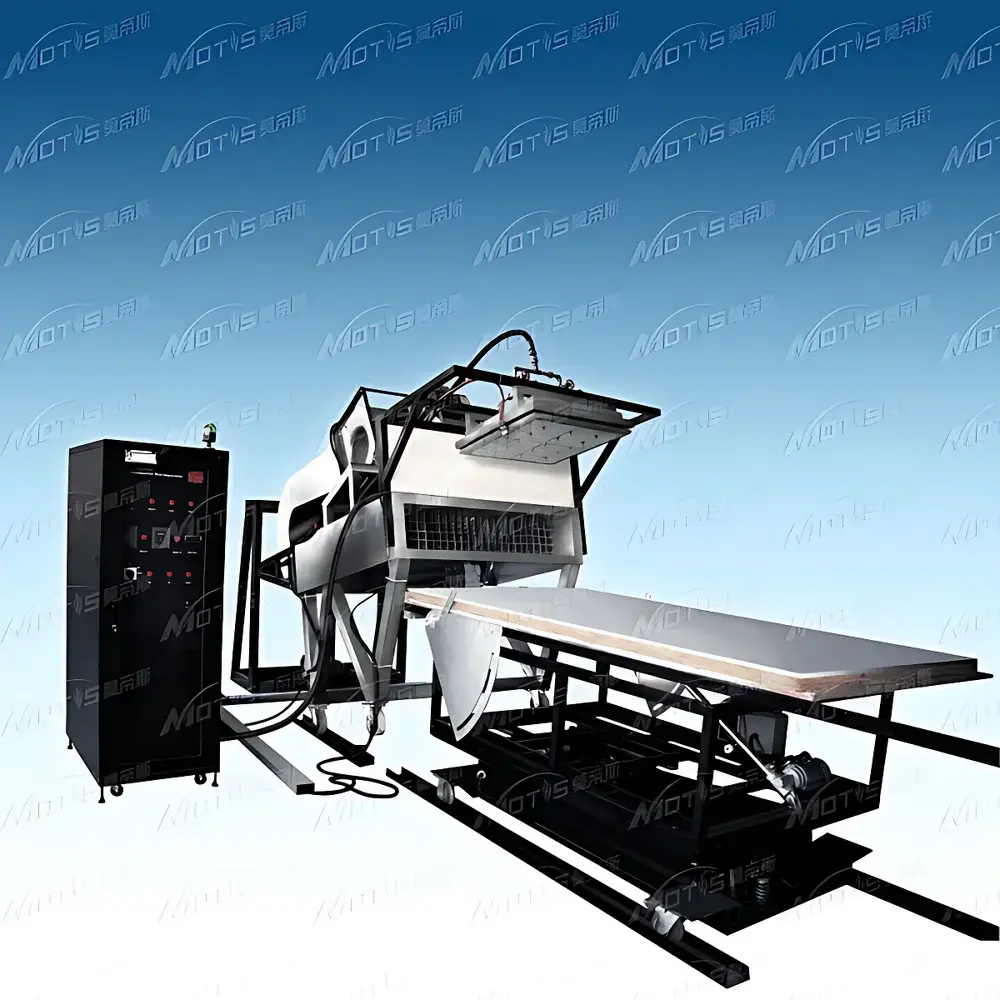
MOTIS RCF Roofing Material Fire Reaction Test Apparatus
| Brand | MOTIS |
|---|---|
| Origin | Jiangsu, China |
| Model | RCF |
| Compliance | GB/T 30735-2014, ENV 1187 (t1), ISO 12468-1 |
| Sample Mounting Angle Range | 0–50° |
| Air Duct Adjustment Range | 0–35° |
| Airflow Capacity | up to 250 m³/min |
| Fan Motor Power | 5.5 kW |
| Radiation Panel Dimensions | 600 mm × 600 mm |
| Ignition Method | Electric Spark with Thermocouple-Monitored Flame Supervision |
| Wind Speed Measurement | Three Vane Anemometers (±0.1 m/s accuracy) |
| Construction Materials | SUS304 Stainless Steel Duct (2 mm thickness), Structural Steel Frame with Pneumatic & Servo-Driven Actuation |
Overview
The MOTIS RCF Roofing Material Fire Reaction Test Apparatus is a precision-engineered system designed to evaluate the external fire performance of roofing products in accordance with internationally harmonized standards—primarily GB/T 30735-2014, ENV 1187 (Test Method t1), and ISO 12468-1. It quantifies flame spread behavior under controlled exposure conditions simulating real-world roof fire scenarios, including radiant heat flux, direct flame impingement, and convective airflow influence. The apparatus implements three distinct test configurations: Method A (tilted specimen under radiant exposure, aligned with ENV 1187 t1), and Methods B and C (inclined air duct + flame source combinations per ISO 12468-1). Its modular architecture integrates calibrated radiation delivery, dynamically adjustable specimen orientation, and regulated airflow generation—all traceable to metrological best practices for fire testing laboratories.
Key Features
- Motorized, servo-controlled air duct positioning system enabling precise angular adjustment from 0° to 35°, fully compliant with ISO 12468-1 Methods B and C.
- Pneumatically actuated specimen mounting frame with fine-tuned tilt capability (0–50°), satisfying the maximum 45° inclination requirement specified in ENV 1187 t1 and GB/T 30735-2014 Method A.
- High-capacity centrifugal fan (250 m³/min max airflow, 5.5 kW motor) paired with a 3-phase 380 V variable-frequency drive for stable, repeatable air velocity control.
- Robust SUS304 stainless steel air duct construction (2 mm wall thickness), incorporating upstream fine-honeycomb flow straighteners and downstream coarse-honeycomb diffusers to ensure uniform, turbulence-minimized airflow profiles.
- 600 mm × 600 mm ceramic-fiber-backed radiant panel with integrated thermocouple monitoring and automatic gas shutoff upon flame extinction—ensuring operational safety and regulatory compliance.
- Dual independent ignition subsystems: electric spark ignition for radiant panel operation, plus a dedicated small-diameter stainless steel burner for particle-based combustibility assessment (e.g., wood chip or shingle debris).
- Comprehensive instrumentation suite: three calibrated vane anemometers (±0.1 m/s resolution) mounted at critical duct cross-sections for real-time airflow validation; dual high-resolution video surveillance systems for synchronized visual documentation of flame propagation dynamics.
Sample Compatibility & Compliance
The RCF apparatus accommodates standard-sized roofing specimens (typically 1000 mm × 500 mm or as defined in GB/T 30735-2014 Annex A) across diverse material classes—including bituminous membranes, polymer-modified sheets, metal roof panels, fiber-cement tiles, and vegetative roof assemblies. All mechanical adjustments, thermal exposures, and airflow parameters are validated against the procedural rigors of GB/T 30735-2014, which mirrors the technical basis of European prestandard ENV 1187 and ISO 12468-1. The system supports full auditability for GLP-compliant laboratories, with hardware-level interlocks (e.g., flame supervision cutoff), documented calibration intervals for anemometers and thermocouples, and mechanical repeatability verified per ISO/IEC 17025 requirements for fire test equipment.
Software & Data Management
While the RCF operates primarily via hardware-integrated controls (push-button tilt actuation, VFD speed setting, ignition activation), it is designed for seamless integration into laboratory information management systems (LIMS) through analog signal outputs (4–20 mA or 0–10 V) for airflow, surface temperature, and actuator position. Optional digital I/O modules support RS-485 Modbus RTU communication, enabling remote status monitoring and event logging compatible with FDA 21 CFR Part 11–compliant data acquisition platforms. Video feeds are timestamped and stored externally on network-attached storage, supporting traceable correlation between visual flame development and quantitative sensor readings during post-test analysis.
Applications
- Evaluation of flame spread resistance for Class A, B, and C roof coverings per ASTM E108 and UL 790 equivalency pathways.
- Development and validation of fire-retardant coatings and intumescent layers applied to organic roof substrates.
- Comparative assessment of edge-of-roof fire propagation under wind-driven conditions (simulated via duct angle and airflow modulation).
- Regulatory submission testing for CE marking (EN 13501-5), CCC certification (China Compulsory Certification), and national building code approvals.
- Research into ignition delay times, char depth progression, and pyrolysis gas evolution kinetics under standardized radiant flux profiles (e.g., 50 kW/m²).
FAQ
What standards does the RCF apparatus directly support?
It is configured and validated for GB/T 30735-2014, ENV 1187 (t1), and ISO 12468-1 Methods A, B, and C.
Is the system suitable for testing non-flat roofing materials such as tiles or shingles?
Yes—specimen fixtures accommodate profiled surfaces; mounting brackets are adjustable to maintain consistent gap tolerances per standard requirements.
How is airflow uniformity verified during qualification?
Using the three included vane anemometers, users perform grid-based velocity mapping at the duct exit plane per ISO 5801 guidelines, with deviation limits ≤ ±5% across the measurement area.
Can the apparatus be upgraded for automated data capture?
Yes—optional analog/digital interface modules enable connection to third-party DAQ systems, supporting CSV export, trend charting, and electronic signature workflows.
Does the system include calibration certificates for critical sensors?
Factory calibration reports are provided for all anemometers and thermocouples; field recalibration services follow ISO/IEC 17025-accredited protocols.



