
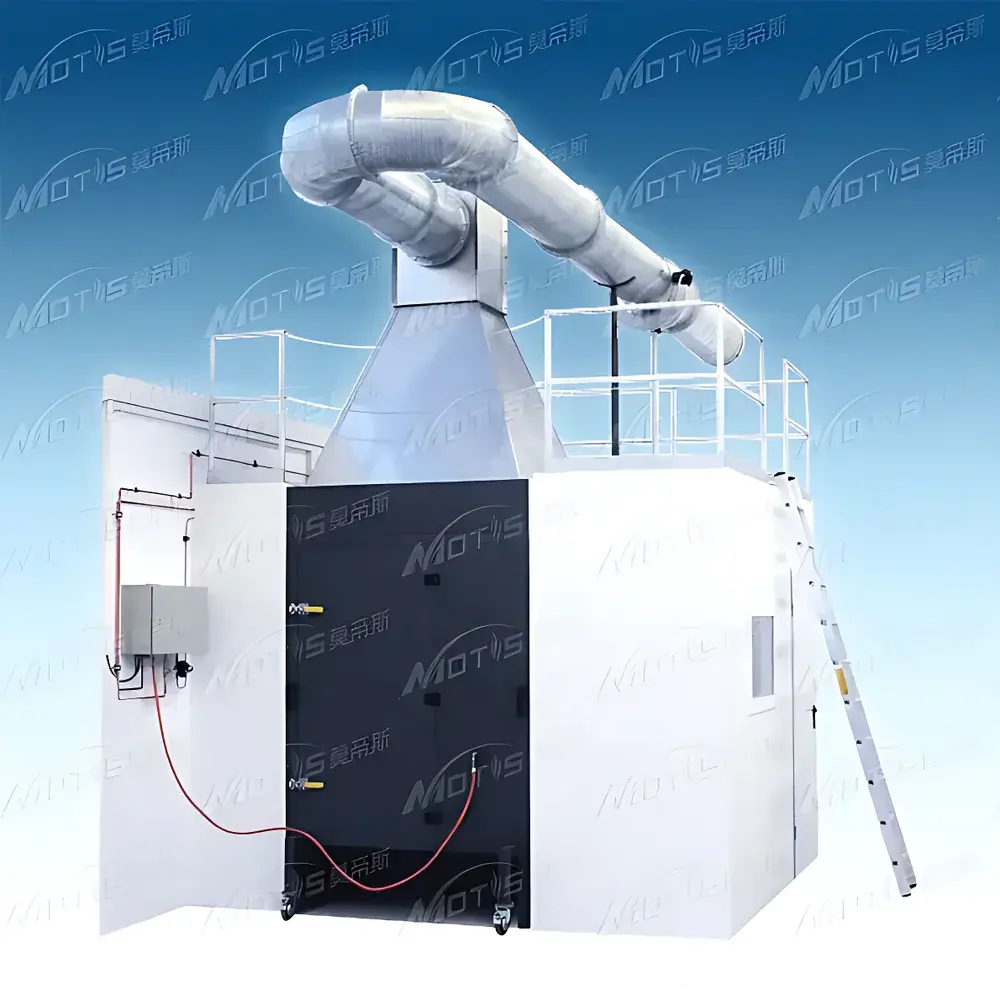
MOTIS SBI- Single Burning Item (SBI) Fire Test Apparatus
| Brand | MOTIS |
|---|---|
| Origin | Jiangsu, China |
| Model | SBI- |
| Compliance | GB/T 20284-2006, EN 13823 |
| Power Supply | 380 V AC, 50 Hz |
| Fuel | 95% commercial propane |
| Exhaust Flow Rate | ≥8000 m³/h |
| Gas Flow Control | Mass flow controller (0–2.3 g/s C₃H₈, ±1% FS accuracy) |
| Temperature Measurement | K-type thermocouples (±0.5 °C) |
| Pressure Sensing | Differential pressure transducers (±0.5 Pa) |
| Oxygen Analysis | 0–25% vol, T90 ≤ 2 s, linearity < ±0.1% O₂ |
| CO/CO₂ Analysis | CO (0–1% vol, ±0.02% vol), CO₂ (0–10% vol, ±1% FS), T90 ≤ 2 s |
| Smoke Measurement | White-light extinction method (24 V, 6 W incandescent source |
| Data Acquisition | NI-compatible 16-bit analog input modules, LabVIEW-based real-time system |
| Cooling System | Active chiller (≤5 °C operational setpoint) |
| Filtration | Dual-stage (coarse ≤25 µm, fine ≤3 µm) |
| Exhaust Duct | J-shaped double-walled 304 stainless steel (ID 315 mm) |
Overview
The MOTIS SBI- Single Burning Item (SBI) Fire Test Apparatus is a fully integrated, standards-compliant fire testing system engineered for the quantitative assessment of flame spread, heat release, smoke production, and toxic gas emissions from building products under controlled, intermediate-scale fire exposure. Based on the cone calorimeter principle adapted to the single-burning-item configuration, the apparatus subjects vertically mounted specimens (up to 1000 mm × 500 mm) to a defined radiant flux (30 kW/m² at sample surface) and a pilot flame from propane gas—simulating realistic fire initiation in compartment corners. The system operates according to the fundamental thermochemical measurement paradigm: combustion gases are quantitatively extracted through a calibrated exhaust duct, enabling real-time calculation of heat release rate (HRR), total heat released (THR), specific extinction area (SEA), CO/CO₂ yields, and oxygen depletion—key parameters required for Euroclass classification (EN 13501-1) and national regulatory submissions (e.g., GB/T 20284-2006). Its robust architecture—including refractory-lined combustion chamber (>900 °C thermal stability), precision mass flow control, NIST-traceable gas analyzers, and LabVIEW-driven data acquisition—ensures high reproducibility and metrological integrity across repeated test cycles.
Key Features
- Refractory combustion chamber constructed from high-alumina firebrick with dual observation windows for real-time visual monitoring of flame propagation and charring behavior.
- Integrated exhaust system featuring J-shaped double-walled 304 stainless steel ducting (ID 315 mm), equipped with three-point K-type thermocouple arrays and differential pressure sensing for accurate volumetric flow correction.
- High-fidelity gas analysis suite: electrochemical O₂ analyzer (0–25% vol, <±0.1% linearity), NDIR CO and CO₂ analyzers (0–1% and 0–10% ranges respectively, T90 ≤ 2 s), all factory-calibrated and compliant with ISO 13943 and ASTM E1354 reference methodologies.
- Optical smoke measurement subsystem utilizing a stabilized 24 V / 6 W incandescent light source and Hamamatsu silicon photodiode detector, delivering extinction coefficient data traceable to CIE standard illuminants.
- Automated propane delivery system incorporating a NIST-calibrated mass flow controller (316 stainless steel wetted parts, 0–2.3 g/s range, ±1% FS accuracy), fail-safe solenoid valves, and high-temperature auto-ignition module eliminating pilot flame interference in HRR calculations.
- Real-time environmental monitoring: ambient pressure sensor (±200 Pa), inlet air temperature probes (±0.5 °C), and dynamic exhaust backpressure transducer (0–250 Pa, ±0.5 Pa) ensure thermodynamic boundary condition control per EN 13823 Annex A.
- Modular data acquisition platform built on National Instruments hardware architecture (16-bit analog I/O, 8-channel thermocouple input, digital I/O, real-time LabVIEW RT engine), supporting full audit trail generation for GLP/GMP-aligned laboratories.
Sample Compatibility & Compliance
The SBI- apparatus accommodates rigid and semi-rigid building products—including wall claddings, ceiling panels, insulation boards, and floor coverings—mounted vertically on a motorized trolley with adjustable clamping fixtures. Specimen dimensions conform to EN 13823 (1000 mm height × 500 mm width × max. 200 mm thickness) and GB/T 20284-2006 requirements. All critical subsystems meet or exceed metrological specifications stipulated in ISO/IEC 17025:2017 for testing laboratories. The system supports full compliance with European Commission Regulation (EU) No 305/2011 (CPR), EN 13501-1:2018 fire classification procedures, and Chinese mandatory standard GB 8624–2012. Optional calibration kits—including heptane verification burner, duct flow coefficient calibrator, and certified reference gases (NIST-traceable O₂/CO/CO₂ mixtures)—enable routine performance verification aligned with ISO 17025 clause 7.7.
Software & Data Management
Control and data processing are executed via a custom LabVIEW-based application running on an industrial PC (Intel Core i5, 4 GB RAM, Windows 10 IoT Enterprise). The software provides synchronized acquisition of >64 analog and digital channels at 10 Hz sampling rate, automatic calculation of fire growth index (FIGRA), lateral flame spread index (LFS), and smoke growth rate (SMOGRA), and export of tabular and graphical outputs in CSV, PDF, and XML formats. Audit trail functionality records all operator actions, parameter changes, calibration events, and system errors with time stamps and user IDs—fully satisfying FDA 21 CFR Part 11 electronic record requirements. Raw data files are stored with SHA-256 checksums; backup routines integrate with network-attached storage (NAS) or cloud-based repositories via TLS 1.2–encrypted SFTP.
Applications
- Regulatory fire testing for CE marking and CCC certification of construction products.
- Development and validation of intumescent coatings, mineral wool composites, and bio-based insulation materials.
- Comparative evaluation of fire-retardant additives in polymer matrices (e.g., PVC, PET, polyolefins).
- Supporting computational fluid dynamics (CFD) model validation using measured HRR, smoke opacity, and gas species time-histories.
- Third-party certification testing accredited to CNAS (China), UKAS (UK), and DAkkS (Germany) scopes.
FAQ
What international standards does the MOTIS SBI- system fully support?
The system is designed and validated for EN 13823:2010+A1:2014 and GB/T 20284–2006, with hardware and software configurations meeting all mandatory sub-clauses including airflow calibration, gas analyzer drift limits, and thermocouple placement tolerances.
Is the data acquisition system compliant with regulatory audit requirements?
Yes—the LabVIEW RT application implements role-based access control, electronic signatures, immutable audit logs, and automated backup, fulfilling 21 CFR Part 11, ISO/IEC 17025:2017 clause 7.11, and EU Annex 11 for computerized systems.
Can the system be upgraded to support future revisions of EN 13823?
All firmware, analyzer firmware, and software modules are field-upgradable via secure authenticated channels; MOTIS provides documented change notifications and re-validation protocols for major standard revisions.
What maintenance intervals are recommended for gas analyzers and flow controllers?
Oxygen and CO/CO₂ analyzers require zero/span verification every 24 hours of operation and full calibration every 3 months using certified reference gases; mass flow controllers should undergo annual NIST-traceable recalibration.
Does the system include provisions for inter-laboratory comparison studies?
Yes—built-in reference test sequences (e.g., PMMA calibration panel protocol), standardized output templates, and raw data export capability enable participation in ILAC P14–aligned round-robin trials.



