
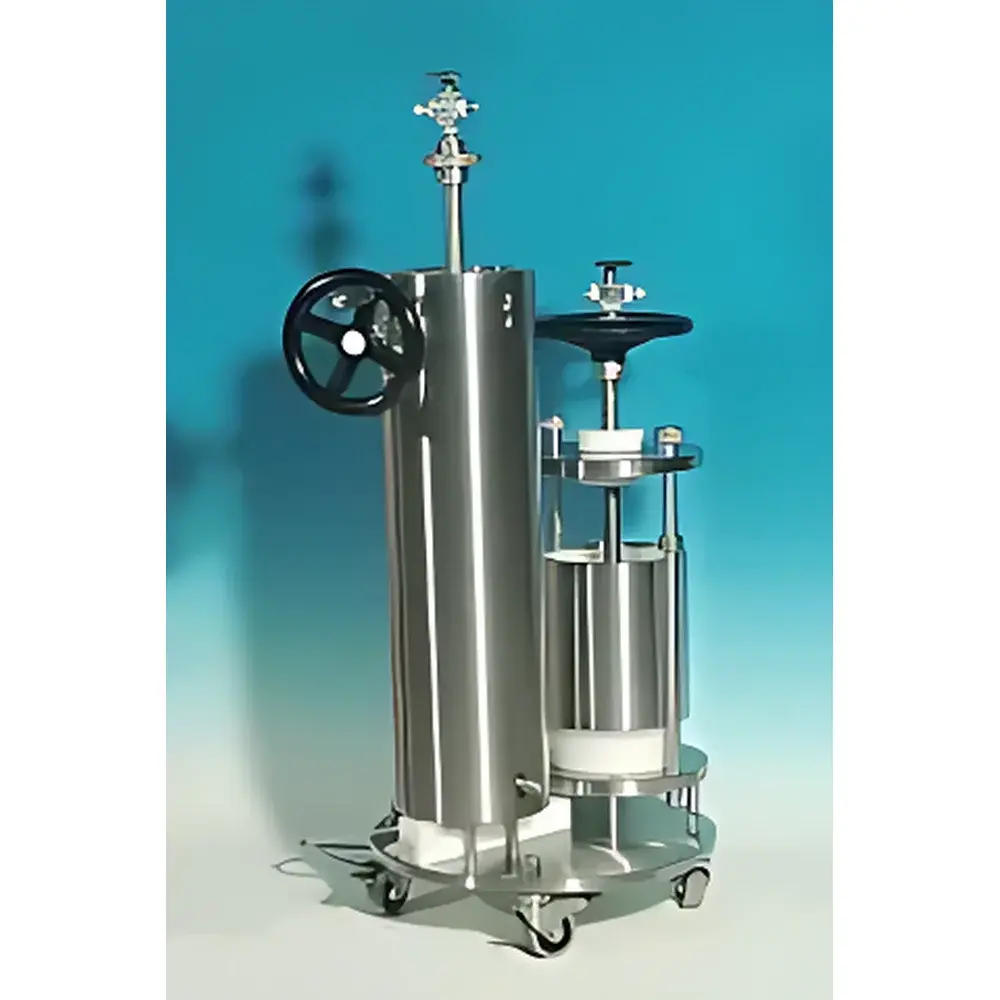
JumboFlash Flash Chromatography System by GYAN
| Origin | Italy |
|---|---|
| Manufacturer Type | Authorized Distributor |
| Origin Category | Imported |
| Model | JumboFlash |
| Instrument Type | Medium-Pressure Preparative Liquid Chromatography |
| Max. Sample Load | 40 g (scalable to larger loads) |
| Operating Pressure Range | 0–20 bar |
| Column Mounting | Modular, Multi-Size Compatible |
| Core Technology | Patented 360° Radial Compression Sealing |
Overview
The JumboFlash Flash Chromatography System is a medium-pressure preparative liquid chromatography platform engineered by GYAN (Italy) for high-efficiency, scalable purification of complex organic mixtures. Unlike gravity-fed open-column chromatography, the JumboFlash applies controlled backpressure—up to 20 bar—to accelerate mobile phase flow while maintaining optimal band resolution and column packing integrity. Its operational principle is based on classical liquid-solid adsorption chromatography, where differential partitioning of analytes between a stationary phase (e.g., silica gel, C18, or amino-modified silica) and a gradient or isocratic eluent enables reproducible fractionation. Designed specifically for preparative-scale applications, it bridges the performance gap between low-pressure flash systems and high-pressure HPLC—offering significantly faster run times and superior resolution than atmospheric methods, without the capital expenditure, solvent consumption, or method development overhead associated with analytical or semi-preparative HPLC platforms.
Key Features
- Scalable Sample Capacity: Supports loading up to 40 g of crude material per run—extendable to higher capacities via column diameter scaling (e.g., 40 mm to 100 mm ID columns)—making it suitable for natural product isolation, combinatorial library purification, and fine chemical synthesis workflows.
- Modular Column Integration: A single, rigid column mounting frame accommodates multiple column diameters (e.g., 15 mm, 25 mm, 40 mm, 60 mm) without hardware reconfiguration—enabling rapid method translation from analytical scouting to gram-scale isolation.
- Patented 360° Radial Compression Sealing: Ensures uniform, bubble-free packing across the entire column cross-section by applying isotropic mechanical pressure around the frit and bed interface—eliminating channeling, wall voids, and axial dead volume that compromise resolution and recovery.
- Reduced Solvent Consumption: Optimized flow dynamics and column efficiency yield 20–35% lower solvent volumes per separation compared to conventional flash systems operating at identical loadings—reducing disposal costs and environmental footprint.
- Robust Architecture: Constructed with chemically resistant stainless steel and PEEK fluidic pathways; compatible with common organic solvents (hexane, EtOAc, DCM, MeOH, ACN) and mild acid/base modifiers—ensuring long-term reliability under routine laboratory use.
Sample Compatibility & Compliance
The JumboFlash system is routinely deployed in ISO 17025-accredited laboratories for purification of thermally labile natural products (e.g., alkaloids, flavonoids, terpenes), synthetic intermediates, and peptide fragments. It supports both normal-phase and reversed-phase chemistries, with validated compatibility for silica, diol, NH₂, CN, and C18 stationary phases. While not a regulated GMP instrument per se, its mechanical consistency, traceable pressure control, and repeatable fraction collection support GLP-compliant documentation when integrated with external fraction collectors equipped with audit-trail logging (e.g., compliant with FDA 21 CFR Part 11 when paired with validated software). Method parameters—including flow rate, gradient slope, and collection thresholds—are manually documented per ICH Q5A/Q5B guidelines for biopharmaceutical intermediate purification.
Software & Data Management
The JumboFlash operates as a stand-alone, hardware-controlled system without embedded software or touchscreen interface—intentionally designed to maximize operational simplicity and minimize validation burden. All parameters (flow rate, pressure limit, run duration) are set via calibrated analog dials and monitored using dual-range analog gauges (0–20 bar main pressure, 0–5 bar backpressure). Fraction collection is performed manually or synchronized with third-party fraction collectors (e.g., Gilson FC204, Biotage Isolera-compatible units) that provide time- or UV-triggered fractionation and CSV-exportable log files. This architecture ensures full traceability through lab notebook entries and eliminates software qualification requirements typical of fully automated LC systems.
Applications
- Purification of plant extracts for phytochemical screening and reference standard preparation (ASTM D7984-15 compliant workflows)
- Rapid cleanup of Suzuki-Miyaura and Buchwald-Hartwig reaction mixtures prior to NMR or MS characterization
- Isolation of enantiomerically enriched fractions using chiral stationary phases (e.g., Chiralpak AD-H, OD-H)
- Desalting and buffer exchange of synthetic peptides prior to lyophilization
- Scale-up of medicinal chemistry hits from 100 mg to multi-gram batches under consistent resolution metrics (Rs ≥ 1.5)
FAQ
What is the maximum recommended column length for the JumboFlash system?
Standard configurations support columns up to 500 mm in length; extended-length options (up to 1000 mm) are available with reinforced compression housings and calibrated pressure compensation.
Can the system be used with chlorinated solvents such as dichloromethane or chloroform?
Yes—provided all wetted components (seals, tubing, frits) are specified for halogenated solvent compatibility during configuration; standard PTFE and FFKM seals are recommended.
Is method transfer from analytical TLC or HPLC possible?
Direct transfer is supported via linear velocity scaling (v0) and retention factor (k) correlation; GYAN provides a validated conversion protocol for Rf-to-k mapping and gradient dwell volume compensation.
Does the system include UV detection capability?
No—UV-Vis detection is optional and implemented externally via in-line flow cells (e.g., 2 mm pathlength, 190–800 nm range) connected to standalone spectrophotometers or fraction collectors with absorbance monitoring.
What maintenance intervals are recommended for long-term reliability?
Frit inspection and seal replacement every 200 runs or 6 months (whichever occurs first); column compression mechanism lubrication every 500 hours of cumulative operation.






