
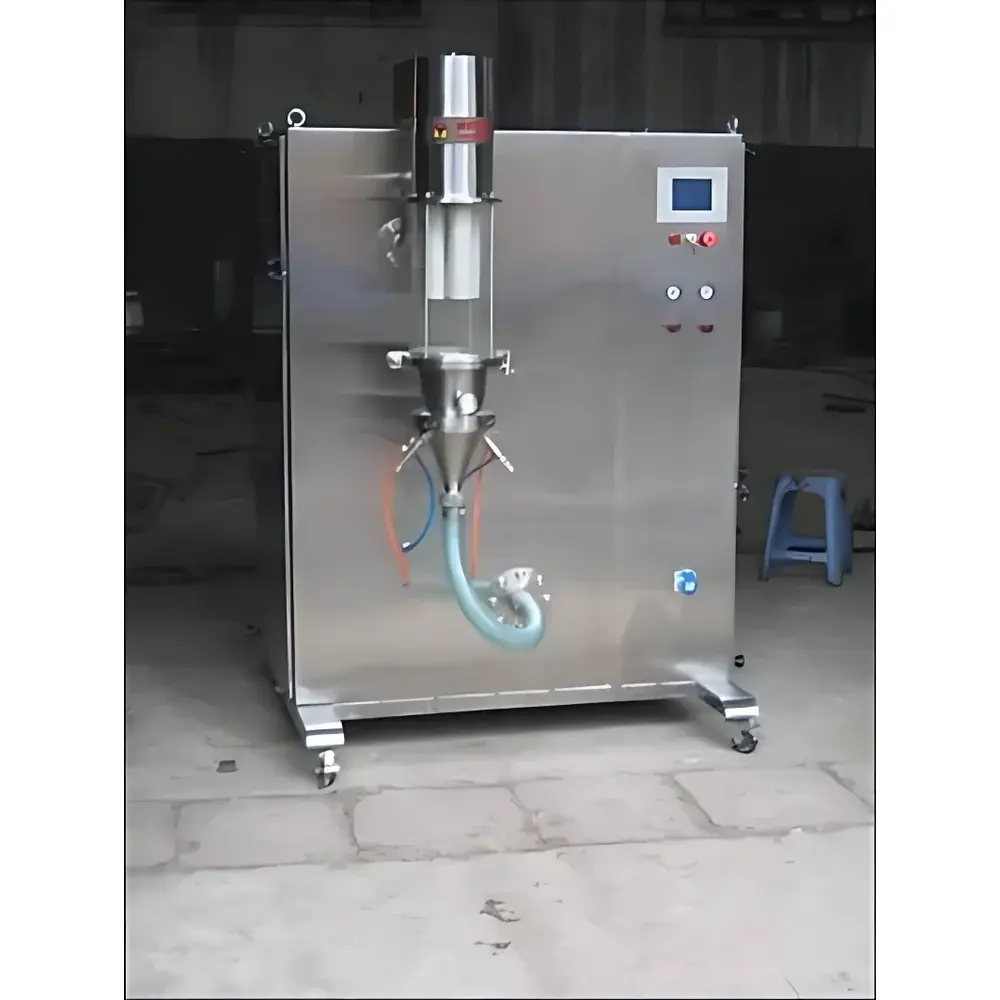
English Product Name
| Origin | China |
|---|---|
| Manufacturer Type | Authorized Distributor |
| Model | HJ-180 Enhanced |
| Batch Capacity | 0.5–4 kg |
Overview
The HJ-180 Enhanced Lab-Scale Fluidized Bed Processor is an integrated, single-pot platform engineered for the development and optimization of solid oral dosage forms under controlled, reproducible laboratory conditions. Based on the fundamental principles of fluidization dynamics—where solid particles behave as a fluid when subjected to upward-moving gas flow—the system enables precise control over particle motion, heat and mass transfer, and liquid distribution. This architecture supports seamless transition across unit operations critical to pharmaceutical process development: dry powder blending, moisture removal via convective drying, wet granulation using bottom-spray binder application, and thin-film coating of diverse particulate substrates—including powders, granules, pellets, capsules, tablets, and crystals. Designed for GMP-aligned R&D labs, the HJ-180 eliminates mechanical reconfiguration between steps, reducing cross-contamination risk, operator variability, and method transfer delays.
Key Features
- Turbojet Fluidization Base: A high-efficiency turbine-driven distributor plate ensures uniform gas distribution across the entire bed cross-section. This design promotes consistent particle suspension, minimizes localized mechanical stress on fragile particles, and establishes a defined axial and radial flow pattern—critical for predictable binder penetration and coating uniformity.
- Under-Bed Spray System with Protective Gas Shroud: Multi-nozzle spray assembly mounted beneath the fluidization plate delivers binder or coating solution directly into the expanding particle cloud. A coaxial protective gas stream isolates the atomized spray cone from hot, dry process air, preventing premature solvent evaporation or nozzle clogging due to binder precipitation at the orifice. The shroud also enhances bubble formation and increases effective surface area for droplet–particle interaction throughout the entire processing cycle.
- Dynamic Filter Cleaning System: Cylindrical, modular filter housings are independently mounted to minimize airflow disruption during pulse cleaning. Process air—not compressed air—is used for reverse-jet filtration, significantly lowering operational cost and eliminating oil/water contamination risks. Fine particles dislodged during cleaning settle gradually back into the fluidized bed due to optimized dome geometry and reduced upward velocity, ensuring near-complete material recovery and minimal yield loss.
- Modular Construction & Process Flexibility: All core modules—including air handling unit, product chamber, spray system, and control interface—are designed for rapid validation and qualification. No hardware modification is required to switch between mixing, drying, granulating, or coating modes, supporting QbD-based experimental design and regulatory documentation per ICH Q5A, Q5C, and Q8(R2).
Sample Compatibility & Compliance
The HJ-180 accommodates a broad spectrum of pharmaceutical solids: free-flowing excipients (e.g., lactose, microcrystalline cellulose), cohesive APIs, heat-sensitive biologics (under low-temperature drying protocols), and delicate multiparticulates. Its stainless-steel 316L contact surfaces meet ASME BPE and ISO 14644-1 Class 7 cleanroom compatibility requirements. The system supports audit-ready operation with configurable electronic logbooks, user-level access control, and optional 21 CFR Part 11-compliant software modules for data integrity, electronic signatures, and change management—aligning with FDA, EMA, and PMDA expectations for early-phase formulation studies and tech transfer packages.
Software & Data Management
Equipped with a programmable logic controller (PLC) and HMI touchscreen interface, the HJ-180 records real-time parameters—including inlet/outlet air temperature, humidity, static pressure differential, spray rate, fluidization velocity, and filter pressure drop—at user-defined intervals (≥1 Hz). Exportable CSV/Excel logs support statistical process analysis (SPC), multivariate modeling (e.g., PLS regression for endpoint prediction), and integration with LIMS or MES platforms. Optional advanced software includes PAT-ready tools for in-process monitoring of granule growth kinetics and coating thickness estimation via temperature profile correlation.
Applications
- Formulation screening for immediate- and modified-release granules
- Development of functional film coatings (enteric, sustained-release, taste-masking)
- Scale-down modeling for commercial fluid-bed processes (ICH Q5A comparability assessments)
- Stability-indicating drying studies under controlled dew point conditions
- Process characterization of cohesive or low-density materials prone to channeling or agglomeration
- Support for regulatory submissions including ANDAs, MAAs, and CMC sections of INDs
FAQ
Can the HJ-180 be qualified for GMP pilot-scale batches?
Yes—its construction, material traceability, and documentation package support IQ/OQ/PQ execution per ASTM E2500 and Annex 15 guidelines. Validation templates are provided.
Is it possible to integrate third-party PAT sensors (e.g., NIR, Raman)?
The system features standardized 4–20 mA and RS485 interfaces, enabling direct integration with inline spectroscopic probes for real-time endpoint detection.
What is the typical residence time for granulation versus coating cycles?
Granulation typically requires 8–25 minutes depending on binder viscosity and target size distribution; film coating ranges from 30–120 minutes based on coating weight gain and polymer solubility.
Does the dynamic filter system require scheduled replacement of filter cartridges?
Filter elements are rated for ≥500 cleaning cycles; routine inspection is recommended every 50 batches, with individual cartridge replacement only upon integrity test failure.
How is temperature uniformity verified across the fluidized bed?
Three calibrated PT100 sensors (top/mid/base) are embedded in the product chamber, and thermal mapping per USP <1058> is supported via external data logger synchronization.




