
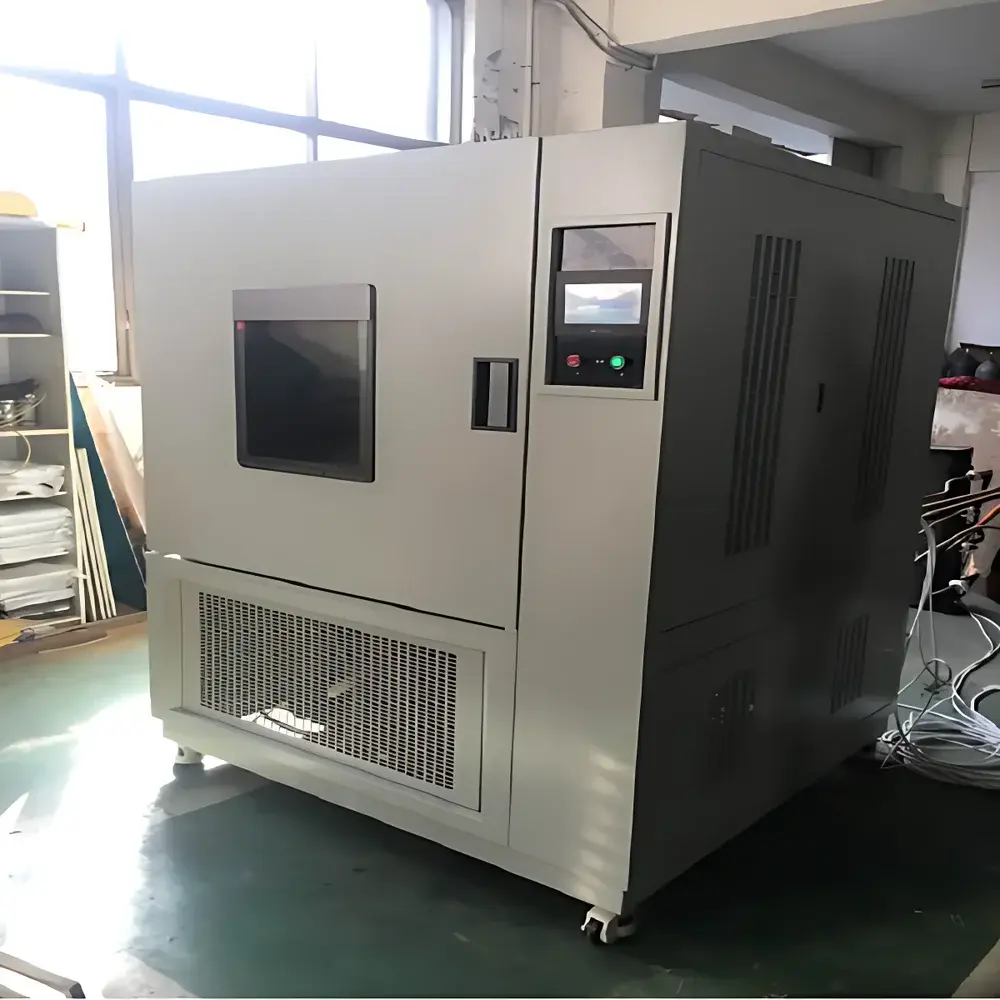
QJCK High-Low Temperature Cycling Humidity Chamber
| Origin | Shanghai, China |
|---|---|
| Manufacturer Type | Authorized Distributor |
| Origin Category | Domestic (China) |
| Model | QJCK |
| Price | ¥55,000 |
| Temperature Deviation | ±0.5 °C |
| Heating Rate | −20 °C to 100 °C in 30 min |
| Cooling Rate | 20 °C to −40 °C in 35 min |
| Temperature Range | −40 °C to +150 °C |
| Humidity Range | 10 %RH to 99.9 %RH |
| Temperature Resolution | 0.01 °C |
| Humidity Resolution | 0.01 %RH |
| Temperature Uniformity | ±2.0 °C |
| Humidity Uniformity | ±3.0 %RH |
| Programmable Steps | 120 programs / 1200 segments |
| Interior Dimensions (H×W×D) | 450 × 400 × 350 mm |
| Exterior Dimensions (H×W×D) | 1550 × 920 × 820 mm |
| Power Supply | 220 V AC |
| Rated Power | 2.0 kW |
| Net Weight | ~180 kg |
Overview
The QJCK High-Low Temperature Cycling Humidity Chamber is a precision-engineered environmental test system designed to replicate dynamic climatic conditions for reliability validation of materials and finished products. Based on the fundamental principles of forced-air convection, refrigerant-based vapor compression cooling, and steam-humidification with PID-controlled dew-point regulation, the chamber delivers tightly controlled temperature and humidity profiles across wide operational ranges. It supports both steady-state exposure and programmable cycling protocols—enabling simulation of real-world thermal and hygrothermal stresses encountered during storage, transportation, and operational use. The system complies with core test standards including IEC 60068-2-1 (cold), IEC 60068-2-2 (dry heat), IEC 60068-2-14 (temperature cycling), and IEC 60068-2-78 (damp heat, steady state), making it suitable for pre-compliance screening in electronics, automotive components, medical devices, and aerospace subsystems.
Key Features
- Wide operating envelope: −40 °C to +150 °C temperature range with 10 %RH–99.9 %RH humidity coverage, enabling comprehensive environmental stress profiling.
- High-fidelity control architecture: Dual independent PID loops for temperature and humidity, each with 0.01 °C and 0.01 %RH resolution, ensuring repeatable setpoint tracking under load.
- Rapid thermal response: Achieves −20 °C → 100 °C ramp in ≤30 minutes and 20 °C → −40 °C cooldown in ≤35 minutes—optimized via high-efficiency scroll compressor, oversized evaporator, and low-thermal-mass chamber walls.
- Programmable test sequencing: Supports up to 120 multi-segment programs (1200 total steps), with user-defined dwell times, ramp rates, and humidity transitions—essential for accelerated life testing (ALT) and HALT pre-screening.
- Structural integrity: Stainless steel inner chamber (SUS304), double-layer insulated door with anti-condensation heater, and reinforced frame ensure long-term dimensional stability and corrosion resistance.
- Operational safety: Integrated over-temperature, over-humidity, compressor high-pressure, and phase-failure protection circuits meet IEC 61000-6-2/6-4 immunity and emission requirements.
Sample Compatibility & Compliance
The QJCK chamber accommodates samples up to 450 mm (H) × 400 mm (W) × 350 mm (D), with standardized mounting options including adjustable stainless-steel shelves and cable access ports. Its uniformity performance—±2.0 °C temperature and ±3.0 %RH humidity across the working volume—is verified per IEC 60068-3-5 and ASTM E145-22 Annex A3. The unit is routinely deployed in GLP-compliant laboratories for qualification testing per ISO 17025, supporting audit-ready documentation for regulatory submissions. While not certified to UL or CE as a standalone appliance, its electrical design conforms to IEC 61010-1 safety requirements for laboratory equipment, and humidity control accuracy aligns with USP environmental monitoring tolerances for pharmaceutical stability chambers.
Software & Data Management
The embedded controller features a 7-inch TFT-LCD touchscreen interface with multilingual support (English, Chinese, Spanish), real-time graphing, and USB data export (CSV format). Optional PC-based software enables remote monitoring, alarm logging, and automated report generation—including timestamped deviation alerts, trend analysis, and compliance summaries against user-defined acceptance criteria. Audit trails record all parameter changes, operator logins, and calibration events, satisfying FDA 21 CFR Part 11 requirements when paired with electronic signature modules. Data integrity is preserved via non-volatile memory backup and cyclic redundancy check (CRC) verification on all stored program sequences.
Applications
- Electronics: Thermal cycling of PCBAs per JESD22-A104, moisture sensitivity level (MSL) preconditioning per J-STD-020, and solder joint fatigue assessment.
- Automotive: Component validation per ISO 16750-4 (climate loads) and GMW16265 (humidity cycling).
- Medical Devices: Biocompatibility material aging per ISO 10993-12 and packaging integrity testing per ISO 11607-1.
- Aerospace: Non-destructive evaluation of composite layups under combined thermal-hygric stress per SAE AMS2750E Appendix C.
- Research & Development: Accelerated corrosion studies, polymer crystallinity mapping, and battery electrolyte volatility screening.
FAQ
What standards does the QJCK chamber support for validation and routine operation?
It is configured to meet the environmental profile requirements of IEC 60068-2 series, MIL-STD-810H Method 502.7 (low temperature), Method 503.7 (high temperature), and Method 507.6 (humidity). Calibration certificates traceable to NIM (China National Institute of Metrology) are available upon request.
Can the chamber be integrated into a centralized lab monitoring network?
Yes—via optional RS485 Modbus RTU or Ethernet TCP/IP interface, enabling integration with LabVantage, Thermo Fisher SampleManager, or custom SCADA systems for enterprise-wide environmental data aggregation.
Is third-party IQ/OQ/PQ protocol support provided?
Comprehensive qualification documentation templates (including sensor placement maps, uniformity test plans, and alarm response verification checklists) are supplied. On-site IQ/OQ execution by certified field engineers is available under separate service agreement.
What maintenance intervals are recommended for sustained accuracy?
Compressor oil and refrigerant levels should be verified annually; humidity sensor recalibration is advised every 6 months or after 500 operational hours—whichever occurs first—using NIST-traceable saturated salt solutions.



