
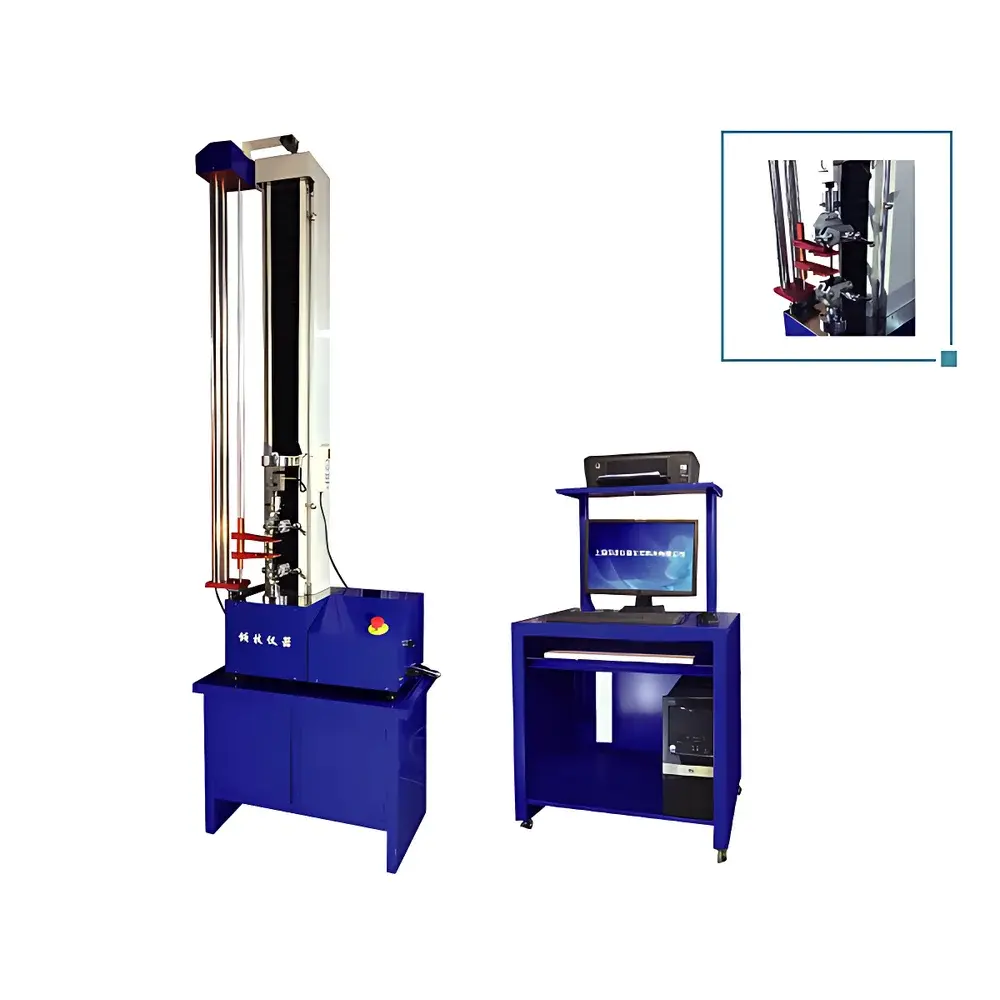
QJ210A Universal Tensile Testing Machine
| Origin | Shanghai, China |
|---|---|
| Manufacturer Type | Authorized Distributor |
| Origin Category | Domestic (PRC) |
| Model | QJ210A |
| Price | USD 4,200 (FOB Shanghai) |
| Instrument Type | Electromechanical Tensile Tester |
| Max Test Load | 5 kN |
| Force Measurement Range | 0.2%–100% of Full Scale |
| Force Accuracy | ±0.5% of reading |
| Travel Distance | 500 mm |
| Displacement Resolution | ±0.5% of indicated value |
| Effective Test Width | 150 mm |
| Effective Tensile Stroke | 800 mm |
| Test Speed Range | 0.01–500 mm/min (adjustable) |
| Speed Accuracy | ±0.5% of set value |
| Position Measurement Accuracy | ±0.5% of reading |
| Strain Measurement Accuracy | ±0.5% of reading |
| Load Cell | High-precision U.S.-sourced strain-gauge sensor |
| Control System | Panasonic full-digital AC servo controller |
| Crosshead Movement | Dual-speed (fast/slow) motorized adjustment |
| Safety Protection | Software-based fault diagnosis, electronic travel limits, overload protection at 110% FS |
| Return Mode | Manual or programmable automatic return to origin |
| Fixture Customization | Application-specific grips available upon sample specification |
| Optional Accessories | Lenovo LCD desktop PC |
| Power Supply | 200 V AC, 400 W |
| Dimensions (L×W×H) | 590 × 355 × 1640 mm |
| Net Weight | ~85 kg |
Overview
The QJ210A Universal Tensile Testing Machine is an electromechanical static testing system engineered for high-reproducibility mechanical characterization of solid materials under uniaxial tension and compression. Based on closed-loop servo-controlled load application and precision displacement feedback, the instrument complies with fundamental principles defined in ISO 7500-1 (static calibration of force-proving systems), ASTM E4 (load verification of testing machines), and ISO 5893 (tensile testing machine verification). Its modular architecture supports standardized test protocols across diverse material classes—including polymeric films, metallic wires, elastomeric composites, textile yarns, coated substrates, and biomedical tubing—enabling quantitative determination of tensile strength, yield point, elongation at break, modulus of elasticity, and compressive stiffness.
Key Features
- Full-scale load capacity of 5 kN with seamless internal force range switching across 11 calibrated steps (5 N to 5,000 N), eliminating manual range changes during multi-specimen testing.
- High-resolution force measurement using a U.S.-certified load cell with 500,000-count A/D resolution and no internal range segmentation—ensuring consistent sensitivity across the entire measurement span.
- Panasonic digital AC servo drive system delivering precise speed control from 0.01 mm/min to 500 mm/min, with closed-loop positional accuracy maintained within ±0.5% of set value per ISO 5893.
- Dual-mode crosshead actuation: rapid positioning (up to 300 mm/min) for setup efficiency and fine-tuned testing speed (0.01–500 mm/min) for compliance with low-strain-rate standards such as ISO 527-2 or ASTM D638.
- Integrated safety architecture including real-time software diagnostics, programmable electronic travel limits, hardware-based overload cutoff at 110% FS, and automatic emergency stop on signal loss or encoder fault.
- Modular grip interface accommodating user-supplied or factory-engineered fixtures—e.g., pneumatic vise grips for metallic wire, roller-type clamps for flexible cables, and serrated jaws for high-friction polymer strips.
Sample Compatibility & Compliance
The QJ210A accommodates specimens up to 150 mm wide and 800 mm effective gauge length, supporting standard test geometries defined in ISO 527 (plastics), ASTM D3039 (composites), ASTM D882 (thin films), IEC 60811-501 (cable insulation), and GB/T 228.1 (metallic materials). It meets mechanical verification requirements per ISO 7500-1 Class 0.5, ensuring traceable force uncertainty ≤ ±0.5% across all calibrated ranges. The system is compatible with GLP-compliant workflows when paired with validated software (see below), and supports audit-ready reporting aligned with ISO/IEC 17025 documentation requirements for accredited testing laboratories.
Software & Data Management
Control and analysis are performed via embedded Windows-based software compliant with FDA 21 CFR Part 11 requirements when configured with user authentication, electronic signatures, and audit-trail logging. Raw data—including time-stamped load, displacement, and strain values—is recorded at ≥100 Hz sampling rate and exported in CSV, XLSX, or XML formats. Real-time curve visualization includes stress–strain, load–extension, and creep/recovery overlays. Calibration certificates are digitally signed and stored with metadata (operator ID, environmental conditions, verification date). Optional integration with LIMS platforms is supported via OPC UA or TCP/IP API.
Applications
- Wire & cable manufacturers: tensile strength and elongation testing of copper/aluminum conductors, PVC/XLPE insulation layers, and armored sheaths per IEC 60227 and UL 1581.
- Textile & fiber labs: breaking strength and extension of filament yarns, woven fabrics, and nonwovens per ASTM D5035 and ISO 13934-1.
- Packaging R&D: peel adhesion of laminated films, seal strength of pouches, and tear resistance of corrugated board per ASTM F88 and ISO 8510-2.
- Medical device QA: tensile integrity of catheter shafts, suture tensile strength per USP , and balloon burst pressure correlation studies.
- Automotive component validation: tensile behavior of rubber bushings, seatbelt webbing, and composite reinforcement tapes per SAE J211 and ISO 6892-1.
FAQ
What international standards does the QJ210A support out-of-the-box?
It natively implements test methods from ASTM D638, ISO 527-2, ISO 6892-1, GB/T 228.1, and IEC 60811-501 through preloaded test templates and calculation modules.
Can the system perform compression tests on rigid plastics or foams?
Yes—the dual-direction load frame and reversible crosshead enable compression testing per ASTM D695 and ISO 604, with optional flat platens and alignment fixtures.
Is third-party calibration certification included with delivery?
Each unit ships with a factory-issued ISO/IEC 17025-accredited calibration certificate covering force, displacement, and speed verification, valid for 12 months.
How is data integrity ensured during long-duration creep tests?
The system employs non-volatile memory buffering and periodic auto-save intervals (<5 sec), preventing data loss during power interruption or software reset.
Does the controller support analog output for external DAQ integration?
Yes—two isolated 0–10 V analog outputs provide real-time load and displacement signals for synchronization with oscilloscopes or industrial PLCs.



