
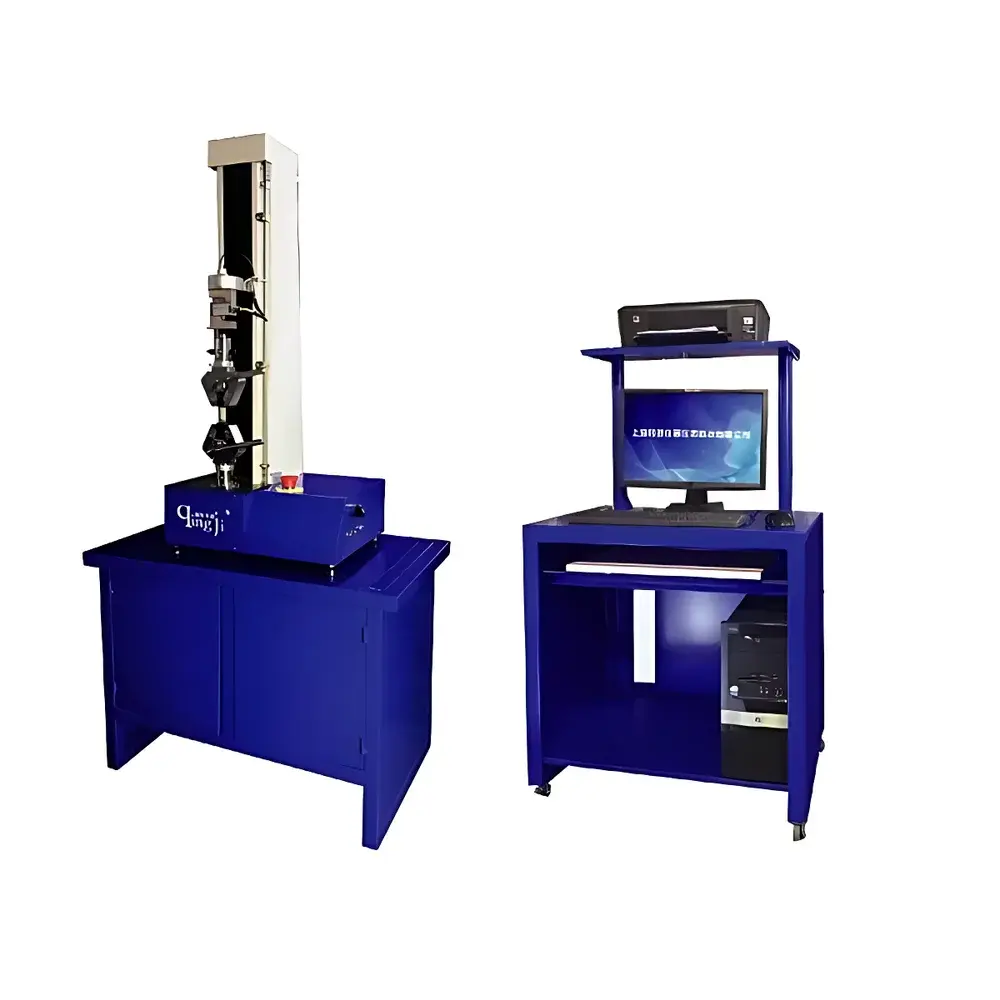
Qinsun QJ210 Compact Electromechanical Tensile Testing Machine
| [Brand | Qinsun |
|---|---|
| Origin | Shanghai, China |
| Model | QJ210 |
| Max Test Load | 5000 N |
| Force Range | 1–5000 N (Full-Scale) |
| Force Accuracy | ±0.5% of reading |
| Crosshead Travel | 800 mm |
| Displacement Resolution | 0.001 mm |
| Speed Range | 0.01–300 mm/min |
| Speed Accuracy | ±0.5% of set value |
| Positional Repeatability | ±0.5% of reading |
| Load Cell | High-precision imported strain-gauge sensor (500,000-count resolution, no internal range switching) |
| Control System | Panasonic全数字交流伺服 controller with closed-loop feedback |
| Software | Fully digital, real-time control and analysis platform supporting constant load, constant strain, and constant displacement modes |
| Compliant Standards | GB/T, ISO 6892, ASTM E8/E21, JIS Z2241, DIN 50125, EN 10002, YY/T 0680, QB/T 2358, YB/T 5349] |
Overview
The Qinsun QJ210 Compact Electromechanical Tensile Testing Machine is a precision-engineered, benchtop-scale universal testing system designed for routine mechanical property evaluation of polymeric films, foils, textiles, adhesives, biomedical packaging, thin metallic strips, and elastomeric components. It operates on the principle of controlled uniaxial force application via a high-rigidity dual-column frame driven by a low-inertia AC servo motor coupled to a preloaded recirculating ball screw assembly. The system employs a calibrated load cell and optical encoder-based displacement sensing to deliver traceable, repeatable measurements of tensile strength, elongation at break, Young’s modulus, yield point, peel resistance, and puncture force — all in accordance with internationally recognized test methodologies. Its compact footprint (430 × 315 × 855 mm) and modular architecture make it suitable for QC laboratories, R&D centers, and contract testing facilities where space efficiency, operational consistency, and regulatory traceability are critical.
Key Features
- High-resolution force measurement: 500,000 internal data points across full 1–5000 N range; no auto-ranging or manual scaling required — ensures consistent resolution from 0.2% to 100% FS.
- Precise motion control: Adjustable crosshead speed from 0.01 to 300 mm/min with ±0.5% speed accuracy; dual-speed lift mechanism (fast/slow) for rapid positioning and fine-tuning.
- Robust mechanical design: Heavy-duty aluminum alloy frame with hardened steel guide rods and self-lubricating linear bearings; optimized for long-term stability and minimal thermal drift.
- Integrated safety architecture: Dual-layer protection including software-defined electronic limits, hardware-based emergency stop circuitry, overload cutoff (>110% FS), and automatic post-fracture halt.
- Real-time data acquisition: Synchronized sampling of force, displacement, and time at up to 1 kHz; raw data export in CSV and XML formats compatible with LIMS and ELN systems.
- Modular fixture interface: Standard M6 threaded mounting base supports quick-change grips for tensile, peel, shear, compression, and puncture configurations — customizable per material geometry and standard requirements.
Sample Compatibility & Compliance
The QJ210 accommodates specimens up to 150 mm wide and 300 mm active gauge length, enabling standardized testing of flexible packaging (e.g., aluminum foil, PET/PE laminates), medical device tubing, suture materials, battery separator films, and automotive interior trim. It supports specimen thicknesses ranging from 0.01 mm (ultra-thin barrier films) to 5 mm (reinforced composites), with optional extensometer integration for strain-critical applications. All test protocols align with ISO 6892-1 (metallic materials), ASTM D882 (thin plastic sheeting), ASTM D3330 (adhesive tape peel), ISO 11339 (peel strength of laminates), YY/T 0680.1 (surgical suture tensile performance), and GB/T 1040.3 (plastics — tensile testing of films and sheets). The system’s firmware and software comply with GLP documentation requirements, including audit-trail-enabled user authentication, timestamped parameter logging, and tamper-resistant result archiving.
Software & Data Management
The proprietary QinsunTest v4.x software provides a fully configurable, Windows-based interface for method definition, real-time visualization, statistical reporting, and compliance-ready documentation. Users define test sequences with programmable hold steps, ramp rates, and termination conditions (e.g., fracture detection via slope threshold or absolute load drop). The software implements full digital closed-loop control — maintaining target stress or strain rate within ±0.5% tolerance throughout dynamic loading. All test data are stored with metadata (operator ID, calibration certificate ID, environmental conditions if linked to optional external sensors), and reports conform to ISO/IEC 17025 documentation standards. Optional 21 CFR Part 11 compliance package includes electronic signatures, role-based access control, and immutable audit logs — validated for regulated environments in pharmaceutical packaging and medical device manufacturing.
Applications
- Quality assurance of flexible packaging: Peel strength of heat-sealed pouches (ASTM F904), puncture resistance of blister foil (ISO 11607-2), and tensile integrity of laminated labels (GB/T 7707).
- Biomedical material characterization: Tensile properties of surgical meshes (ISO 13485-aligned), suture breaking strength (USP ), and burst pressure of catheter balloons (ISO 10555-1).
- Electronics and energy: Adhesion testing of battery electrode coatings (ASTM D4145), tensile modulus of flexible PCB substrates, and delamination resistance of encapsulant films.
- Automotive interiors: Seatbelt webbing elongation (SAE J369), airbag fabric tear propagation (ISO 13937-2), and foam compression set (ISO 1856).
- R&D validation: Creep and relaxation behavior under constant load (ISO 899-1), cyclic fatigue of elastomers (ISO 10014), and temperature-dependent modulus mapping (with optional environmental chamber).
FAQ
What is the maximum specimen width supported by the QJ210?
The effective test width is 150 mm, accommodating standard film strips, adhesive tapes, and narrow composite coupons.
Does the system support ASTM E8/E21 metallic tensile testing?
Yes — when equipped with appropriate wedge-action grips and extensometer, the QJ210 meets ASTM E8/E21 requirements for non-proportional specimens up to 5 mm thickness.
Can test methods be exported and shared across multiple instruments?
Yes — method files (.qtm) are portable and interoperable between QJ210 units running identical firmware versions; version-controlled backups ensure method reproducibility.
Is third-party calibration certification available?
Qinsun provides NIST-traceable factory calibration certificates; users may engage ISO/IEC 17025-accredited external labs for periodic verification per internal QA policy.
What maintenance is required to sustain measurement accuracy?
Routine checks include load cell zero verification, crosshead alignment inspection, and lubrication of ball screw every 6 months; annual recalibration is recommended for GMP/GLP environments.



