
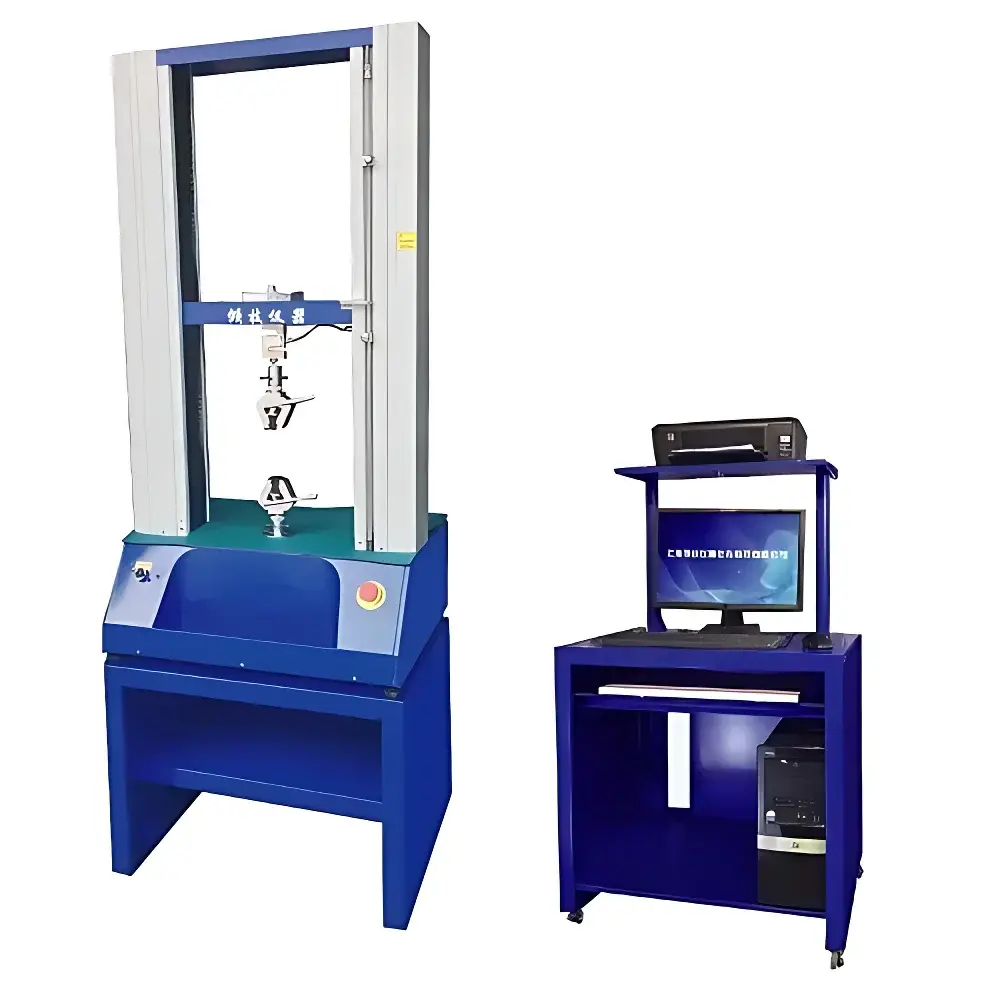
QJ211S Microcomputer-Controlled Spring Compression Testing Machine
| Origin | Shanghai, China |
|---|---|
| Manufacturer Type | Authorized Distributor |
| Country of Origin | China |
| Model | QJ211S |
| Price | USD 4,200 (FOB Shanghai) |
| Instrument Type | Electromechanical Universal Testing Machine |
| Load Capacity | 30 kN |
| Force Accuracy | Class 0.5 per ISO 7500-1 |
| Effective Force Range | 0.2%–100% of full scale |
| Force Resolution | 500,000 counts (no internal range switching, constant resolution across full range) |
| Effective Test Width | 320 mm |
| Effective Vertical Travel | 500 mm |
| Test Speed Range | 0.01–500 mm/min (standard configuration: 300 mm/min) |
| Speed Accuracy | ±0.5% of indicated value |
| Displacement Accuracy | ±0.5% of indicated value |
| Strain Measurement Accuracy | ±0.5% of indicated value |
| Motor Power | 400 W |
| Net Weight | 145 kg |
Overview
The QJ211S Microcomputer-Controlled Spring Compression Testing Machine is an electromechanical universal testing system engineered for high-reproducibility mechanical characterization of helical compression and tension springs, elastomeric components, leaf springs, and other quasi-linear elastic elements. It operates on the principle of controlled displacement actuation via a precision ball-screw-driven crosshead, with real-time load feedback from a calibrated S-type or column-type load cell. The system complies with fundamental static mechanical testing standards—including ISO 7500-1 (metallic materials — calibration of force-proving instruments), ISO 5893 (tensile and compressive testing machines — specification), and ASTM E4 (standard practices for force verification of testing machines). Designed for laboratory, QC, and production-line environments, it delivers traceable force-displacement data essential for spring design validation, batch release testing, and failure mode analysis in automotive, aerospace, medical device, and industrial equipment manufacturing.
Key Features
- Class 0.5 force accuracy certified per ISO 7500-1, ensuring metrological reliability for regulatory submissions and inter-laboratory comparisons.
- Full-scale 30 kN capacity with seamless 500,000-count force resolution—no auto-ranging or hardware switching required, eliminating step discontinuities in force curves.
- Adjustable test speed from 0.01 to 500 mm/min (standardized at 300 mm/min), programmable in discrete steps or continuous ramp profiles to replicate service loading conditions.
- Dual-speed manual control for crosshead positioning (fast jog + fine adjustment), coupled with electronic limit switches and mechanical end-stops for operator safety and specimen protection.
- Automated return-to-start functionality post-fracture or end-of-test, configurable via software logic or manual override.
- Overload protection triggered at 110% of full-scale load, initiating immediate motor shutdown and data logging interruption to preserve integrity of critical test records.
- Integrated microprocessor-based controller with USB/RS232 interface, enabling deterministic real-time sampling (≥100 Hz) and synchronized acquisition of load, displacement, and time stamps.
Sample Compatibility & Compliance
The QJ211S accommodates cylindrical, conical, and rectangular-section compression springs up to 320 mm wide and 500 mm tall. With interchangeable fixtures—including flat platens, spherical seats, and custom mandrels—it supports ISO 10243 (spring testing—general requirements), GB/T 25711 (Chinese national standard for spring mechanical property testing), and DIN EN 13906-1 (cylindrical helical compression springs). Optional extensometers enable direct strain measurement per ISO 9513 for modulus determination. All mechanical and electrical subsystems conform to CE marking directives (2006/42/EC Machinery Directive, 2014/30/EU EMC Directive) and meet IP20 environmental protection requirements for indoor laboratory use.
Software & Data Management
The bundled Windows-based testing software provides ISO/IEC 17025-aligned data handling: automatic zeroing prior to test initiation, real-time graphical display of force–displacement and stress–strain curves, and export of raw ASCII data (CSV/TXT) for third-party statistical analysis (e.g., Minitab, JMP). Audit trails record operator ID, timestamp, calibration history, and parameter modifications—supporting FDA 21 CFR Part 11 compliance when deployed with user authentication and electronic signature modules. Test reports are customizable (PDF/Excel), include pass/fail flags against user-defined limits (e.g., “load at 10 mm deflection ≥ 1,200 N”), and embed digital signatures for GLP/GMP documentation workflows.
Applications
- Verification of spring rate (N/mm), solid height, and set loss in OEM automotive suspension components.
- Compression fatigue pre-screening of medical-grade silicone elastomers used in implantable devices.
- Quality control of battery contact springs in consumer electronics assemblies.
- Characterization of hysteresis and relaxation behavior in polymer-based vibration isolators.
- Evaluation of yield point and permanent deformation in high-tensile steel leaf springs per SAE J1257.
FAQ
What standards does the QJ211S comply with for force calibration?
It meets ISO 7500-1 Class 0.5 requirements; annual verification using traceable deadweight or hydraulic calibrators is recommended.
Can the system perform cyclic compression testing?
Yes—software supports multi-step programs including hold periods, ramp reversals, and dwell cycles up to 999 repetitions.
Is remote diagnostics supported?
Via optional Ethernet module and secure VPN connection, enabling technical support teams to review controller logs and firmware status.
What is the warranty coverage for the load cell and controller?
Comprehensive 12-month parts-and-labor warranty; extended service contracts available for predictive maintenance and recalibration.
Does the system support integration with MES or LIMS platforms?
Yes—through OPC UA or TCP/IP API, enabling automated test initiation, result ingestion, and audit log synchronization.



