
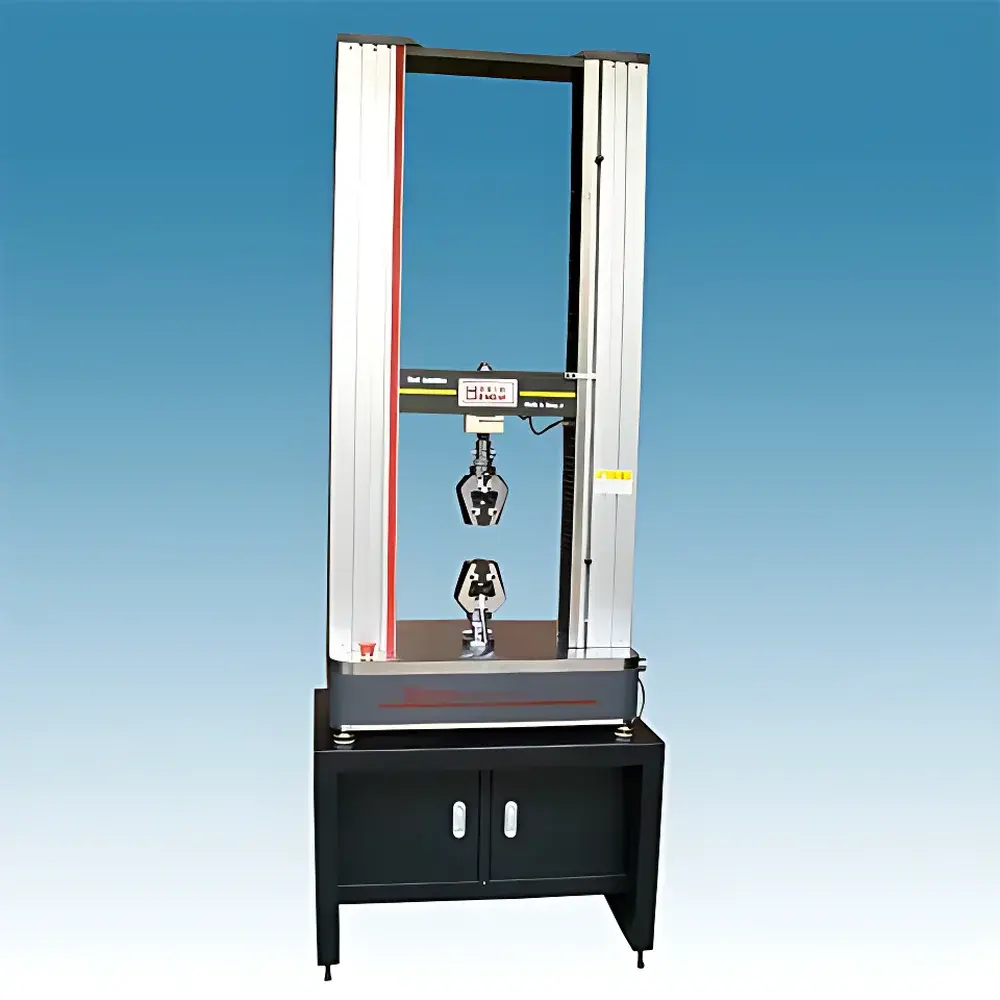
Hengyi HY-1080IOP Universal Testing Machine for Nylon Rope and Wire & Cable Tensile Testing
| Brand | Hengyi |
|---|---|
| Origin | Shanghai, China |
| Manufacturer Type | Direct Manufacturer |
| Country of Origin | China |
| Model | HY-1080IOP |
| Instrument Type | Electromechanical Universal Testing Machine |
| Maximum Load Capacity | 10 kN |
| Load Accuracy | Class 0.5 |
| Measurement Range | 0.001–100% of selected transducer full scale |
| Control Mode | Full PC-based control |
| Effective Width | 380 mm (expandable) |
| Effective Stroke | 800 mm (extendable) |
| Test Speed Range | 0.001–500 mm/min (infinitely variable, customizable up to higher speeds) |
| Speed Accuracy | ±0.5% |
| Displacement Accuracy | ±0.5% |
| Strain/Deformation Accuracy | ±0.5% |
| Safety Features | Electronic limit switches, emergency stop button |
| Unit Weight | ~210 kg |
| Power Supply | 220 V AC |
| Mainframe Dimensions | 700 × 420 × 1600 mm (W × D × H) |
| Software | HYtestV7.0 multi-language test control platform supporting 9 languages and unit systems (N, kN, lbf, kgf, tonf, etc.) |
Overview
The Hengyi HY-1080IOP Universal Testing Machine is an electromechanical static testing system engineered for high-reproducibility tensile, compressive, flexural, peel, and tear evaluations of polymeric, metallic, and composite materials—particularly optimized for nylon rope, wire & cable assemblies, and insulated conductors. Based on closed-loop servo-controlled load cell feedback and precision ball-screw actuation, the system complies with fundamental mechanical testing principles defined in ISO 6892-1 (metallic materials), ASTM D638 (plastics), ASTM D412 (rubber), and IEC 60811 (electric cables). Its rigid aluminum-guarded frame ensures minimal deflection under load, while the integrated 10 kN capacity load cell enables accurate quantification of yield strength, ultimate tensile strength (UTS), elongation at break, Young’s modulus, and proof stress across diverse specimen geometries.
Key Features
- Class 0.5 load accuracy per ISO 7500-1, validated traceably to national metrological standards
- Wide dynamic test speed range: 0.001–500 mm/min, adjustable in real time with ±0.5% speed fidelity
- Full PC-driven operation via HYtestV7.0 software—supporting 9 interface languages and 6 force units (N, kN, lbf, kgf, tf, kP)
- Simultaneous acquisition and synchronization of load, large deformation (extensometer), small deformation (strain gauge), and crosshead displacement
- Automated test logic: programmable fracture detection, auto-return-to-initial-position, and multi-condition termination (time-, load-, or displacement-based)
- Expandable mechanical envelope: standard 380 mm test width and 800 mm stroke—customizable for oversized specimens or specialized fixtures
- Dual-channel safety architecture: hardware-level electronic limit switches + front-panel emergency stop with fail-safe circuit interruption
Sample Compatibility & Compliance
The HY-1080IOP accommodates a broad spectrum of specimen types—including monofilament nylon ropes (1–12 mm diameter), stranded copper/aluminum conductors, armored and fire-resistant cables (e.g., mineral-insulated, LSZH, halogen-free), optical fiber ribbons, and textile-reinforced polymer tapes. Fixture options include pneumatic wedge grips, pin-and-slot clamps, and custom-designed cable anchoring jaws to minimize slippage and ensure axial alignment. The system meets essential regulatory requirements for quality assurance in cable manufacturing environments, including compliance with GB/T 2951 (Chinese national standard), IEC 60227/60245 (cable mechanical tests), UL 1581 (wire & cable reference standard), and supports audit-ready documentation for GLP/GMP-aligned laboratories. All calibration certificates conform to ISO/IEC 17025 traceability protocols.
Software & Data Management
HYtestV7.0 serves as the core analytical engine, built on VB.NET and SQL Server architecture for deterministic data handling and long-term integrity. It provides real-time plotting with automatic axis scaling, post-test curve annotation (yield point, elastic region, necking onset), and parameter extraction using standardized algorithms per ASTM E8/E8M and ISO 527-2. Users may define custom test methods—including multi-step cyclic loading, creep hold sequences, or conditional branching logic—and export results in CSV, PDF, or XML formats compatible with LIMS integration. Audit trails record operator ID, timestamp, method version, and raw data checksums—enabling full 21 CFR Part 11 compliance when deployed with Windows domain authentication and digital signature modules.
Applications
- Tensile characterization of nylon monofilament and braided ropes per ISO 2062 and ASTM D2256
- Mechanical validation of overhead conductors (ACSR, AAAC) under simulated service loads
- Breaking strength and elongation assessment of telecom drop cables, submarine power cables, and railway signaling wires
- Compression testing of cable jackets and insulation layers per IEC 60811-501
- Peel strength evaluation of laminated sheaths and adhesive-bonded armor tapes
- Flex-life endurance testing of portable cords and robotic cables using programmable bend cycles
- Quality control screening in cable extrusion lines, stranding plants, and final assembly facilities
FAQ
What is the maximum allowable specimen thickness for standard wedge grips?
Standard pneumatic wedge grips accommodate specimens up to 15 mm thick; custom jaw inserts are available for thicker or irregular cross-sections.
Can the system perform constant-rate-of-travel (CRT) and constant-rate-of-load (CRL) tests?
Yes—HYtestV7.0 supports both modes, with CRL implemented via real-time PID load regulation and verified against ISO 7500-1 linearity criteria.
Is third-party calibration certification included with delivery?
A factory-issued calibration report traceable to CNAS-accredited standards is provided; optional UKAS or DAkkS-certified calibration is available upon request.
Does the software support automated report generation compliant with ISO 17025?
Yes—templates can be configured to embed laboratory accreditation identifiers, uncertainty budgets, and instrument metadata directly into exported PDF reports.
What maintenance intervals are recommended for optimal long-term accuracy?
Biannual verification of load cell linearity and displacement encoder resolution is advised; annual mechanical inspection of drive train components and grip alignment is required per manufacturer guidelines.



