
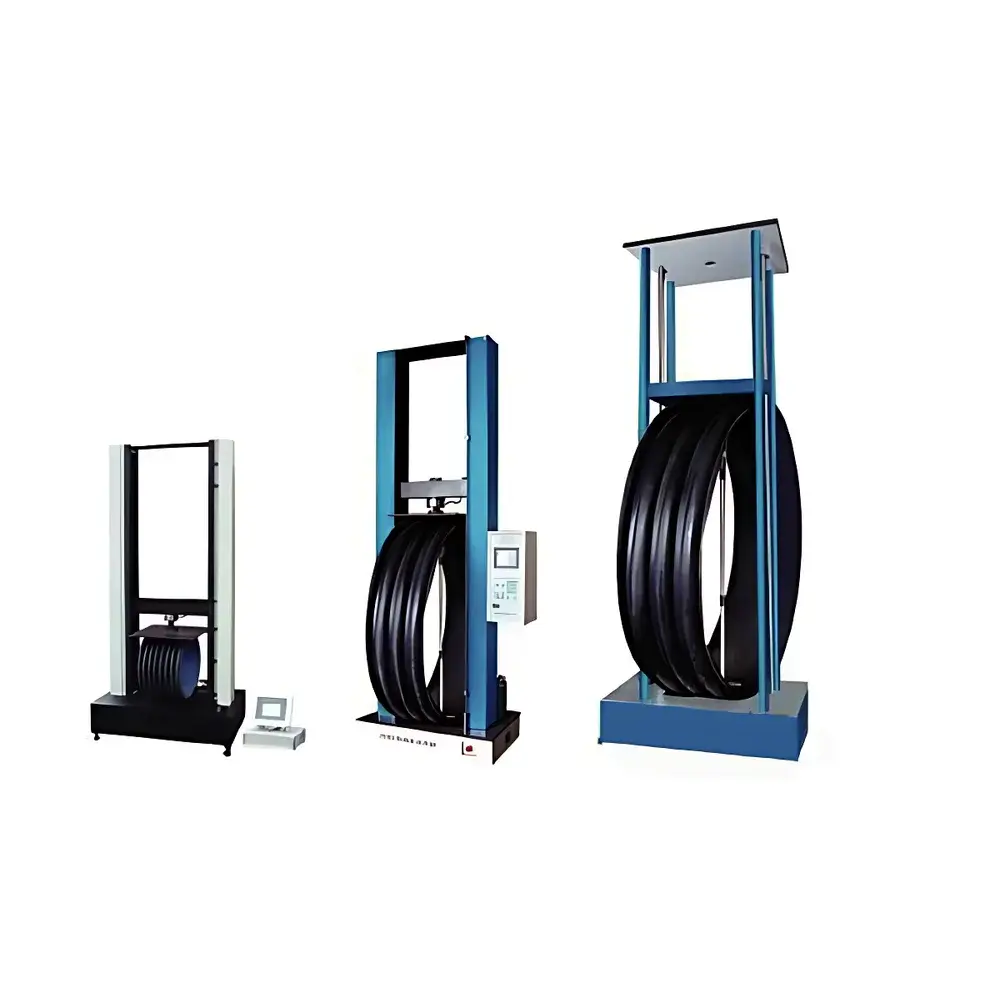
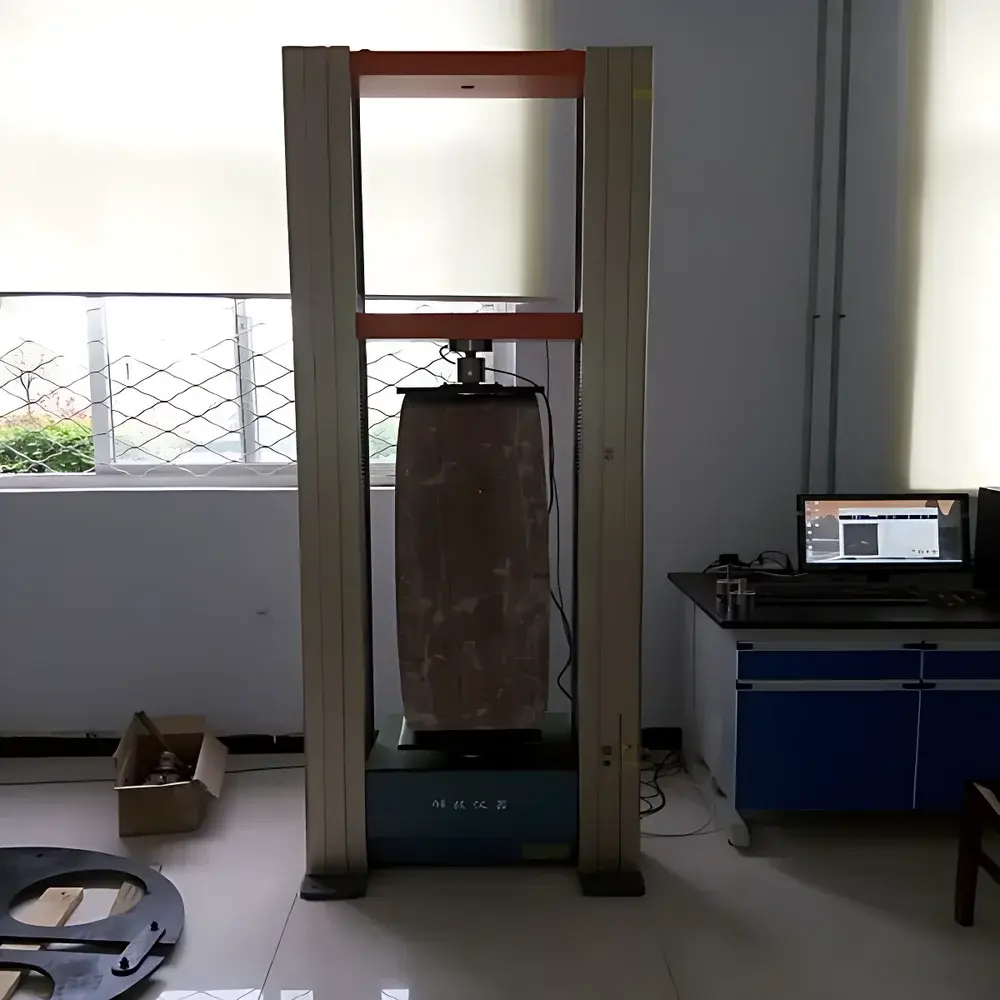
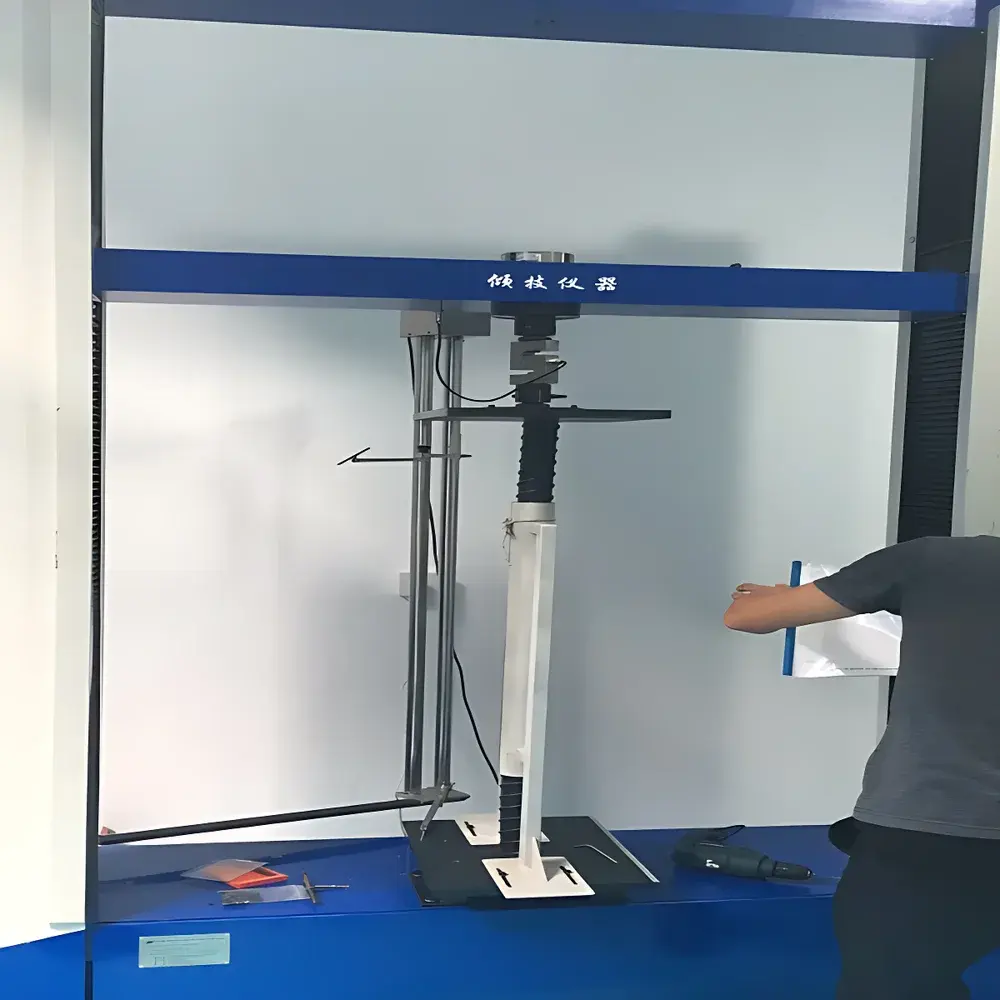
Qinji QJ215 Bellows Ring Stiffness Testing Machine
| Brand | Qinji |
|---|---|
| Origin | Shanghai, China |
| Manufacturer Type | Authorized Distributor |
| Regional Classification | Domestic (China-Made) |
| Model | QJ215 |
| Price Range | USD 7,000 – 14,000 |
| Load Capacity | 50 / 100 / 200 / 300 / 500 kN |
| Max. Specimen Diameter | ≤ Φ5000 mm |
| Accuracy Class | Class 1 / Class 0.5 |
| Test Speed Range | 0.01–1000 mm/min (Standard Default: 300 mm/min) |
| Load Measurement Accuracy | ±1% (±0.5%) of Full Scale |
| Speed Accuracy | ±0.5% (±0.15%) of Indicated Value |
| Displacement Resolution | 0.01 mm |
| Control Interface | Full Chinese GUI with PC-based real-time curve plotting, data auto-storage, and report printing |
| Optional Accessories | Internal Diameter Deformation Measurement Kit for Smooth-wall & Corrugated Pipes |
| Multi-function Capability | Compatible with Universal Testing Machine (UTM) fixtures for compression, bending, and tensile testing per ASTM D2412, ISO 9969, EN 1446, and GB/T 9647 |
Overview
The Qinji QJ215 Bellows Ring Stiffness Testing Machine is a high-precision, vertically oriented universal testing system engineered specifically for structural evaluation of flexible conduits—including corrugated plastic pipes, glass-fiber-reinforced polymer (GRP) ducts, metal bellows, and composite tubular products—under controlled radial compression. It operates on the principle of diametral compression deformation, applying axial load to a pipe segment supported on two parallel knife-edge anvils while measuring vertical displacement and reaction force in accordance with standardized ring stiffness calculation methodology (defined as *S = (F × L) / (δ × D)*, where *F* is applied load, *L* is specimen length, *δ* is deflection, and *D* is mean diameter). Designed for compliance with international test standards including ASTM D2412 (Standard Test Method for Determination of Pipe Stiffness), ISO 9969 (Thermoplastics Pipes — Determination of Ring Stiffness), EN 1446 (Plastics Piping Systems for Non-Pressurized Underground Drainage and Sewerage), and China’s GB/T 9647, the QJ215 delivers traceable, repeatable mechanical characterization essential for quality assurance in infrastructure, municipal engineering, and industrial conduit manufacturing.
Key Features
- Modular four-column or six-column frame architecture supporting load capacities from 50 kN up to 500 kN, enabling scalable application across small-diameter utility conduits and large-diameter stormwater drainage pipes.
- High-resolution displacement measurement with 0.01 mm resolution, coupled with dual-accuracy load cells (Class 1 or optional Class 0.5) certified to ISO 7500-1 and verified per ASTM E4.
- Dedicated internal diameter deformation measurement kit—comprising non-contact LVDTs or precision contact gauges—ensures accurate δ-value acquisition for both smooth-wall and multi-peak corrugated profiles, critical for valid ring stiffness derivation.
- Full-range speed control (0.01–1000 mm/min), with standard operation at 300 mm/min per ISO 9969 requirements; speed accuracy maintained within ±0.5% (±0.15% optional) of setpoint.
- Integrated PC-based control system featuring real-time load–displacement curve visualization, automatic parameter extraction (peak load, yield point, ring stiffness, secant modulus), and export-ready reporting compliant with GLP documentation practices.
- Universal fixture compatibility allows seamless transition between ring stiffness, compressive strength, three-point bending, and flat crush tests—eliminating need for secondary instrumentation.
Sample Compatibility & Compliance
The QJ215 accommodates specimens up to Φ5000 mm in outer diameter, making it suitable for full-scale testing of HDPE, PVC-U, PP, GRP, stainless steel, and aluminum bellows used in cable protection, post-tensioning systems, and HVAC applications. Its mechanical design conforms to ISO 7500-1 (static calibration of force-proving instruments), ISO 5893 (tensile/compression testing machines), and JJG 139–2014 (Chinese national verification regulation for material testing machines). All software-generated reports include audit trails, user authentication logs, and timestamped metadata—supporting FDA 21 CFR Part 11 readiness when configured with electronic signature modules.
Software & Data Management
The proprietary Windows-based control software provides bilingual interface support (English/Chinese), programmable test sequences, and automated pass/fail evaluation against user-defined limits. Raw data is stored in encrypted .CSV and .XLSX formats with embedded metadata (operator ID, calibration date, environmental conditions). Curve overlays, statistical batch analysis, and trend charting are available for long-term quality monitoring. Data integrity safeguards include write-once storage options, role-based access control, and configurable backup intervals to network drives or NAS devices.
Applications
- Ring stiffness verification of pre-stressed concrete ducts and corrugated metal hose assemblies per ASTM A993 and EN 13417.
- Structural validation of underground drainage pipes during third-party certification (e.g., WRAS, KIWA, CSTB).
- R&D testing of novel composite pipe geometries under simulated soil-load conditions.
- Production line QA/QC for manufacturers supplying municipal water and wastewater infrastructure projects.
- Failure mode analysis of deformed or collapsed conduits via post-yield deformation profiling.
FAQ
What standards does the QJ215 comply with for ring stiffness testing?
ASTM D2412, ISO 9969, EN 1446, GB/T 9647, and DIN 16961.
Can the system measure deformation of highly irregular corrugated profiles?
Yes—the optional internal diameter deformation kit includes adjustable probe arms and multi-point contact sensors calibrated for peak-to-valley geometry tracking.
Is the software compliant with regulatory data integrity requirements?
When deployed with audit trail logging, electronic signatures, and secure user authentication, it supports FDA 21 CFR Part 11 and EU Annex 11 compliance frameworks.
What maintenance is required during the first year of operation?
Annual calibration verification is recommended; mechanical components require only routine lubrication and visual inspection per the maintenance schedule provided in the operator manual.
Does the system support remote diagnostics or firmware updates?
Yes—via encrypted HTTPS-based connection to authorized service portals, subject to customer-configured firewall policies and IT security protocols.



