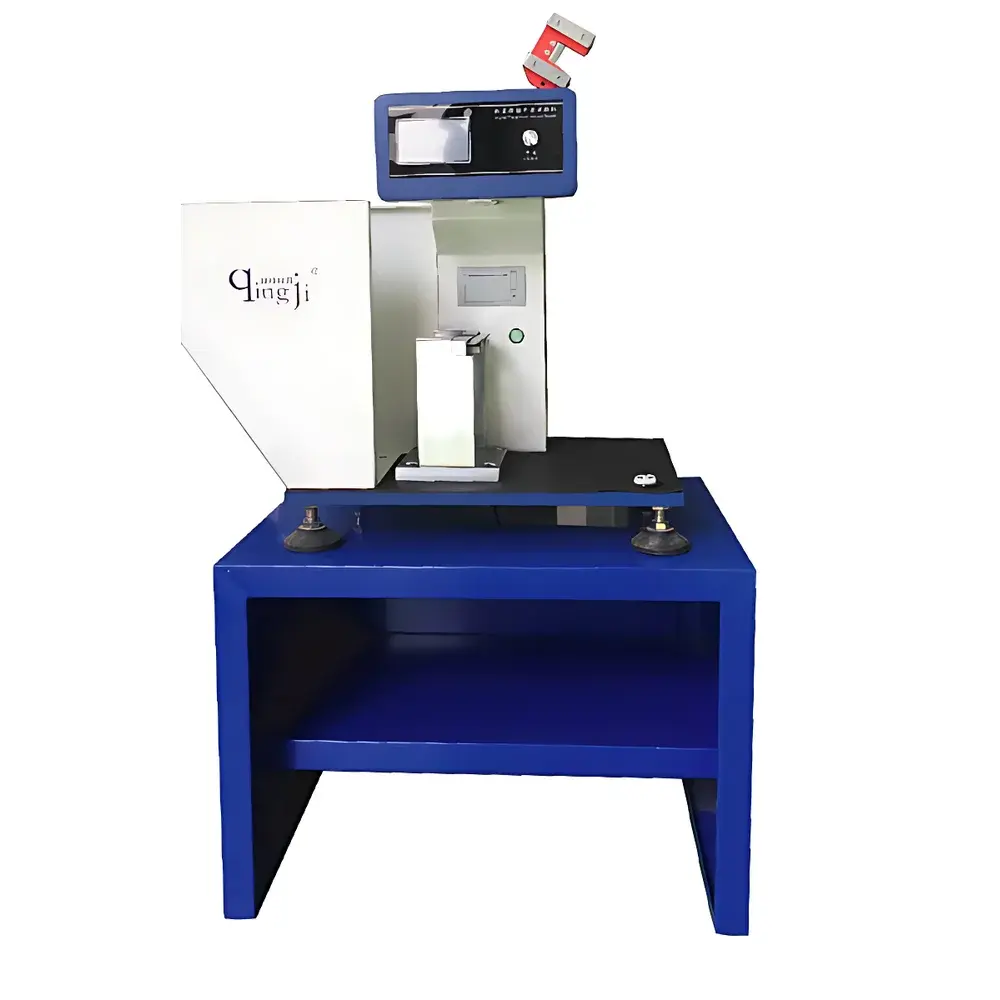
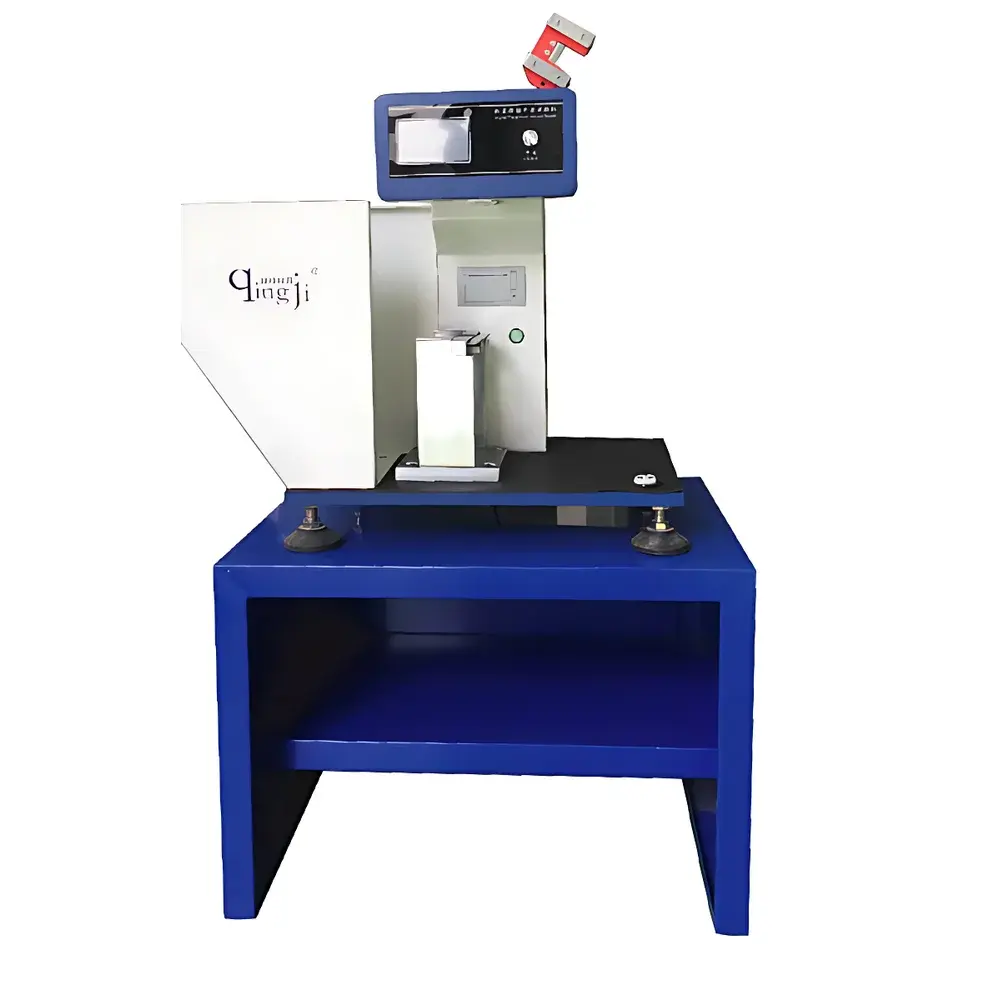
Qinji QJBCJ Series Simply-Supported Beam Impact Tester for Pipes and Plastic Materials
| Brand | Qinji |
|---|---|
| Origin | Shanghai, China |
| Model | QJBCJ- |
| Impact Energy Range | 5 J, 7.5 J, 15 J, 25 J, 50 J |
| Impact Velocity | 2.9 m/s |
| Pendulum Pre-Lift Angle | 160° |
| Distance from Pendulum Axis to Specimen Center | 230 mm |
| Support Span Options | 40 mm, 60 mm, 70 mm, 95 mm |
| Notch Knife Edge Angle | 30° |
| Knife Edge Radius | 2 mm |
| Anvil Radius | 1 mm |
| Dimensions (L×W×H) | 280 × 250 × 500 mm |
| Net Weight | 50 kg |
| Compliance | GB/T 1043, ISO 179-1, ISO 9854-1, DIN 8078, DIN 53453 |
Overview
The Qinji QJBCJ Series Simply-Supported Beam Impact Tester is a precision mechanical testing instrument engineered for the quantitative determination of impact resistance and notch sensitivity in rigid thermoplastic and thermosetting materials—including pipes, profiles, sheets, and composite specimens. It operates on the classical Charpy-type simply-supported beam principle: a pendulum of calibrated mass and length strikes a notched specimen supported at two fixed points, and the energy absorbed during fracture is calculated from the difference between initial and residual pendulum potential energy. This method delivers high reproducibility for comparative evaluation of material toughness under standardized loading conditions. Designed specifically for pipe and profile geometries, the QJBCJ accommodates variable support spans (40 mm, 60 mm, 70 mm, and 95 mm) to align with dimensional requirements across international standards. Its robust cast-iron base, low-friction pendulum bearing system, and precisely machined anvil/knife assembly ensure minimal energy loss and long-term measurement stability—critical for laboratories performing routine quality control or research-grade polymer characterization.
Key Features
- Modular support span configuration (40/60/70/95 mm) enables compliance with multiple standard test configurations for pipes, rods, and flat specimens.
- Five selectable impact energy levels (5 J, 7.5 J, 15 J, 25 J, 50 J) accommodate diverse material stiffnesses—from thin-walled PVC conduits to reinforced fiberglass composites.
- Precision-ground impact knife with 30° included angle and 2 mm tip radius meets ISO 179-1 and GB/T 1043 geometric tolerances.
- Calibrated anvil with 1 mm rounding radius ensures consistent specimen seating and minimizes stress concentration artifacts.
- Optimized pendulum geometry: 230 mm axis-to-specimen center distance and 160° pre-lift angle yield nominal impact velocity of 2.9 m/s—within ±0.1 m/s tolerance per ISO calibration protocols.
- Compact footprint (280 × 250 × 500 mm) and 50 kg net weight facilitate integration into constrained lab spaces without compromising structural rigidity.
Sample Compatibility & Compliance
The QJBCJ supports standardized specimens per ISO 179-1 Type 1a (notched bars), ISO 9854-1 (plastic pipes), and GB/T 1043 (Chinese national standard for rigid plastics). It accepts pipe specimens up to Ø110 mm outer diameter when mounted on custom V-block fixtures (available as optional accessories). The tester is fully compliant with ASTM D6110 (though primarily designed for ISO/GB methods), and its mechanical design satisfies the dimensional and kinetic requirements of DIN 8078 (for PVC pipes) and DIN 53453 (impact testing of plastics). All critical components—including pendulum mass distribution, knife edge geometry, and support span accuracy—are traceable to national metrology institutes via factory calibration certificates. The system is suitable for GLP-compliant environments where documented instrument qualification (IQ/OQ) and periodic verification are required.
Software & Data Management
While the base QJBCJ model operates as a manual analog instrument with digital angle encoder and energy readout, optional PC-based data acquisition modules (sold separately) provide full audit trail functionality. These modules record impact energy, pendulum swing angle, time-stamped test events, and operator ID—supporting 21 CFR Part 11–compliant electronic records when paired with user-access controls and electronic signatures. Raw data export is available in CSV and XML formats for integration with LIMS platforms. Calibration history, maintenance logs, and certificate expiration alerts are managed within the software interface, facilitating internal audits and regulatory inspections under ISO/IEC 17025 frameworks.
Applications
- Quality assurance of extruded plastic pipes (PVC-U, PP-R, PE-RT) in manufacturing plants.
- Comparative toughness screening of polymer blends and fiber-reinforced composites in R&D labs.
- Failure analysis of brittle fracture modes in ceramic matrix composites and cast stone materials.
- Evaluation of aging effects (UV, thermal, hydrolytic) on impact performance of engineering plastics.
- Third-party certification testing for CE marking, CCC, and RoHS-compliant product declarations.
- Teaching laboratories demonstrating fundamental principles of fracture mechanics and energy absorption.
FAQ
Does the QJBCJ comply with ISO 179-1:2019 for notched impact testing?
Yes—the pendulum geometry, knife edge specifications, support span options, and energy calibration procedures are fully aligned with ISO 179-1:2019 Annex A requirements.
Can the tester be used for non-standard pipe diameters beyond Ø110 mm?
Custom support fixtures and alignment jigs are available upon request; however, results must be reported with explicit reference to non-standard geometry per ISO 179-2 guidelines.
Is factory calibration traceable to NIM or other national standards?
Each unit ships with a traceable calibration certificate issued by Shanghai Institute of Measurement and Testing Technology (SIMT), accredited to ISO/IEC 17025.
What maintenance intervals are recommended for long-term accuracy?
Pendulum bearing lubrication and knife edge inspection are advised every 500 tests; annual recalibration is recommended for ISO/IEC 17025-accredited laboratories.
Are consumables such as replacement knives and anvils available separately?
Yes—original-specification knife edges (30°, R2 mm), anvils (R1 mm), and calibration weights are stocked and shipped globally with documented lot traceability.