
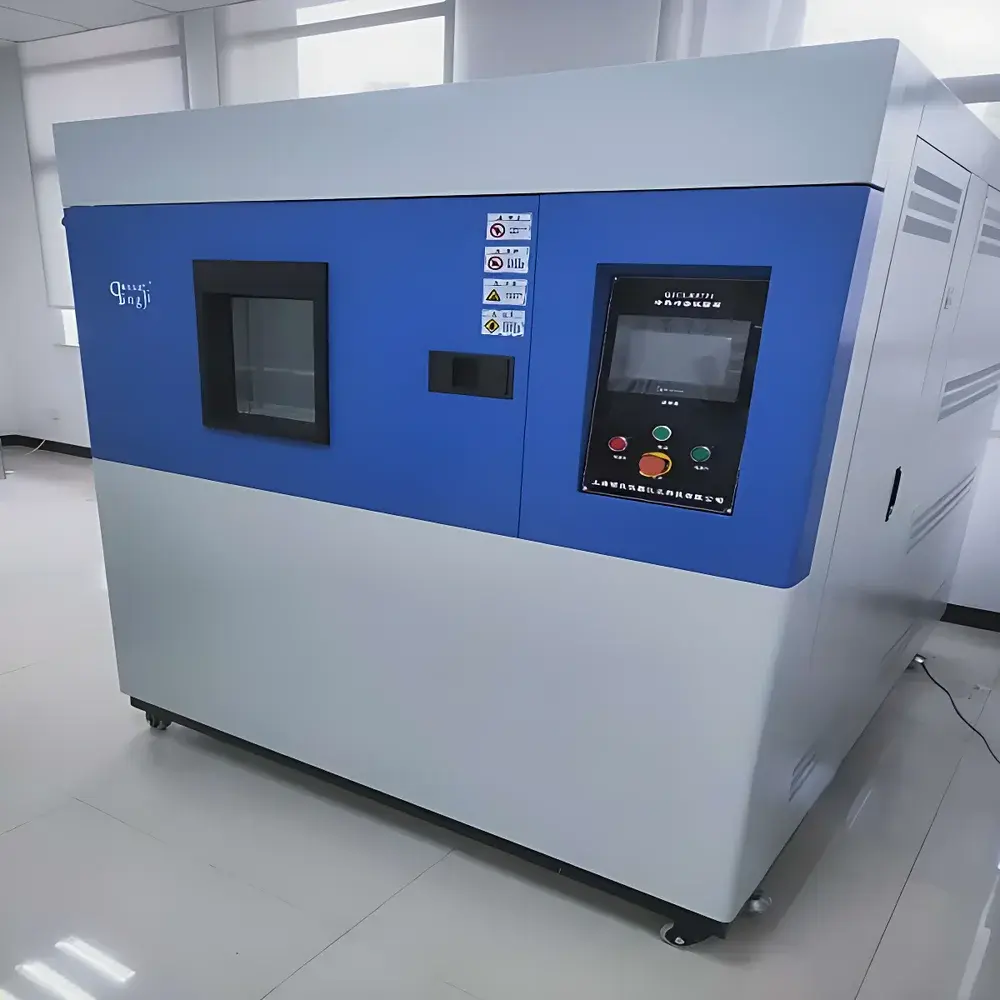
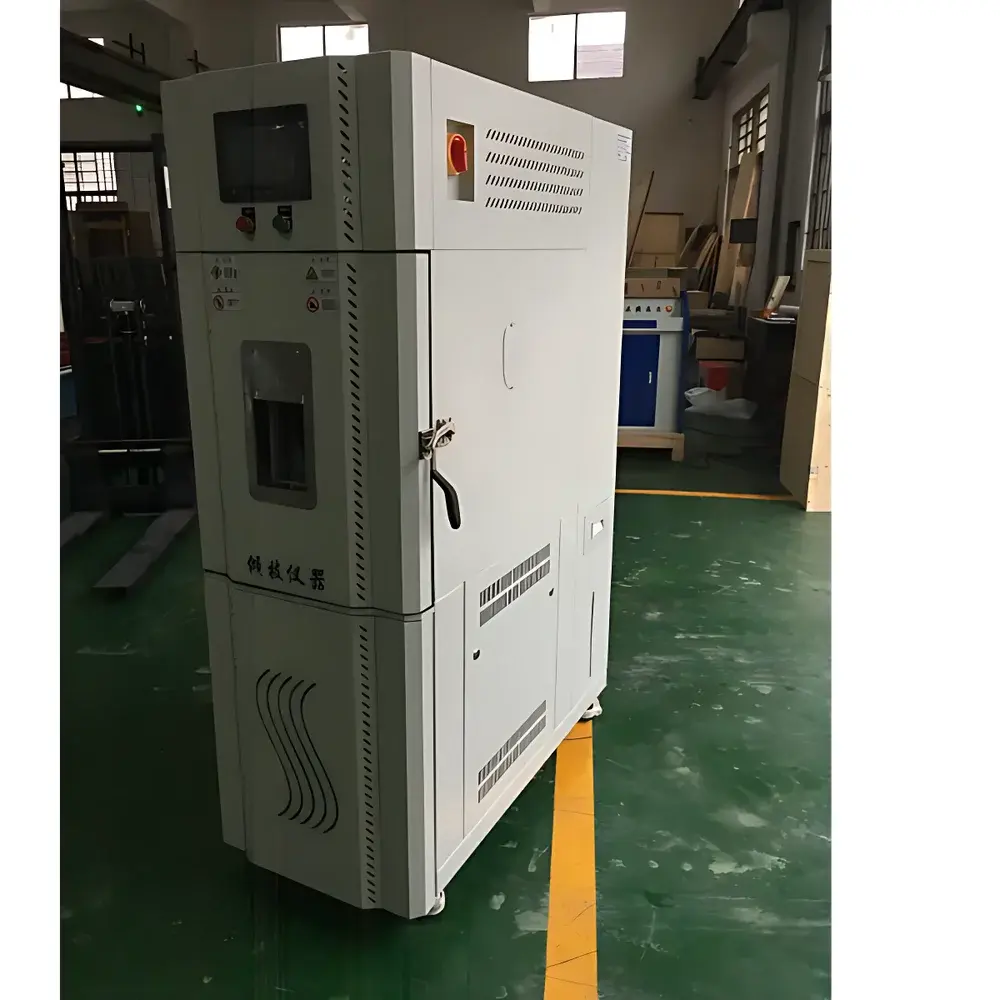
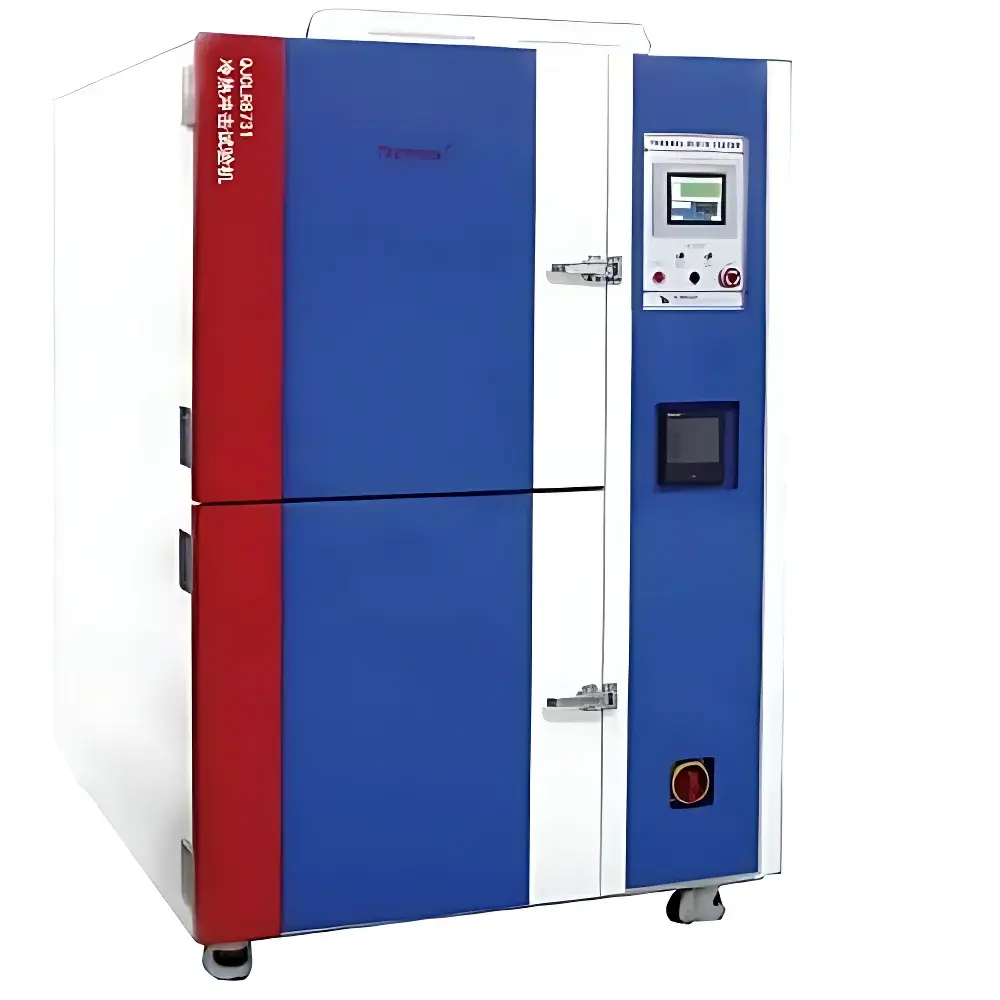
Qinji QJCLR8731 Thermal Shock Test Chamber
| Brand | Qinji |
|---|---|
| Origin | Shanghai, China |
| Model | QJCLR8731 |
| High-Temperature Range | +80 °C to +200 °C |
| Low-Temperature Range | −10 °C to −70 °C (optional: −65 °C or −75 °C) |
| Thermal Shock Zone | +60 °C to +150 °C (hot zone), −10 °C to −40 °C (cold zone) |
| Temperature Stability | ±2 °C |
| Temperature Uniformity | ±2 °C |
| Recovery Time | 5 min |
| Heating Time | 40 min |
| Cooling Time | 60–90 min |
| Controller | 7.5″ color LCD touchscreen with bilingual (Chinese/English) interface |
| Safety Protections | Fuseless circuit breaker, compressor high-pressure/overheat/overcurrent protection, overtemperature cutoff, fan overload protection |
Overview
The Qinji QJCLR8731 Thermal Shock Test Chamber is an engineered environmental test system designed to evaluate material integrity and structural reliability under rapid, repetitive transitions between extreme temperature extremes. Based on the two-zone (hot/cold) pneumatic transfer principle, the chamber subjects test specimens to abrupt thermal excursions—typically within seconds—mimicking real-world operational stresses such as aerospace component cycling, automotive electronics deployment, or semiconductor packaging validation. Unlike steady-state temperature chambers, the QJCLR8731 emphasizes transient thermal loading, enabling quantification of failure modes linked to coefficient-of-thermal-expansion (CTE) mismatch, interfacial delamination, solder joint fatigue, and microcrack propagation. Its architecture complies with fundamental thermal shock test methodology defined in IEC 60068-2-14, while supporting alignment with derivative national standards including GB/T 2423.1–2001, GB/T 2423.2–2001, GJB 150.5A–2009, and GB 10592–2008.
Key Features
- Independent dual-zone configuration: segregated hot and cold chambers with mechanical transfer shuttle for sub-5-second specimen transition
- Wide operational range: hot zone up to +200 °C; cold zone down to −70 °C (configurable to −65 °C or −75 °C upon specification)
- Precision temperature control: ±2 °C stability and uniformity across both zones, verified per ISO 17025-accredited calibration protocols
- Intuitive 7.5-inch full-color LCD touchscreen controller with bilingual (English/Chinese) menu navigation, real-time trend graphing, and programmable multi-step profiles
- Robust safety architecture: integrated protections include fuseless main disconnect, compressor high-pressure cutout, overtemperature limiter, fan motor overload sensing, and phase-loss monitoring
- Standard accessories: two adjustable stainless-steel sample racks and one 50-mm diameter cable/port access opening with silicone gasket seal
Sample Compatibility & Compliance
The QJCLR8731 accommodates rigid and semi-rigid specimens up to 300 mm × 300 mm × 250 mm (W×D×H) and weighing ≤15 kg. It supports testing of metallic alloys, thermoplastics, elastomers, PCB assemblies, MEMS devices, and coated optical substrates. All thermal shock cycles are traceable via onboard event logging, with timestamped temperature records aligned to GLP-compliant data integrity requirements. The system is compatible with external data acquisition interfaces (RS-485, Ethernet optional) for integration into centralized lab management platforms. While not pre-certified to UL or CE for standalone safety compliance, its design adheres to the mechanical and electrical safety principles outlined in IEC 61010-1:2010 for laboratory equipment.
Software & Data Management
The embedded controller firmware enables creation and storage of up to 100 user-defined test programs, each supporting up to 99 segments with independent ramp rates, dwell times, and cycle counts. Real-time data—including chamber setpoints, actual temperatures (hot/cold zones), transfer timing, and alarm status—is logged at configurable intervals (1–60 s) and exportable via USB flash drive in CSV format. Audit trail functionality records operator login, parameter changes, and emergency stops—supporting basic 21 CFR Part 11 readiness when paired with institutional identity management policies. Remote monitoring is achievable through optional Modbus TCP gateway modules, facilitating integration with SCADA or LIMS environments.
Applications
- Qualification testing of avionics housings per MIL-STD-810H Method 503.6
- Reliability screening of automotive ECUs exposed to under-hood thermal transients
- Failure analysis of solder interconnects in lead-free BGA packages
- Validation of adhesive bond strength in multi-material battery enclosures
- Accelerated aging studies for polymer-based medical device housings (ISO 10993-12)
- Pre-release stress screening of photovoltaic module laminates and junction boxes
FAQ
What is the typical thermal transfer time between zones?
The mechanical shuttle transfers samples between hot and cold chambers in ≤5 seconds—critical for achieving true thermal shock conditions per IEC 60068-2-14.
Can the QJCLR8731 be configured for custom temperature ranges?
Yes—while standard configurations cover −70 °C to +200 °C, optional refrigeration upgrades support −75 °C cold zone operation; high-temperature extension to +220 °C is available upon engineering review.
Is calibration documentation included with shipment?
Each unit ships with a factory calibration certificate covering temperature sensors in both zones, validated against NIST-traceable reference standards at three points per zone.
Does the system support automated reporting for quality audits?
Yes—the controller exports time-stamped CSV logs containing all critical parameters; users may generate summary reports externally using Excel or statistical process control (SPC) software.
What maintenance is required during the first year of operation?
Routine tasks include monthly condenser coil cleaning, quarterly verification of door gasket integrity, and annual refrigerant pressure and oil level checks by authorized service personnel.



