
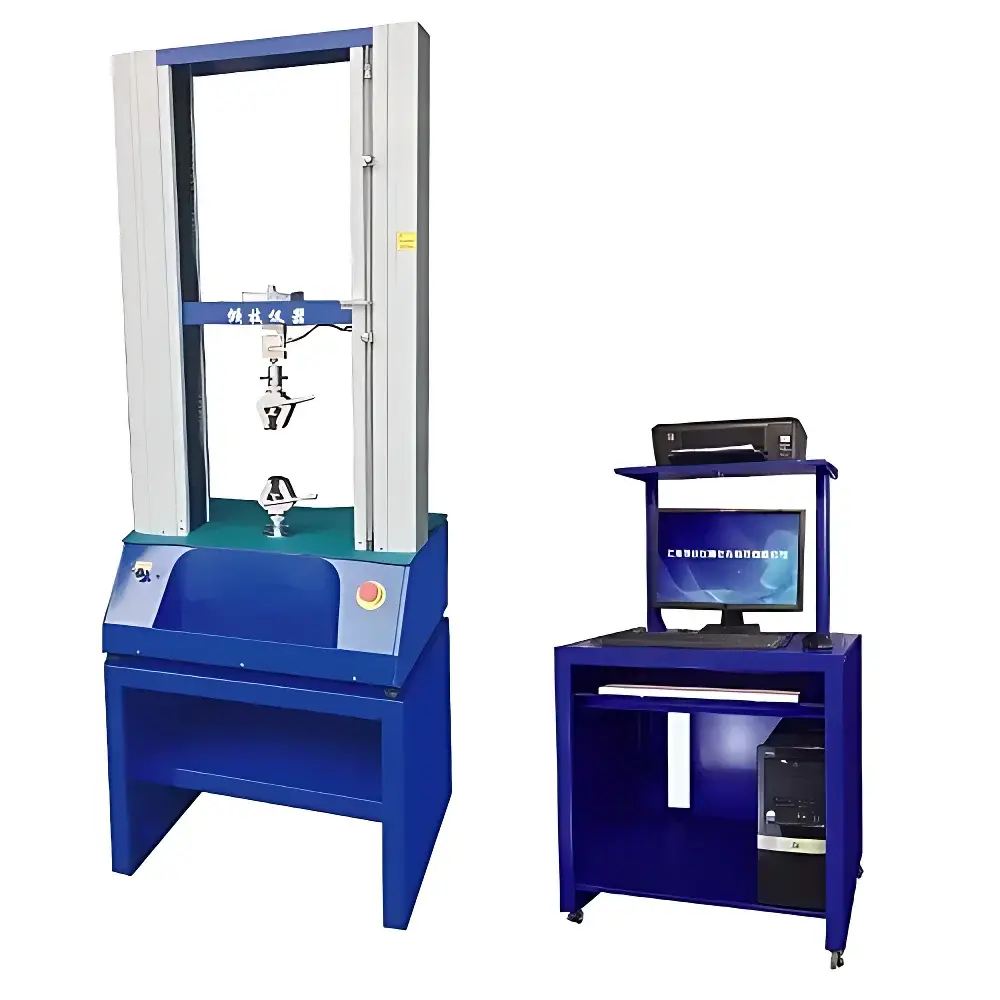
Qingji QJ211S Electronic Tensile Testing Machine for Insulators
| Brand | Qingji |
|---|---|
| Origin | Shanghai, China |
| Model | QJ211S |
| Instrument Type | Electronic Tensile Testing Machine |
| Maximum Test Load | 30 kN |
| Load Range | 0–30 kN (fully adjustable) |
| Load Accuracy | ±0.5% of full scale |
| Test Stroke | 500 mm |
| Displacement Resolution | ±0.5% of reading |
| Load Cell Resolution | 500,000 counts (single-range, no auto-ranging) |
| Effective Test Width | 460 mm |
| Effective Vertical Test Space (excl. fixtures) | 1500 mm |
| Test Speed Range | 0.001–1000 mm/min (continuously adjustable) |
| Speed Accuracy | ±0.5% of set value |
| Displacement Measurement Accuracy | ≤±0.2% of reading |
| Deformation Measurement Accuracy | ≤±0.2% of reading |
| Noise Level | ≤76 dB(A) |
| Continuous Operational Duty Cycle | ≥2000 h |
| Critical Component Service Life | ≥8000 h |
| Overload Protection | Activates at >110% of full-scale load |
| Motor Power | 0.75 kW |
| Dimensions (W×D×H) | ≈670×600×2220 mm |
| Net Weight | ≈195 kg |
Overview
The Qingji QJ211S Electronic Tensile Testing Machine is a precision-engineered universal testing system specifically configured for mechanical characterization of high-voltage insulators and related composite dielectric components. Designed in accordance with fundamental principles of uniaxial static loading per ASTM D412, ISO 527-1, and IEC 60383-1, the system applies controlled tensile, compressive, and flexural forces to evaluate structural integrity, load-bearing capacity, and failure behavior under simulated service conditions. Its rigid dual-column frame, servo-controlled electromechanical actuation, and high-fidelity load cell architecture ensure repeatable force application across the full 0–30 kN range, supporting standardized evaluation of porcelain, glass, and polymeric insulator strings, suspension units, post-type insulators, and associated hardware such as clevis pins, ball sockets, and corona rings.
Key Features
- High-stability dual-column steel frame with reinforced base and crosshead guidance for minimal deflection during high-load testing
- 0.75 kW AC servo motor drive enabling precise speed control from 0.001 to 1000 mm/min with ±0.5% speed accuracy
- 500,000-count internal resolution load measurement system—no range switching required, maintaining consistent sensitivity across 0.02% to 100% of full scale
- Digital displacement encoder with ≤±0.2% linearity error over 500 mm stroke; integrated into closed-loop position feedback
- Programmable dual-speed manual control for rapid positioning and fine adjustment of crosshead height
- Comprehensive safety architecture: electronic travel limit switches, automatic overload cutoff (>110% FS), emergency stop circuitry, and mechanical anti-rotation guides
- Low-noise operation (≤76 dB(A)) suitable for shared laboratory environments without acoustic isolation requirements
- Robust thermal management and sealed drive train design supporting ≥2000 hours of continuous duty cycle and ≥8000 hours of critical component service life
Sample Compatibility & Compliance
The QJ211S accommodates standard insulator geometries per IEC 60383 and ANSI C29 series specifications, including disc-type, long-rod, and station post configurations. Custom fixture sets—including clevis-to-clevis tension adapters, compression platens with self-aligning spherical seats, and bending jigs conforming to ISO 178—are available to support multi-axis mechanical validation. The system meets essential electromagnetic compatibility (EMC) requirements per EN 61326-1 and conforms to mechanical safety standards under EN ISO 12100. While not certified for FDA-regulated applications, its deterministic control architecture and traceable calibration pathways align with GLP-compliant test documentation practices. Data acquisition logs include timestamped metadata, operator ID, environmental conditions (if interfaced with external sensors), and audit-ready parameter configuration records.
Software & Data Management
Control and analysis are executed via Qingji’s proprietary WinTest v4.2 software platform, compliant with basic 21 CFR Part 11 functional expectations—including user-level access control, electronic signature capture, and immutable raw data archiving. The interface supports real-time plotting of stress–strain, load–displacement, and time-based curves with configurable smoothing filters. Export options include CSV, XML, and PDF reports containing statistical summaries (yield strength, ultimate tensile strength, elongation at break, modulus of elasticity), pass/fail flags against preset thresholds, and graphical overlays for comparative batch analysis. All calibration coefficients are digitally signed and stored within encrypted firmware memory; recalibration events trigger automatic versioned log entries with technician ID and traceable reference standard IDs.
Applications
- Tensile strength and fracture toughness evaluation of ceramic and polymer-housed suspension insulators
- Compression testing of insulator cores and end fittings per IEC 61109 Annex B
- Flexural load testing of post-type insulators under cantilever and three-point bending configurations
- Creep and relaxation behavior assessment under sustained loads up to 80% of rated mechanical load (RML)
- Mechanical endurance verification of interfacial bonding between metal fittings and dielectric bodies
- Validation of mechanical performance after thermal cycling, pollution exposure, or UV aging per IEC 62217
- Quality control screening of production batches against contractual mechanical specification limits
FAQ
What insulator standards does the QJ211S directly support?
The system is configured to execute test protocols defined in IEC 60383-1 (ceramic/glass insulators), IEC 61109 (polymer insulators), and ANSI C29.1/C29.2 for mechanical load verification.
Can the machine perform cyclic loading or fatigue tests?
No—the QJ211S is optimized for static and quasi-static mechanical testing. For dynamic or high-cycle fatigue applications, a dedicated electrodynamic or hydraulic servo system is recommended.
Is third-party calibration certification included with purchase?
A factory calibration report traceable to NIM (China National Institute of Metrology) is provided. Full ISO/IEC 17025-accredited calibration requires optional on-site service by an accredited provider.
How is data integrity ensured during long-duration tests?
WinTest v4.2 implements automatic checkpoint saving every 30 seconds; interruption recovery preserves all prior data points and resumes from last valid state without loss.
Are custom fixtures for non-standard insulator geometries available?
Yes—Qingji offers engineering consultation and CNC-manufactured fixture solutions based on customer-supplied CAD models or physical samples, subject to lead time and NRE agreement.



