
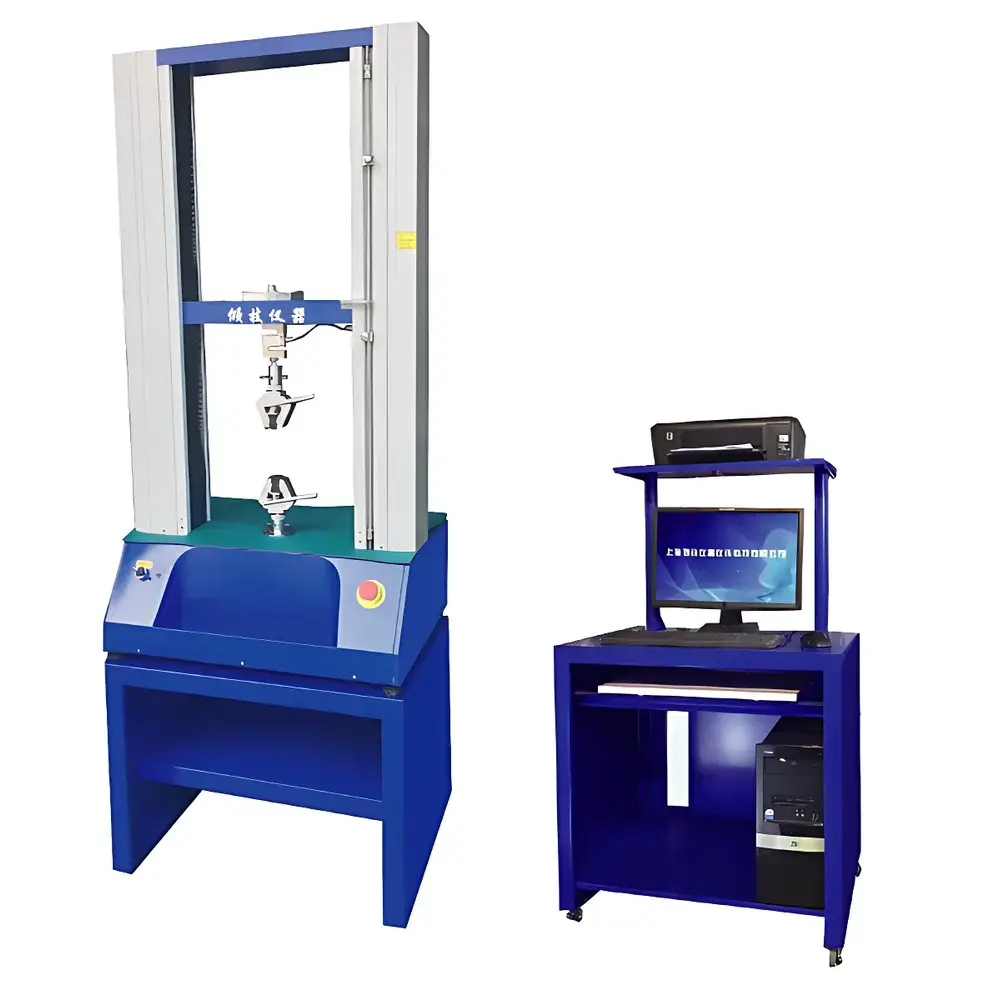
QJ211S Spiral Spring Tensile & Compression Testing Machine
| Origin | Shanghai, China |
|---|---|
| Manufacturer Type | Authorized Distributor |
| Origin Category | Domestic (PRC) |
| Model | QJ211S |
| Price | USD 7,700 (approx.) |
| Instrument Type | Electromechanical Universal Testing Machine |
| Max Test Load | 30 kN |
| Load Range | 0–30 kN (fully adjustable) |
| Load Accuracy Class | Class 1 per ISO 7500-1 |
| Effective Stroke | ~420 mm |
| Displacement Resolution | ±0.5% of reading |
| Load Cell Accuracy | 0.01% FS |
| Speed Range | 0.001–500 mm/min |
| Speed Accuracy | ±0.5% |
| Strain Measurement Accuracy | ±0.5% |
| Safety Features | Electronic stroke limit, emergency stop button, overload auto-shutdown |
| Weight | ~140 kg |
Overview
The QJ211S Spiral Spring Tensile & Compression Testing Machine is an electromechanical universal testing system engineered for high-reproducibility static mechanical characterization of helical coil springs and related elastic components. It operates on a precision servo-controlled ball-screw actuation architecture, delivering controlled displacement or force input while simultaneously acquiring synchronized load, displacement, and strain data. Designed in accordance with ISO 7500-1 (static calibration of force-proving instruments), ASTM E4 (load verification of testing machines), and GB/T 228.1 (metallic materials tensile testing), the system supports standardized evaluation of spring stiffness, yield behavior, permanent set, relaxation, and fatigue pre-conditioning compliance. Its modular load frame accommodates both tension and compression configurations without reconfiguration—critical for evaluating extension springs, compression springs, torsion springs (with optional fixtures), and wire-form elastic elements used in automotive suspension, medical devices, aerospace actuators, and industrial automation.
Key Features
- Precision electromechanical drive system with closed-loop PID control, enabling stable velocity regulation from 0.001 to 500 mm/min (±0.5% accuracy)
- Class 1 load measurement capability per ISO 7500-1, supported by a 0.01% full-scale resolution load cell calibrated traceably to national standards
- Automatic range switching across the 0–30 kN capacity, ensuring optimal signal-to-noise ratio at low and high load levels
- Real-time dynamic display of load-displacement curves during test execution, with on-the-fly calculation of key parameters including Fm, Rm, E, Rp0.2, Rt0.5–0.7, ReH/ReL, and total elongation at break
- Auto-return functionality upon specimen fracture, reducing operator intervention and improving throughput in batch testing environments
- Dual-limit protection: programmable electronic stroke limits plus mechanical hard stops; integrated emergency stop button compliant with IEC 60204-1
- Windows-based proprietary testing software supporting multi-channel data acquisition, customizable test templates, and automated report generation in PDF/Excel formats
Sample Compatibility & Compliance
The QJ211S accommodates cylindrical helical springs with outer diameters up to 120 mm and free lengths within the effective stroke envelope (~420 mm). With optional auxiliary fixtures—including spring compression platens, tensile hooks, and parallel jaw sets—it extends compatibility to wire specimens (diameter ≤ 8 mm), rubber elastomer blocks, and composite laminates per ASTM D3039 and ISO 527-4. All test procedures adhere to regulatory expectations for GLP-compliant laboratories: audit trails, user access controls, electronic signatures, and raw data immutability are enforced via software configuration aligned with FDA 21 CFR Part 11 requirements. Calibration certificates include uncertainty budgets referenced to CNAS-accredited standards.
Software & Data Management
The embedded Windows OS platform runs certified testing software compliant with ISO 17025 documentation practices. It enables full parameter scripting (predefined or custom test sequences), real-time curve overlay comparison, and post-test numerical derivation of modulus, hysteresis area, and energy absorption. Raw ASCII data files (.txt) retain timestamped channel values at ≥100 Hz sampling rate. Export options include CSV, XML, and structured PDF reports containing test metadata, environmental conditions, operator ID, calibration status, and statistical summaries. Data integrity safeguards include write-once storage mode, automatic backup to network drives, and encrypted database archiving.
Applications
- Static load-deflection characterization of automotive valve springs, clutch springs, and brake return springs
- Verification of spring performance per DIN 2091, JIS B 2704, and ISO 2690 specifications
- Quality control of medical device springs (e.g., catheter guidewires, implantable actuator components)
- Material qualification of stainless steel, music wire, and NiTi shape-memory alloys under monotonic loading
- Pre-fatigue conditioning prior to cyclic life testing in accordance with ASTM D1641
- Evaluation of spring relaxation behavior at elevated temperatures using optional environmental chamber integration
FAQ
What international standards does the QJ211S support out-of-the-box?
The system includes preconfigured test methods for GB/T 228.1, ISO 6892-1, ASTM E8/E21, DIN 50125, and JIS Z 2241—each validated against reference material certificates.
Can the machine perform cyclic loading tests?
While primarily configured for static tests, the controller firmware supports basic block-cycle programming (tension-compression-reversal) up to 10,000 cycles; full fatigue testing requires optional high-cycle add-on modules.
Is third-party calibration documentation provided?
Yes—each unit ships with a factory calibration certificate traceable to NIM (National Institute of Metrology, China), including load verification at 20%, 40%, 60%, 80%, and 100% of full scale.
What maintenance intervals are recommended?
Lubrication of the ball screw and linear guides every 6 months; annual recalibration of load cell and displacement encoder is advised for GLP/GMP environments.
Does the software support LIMS integration?
Yes—via configurable ODBC drivers and HL7-compliant API endpoints for bidirectional data exchange with laboratory information management systems.



