
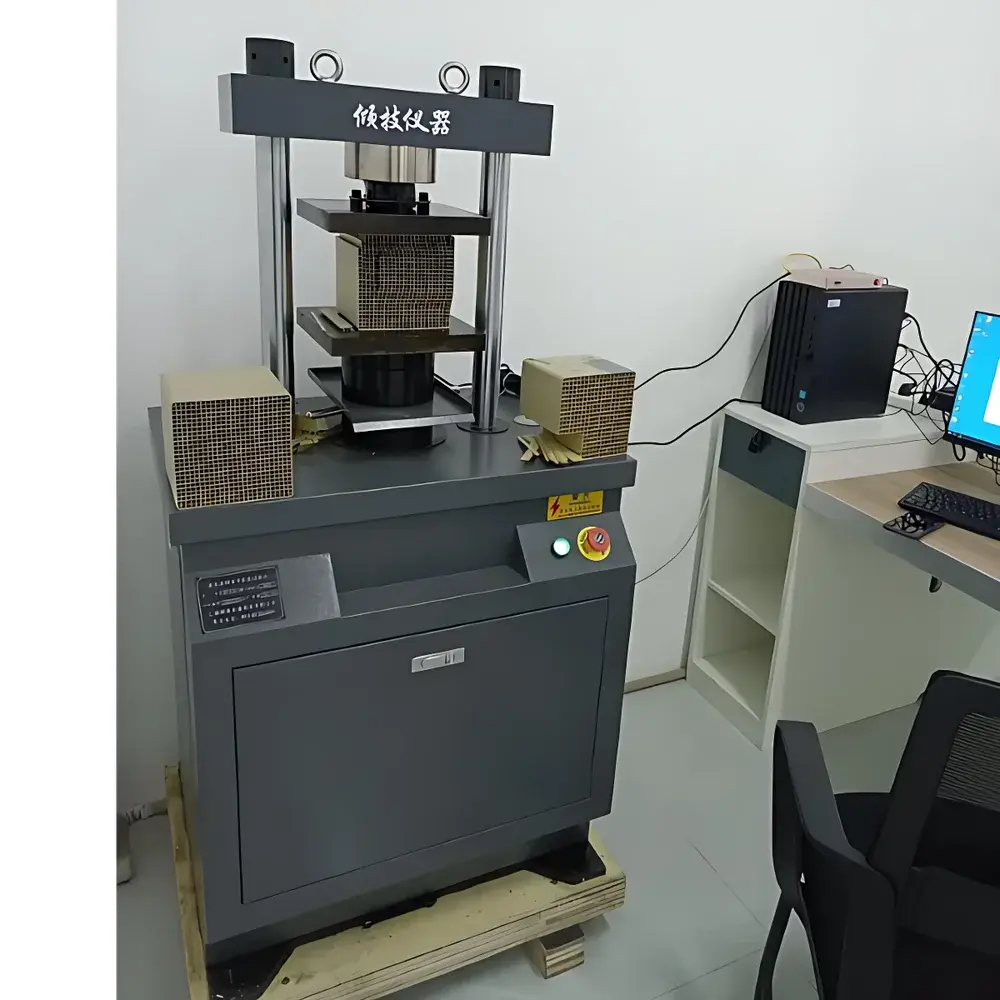
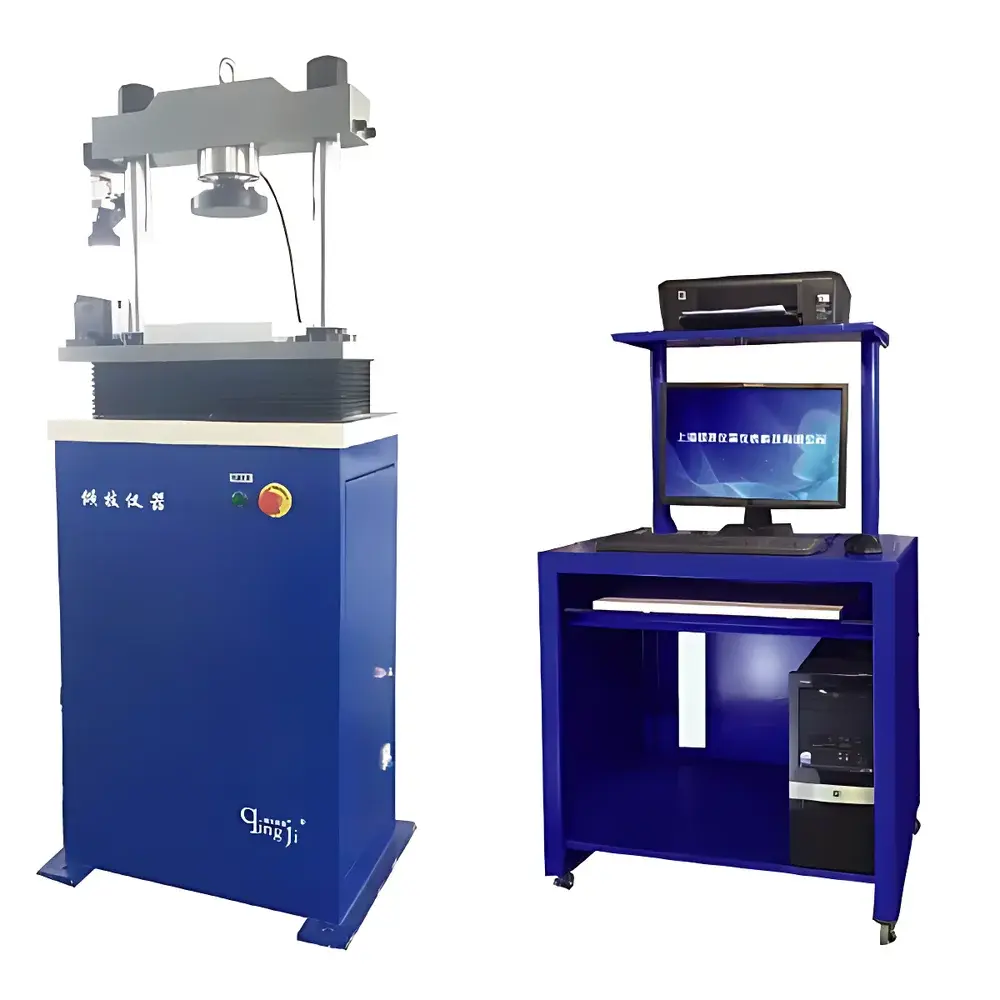
Qinji QJYL872A-200KN Compression Testing Machine for Denitrification Catalysts
| Brand | Qinji |
|---|---|
| Origin | Shanghai, China |
| Model | QJYL872A-200KN |
| Max. Test Load | 200 kN |
| Load Application Rate | 500 N/s |
| Platen Dimensions | 260 mm × 260 mm |
| Platen Spacing | 260 mm |
| Accuracy | ±0.5% of full scale |
| Load Rate Range | 0–2.4 kN/s (±200 N/s) |
| Column Spacing | 310 mm |
| Screw Travel | 100 mm |
| Catalyst Compression Fixture | 250 mm × 250 mm |
| Power Consumption | 0.75 kW |
| Supply Voltage | 220 V AC |
| Dimensions (W×D×H) | 730 mm × 600 mm × 1426 mm |
| Weight | 450 kg |
Overview
The Qinji QJYL872A-200KN Compression Testing Machine is a precision-engineered mechanical testing system designed specifically for the quantitative evaluation of compressive mechanical integrity in honeycomb and plate-type denitrification (DeNOx) catalysts used in selective catalytic reduction (SCR) systems. Operating on the principle of quasi-static uniaxial compression, the instrument applies controlled, monotonic axial load to standardized catalyst specimens—typically 50 mm × 50 mm × 50 mm or 100 mm × 100 mm × 100 mm monolith segments—while continuously recording force-displacement response. This enables direct calculation of compressive strength (MPa), modulus of elasticity (GPa), yield point, and failure strain in accordance with ASTM C773, ISO 10545-6, and GB/T 24218.12 (Chinese standard for ceramic-based catalyst structural testing). The machine’s rigid frame, high-stiffness dual-column architecture, and closed-loop servo-hydraulic or electromechanical actuation (depending on configuration) ensure high reproducibility (<1.2% RSD across replicate tests) and long-term stability under industrial QC laboratory conditions.
Key Features
- 200 kN maximum load capacity, calibrated to ±0.5% of full scale per ISO 7500-1 Class 0.5 requirements
- Programmable load application rate from 0 to 2.4 kN/s, with real-time feedback control maintaining ±200 N/s tolerance
- Fixed platen geometry: 260 mm × 260 mm parallel compression surfaces with 260 mm adjustable vertical spacing—optimized for standard SCR catalyst brick dimensions
- Dedicated 250 mm × 250 mm custom fixture set with low-friction ceramic-coated platens to minimize lateral constraint and edge effects during monolith crushing
- Integrated digital displacement transducer (resolution: 0.001 mm) synchronized with 1 kHz force sampling for high-fidelity stress–strain curve reconstruction
- Stainless-steel-reinforced load frame with 310 mm column spacing and 100 mm screw travel, engineered for minimal deflection (<0.02 mm at 200 kN)
- Embedded microprocessor controller with Ethernet interface and USB host port for firmware updates and data export
Sample Compatibility & Compliance
The QJYL872A accommodates both cordierite- and titania-based honeycomb catalysts (cell densities 20–60 cpsi), as well as extruded plate-type vanadium-tungsten-titanium oxide formulations. Specimen height is constrained between 20 mm and 100 mm; width/depth must fit within the 250 mm × 250 mm fixture envelope. The system supports compliance with multiple regulatory and industry frameworks: test protocols align with EPA Method 202 for catalyst mechanical qualification, satisfy material verification requirements under EN 15199-2 (industrial air pollution control equipment), and support GLP-compliant documentation when paired with audit-trail-enabled software. All hardware components meet CE machinery directive (2006/42/EC) and IEC 61000-6-2/6-4 electromagnetic compatibility standards.
Software & Data Management
Control and analysis are performed via Qinji’s proprietary WinTest Pro v4.2 software, compatible with Windows 10/11 (64-bit). The platform provides real-time force–displacement visualization, automated peak detection, and multi-curve overlay for batch comparison. Raw data files (.tdms) include embedded metadata: operator ID, timestamp (ISO 8601), environmental temperature/humidity (if external sensor integrated), calibration certificate ID, and instrument serial number. Export options include CSV, PDF reports (with configurable header/footer per lab SOP), and XML for LIMS integration. Software supports 21 CFR Part 11-compliant user roles (Admin, Technician, Reviewer), electronic signatures, and immutable audit trails—including all parameter changes, test aborts, and manual data edits.
Applications
- Quality control of incoming catalyst batches prior to SCR reactor installation
- Accelerated aging studies: compressive strength retention after thermal cycling (300–450 °C) and SO2/H2O exposure
- Formulation development: correlation of binder content, extrusion pressure, and calcination profile with mechanical robustness
- Fatigue resistance assessment via repeated sub-yield loading cycles (e.g., 10,000 cycles at 60% of ultimate load)
- Root cause analysis of field failures—comparing fractured monolith fragments against baseline mechanical fingerprints
- Third-party certification testing per ISO/IEC 17025-accredited laboratories
FAQ
What catalyst geometries can be tested on the QJYL872A?
Standard honeycomb monoliths (50 × 50 × 50 mm, 100 × 100 × 100 mm) and plate-type catalysts up to 250 × 250 × 100 mm are supported. Custom fixtures are available for non-standard cross-sections.
Is the system compliant with ASTM or ISO standards for catalyst testing?
Yes—test methodology conforms to ASTM C773 (compressive strength of refractory shapes) and ISO 10545-6 (ceramic tile mechanical testing), adapted for porous ceramic catalyst substrates.
Can the machine perform cyclic or creep testing?
The base configuration supports static compression only. Optional add-ons include programmable dwell steps and low-frequency sinusoidal loading (up to 5 Hz) for dynamic characterization.
How often does the load cell require recalibration?
Annual traceable recalibration is recommended. Internal verification using certified deadweight standards can be performed daily or per-shift per ISO/IEC 17025 requirements.
Does the system support remote monitoring or integration with MES?
Yes—via OPC UA server mode and RESTful API endpoints, enabling live data streaming to SCADA or manufacturing execution systems without middleware.



