
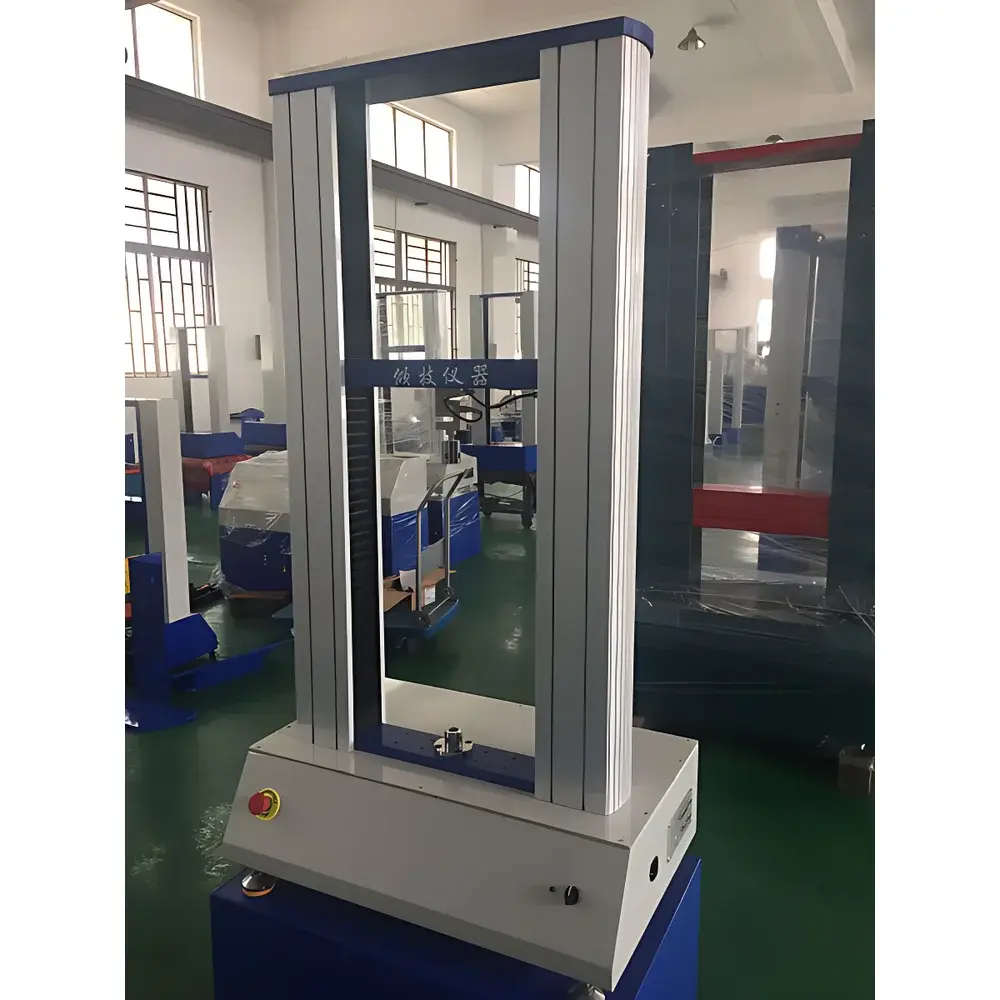
QJ211S Medical Polymer Cast Tensile Testing Machine
| Origin | Shanghai, China |
|---|---|
| Manufacturer Type | Authorized Distributor |
| Origin Category | Domestic (China) |
| Model | QJ211S |
| Quotation | USD 6,450 (FOB Shanghai) |
| Instrument Type | Electromechanical Universal Testing Machine |
| Max Test Load | 30 kN |
| Load Range | 0–30 kN (fully adjustable) |
| Load Accuracy Class | Grade 1 (per ISO 7500-1 / ASTM E4) |
| Traverse Stroke | 800 mm |
| Displacement Resolution | ±0.5% of reading |
| Load Cell Accuracy | 0.01% of full scale |
| Speed Range | 0.001–500 mm/min |
| Speed Accuracy | ±0.5% |
| Effective Test Width | 420 mm |
| Weight | ~140 kg |
| Safety Features | Dual electronic stroke limit, emergency stop button, overload auto-shutdown |
| Control Interface | Windows-based PC software with real-time data acquisition and GLP-compliant audit trail |
Overview
The QJ211S Medical Polymer Cast Tensile Testing Machine is a precision electromechanical universal testing system engineered for the mechanical characterization of orthopedic fixation materials—specifically synthetic polymer-based casting systems used in clinical and biomedical applications. It operates on the principle of controlled uniaxial force application under displacement- or load-controlled conditions, conforming to standardized quasi-static tensile, compression, flexural, peel, shear, and tear test protocols. Designed to meet the stringent repeatability and traceability requirements of medical device R&D, quality control, and regulatory validation, the system delivers high reproducibility across low-force (e.g., thin cast film elongation) and high-force (e.g., rigid composite cast structural integrity) regimes. Its modular architecture supports rapid fixture reconfiguration, enabling seamless transition between ASTM D638, ISO 527-2, GB/T 1040.2, ISO 179-1, and EN 14322-compliant test configurations.
Key Features
- High-fidelity 30 kN load frame with dual-range, temperature-compensated load cell (0.01% FS accuracy per ISO 376), certified to ISO 7500-1 Class 1
- Programmable crosshead speed from 0.001 to 500 mm/min with closed-loop servo control and ±0.5% speed fidelity
- 800 mm effective vertical travel with optical encoder-based displacement feedback (±0.5% linearity)
- Real-time dynamic display of force-displacement, stress-strain, and time-dependent curves during test execution
- Automated sequence functions: auto-zero initiation, post-fracture return-to-start, multi-step ramp-hold cycles, and programmable preload application
- Dual-safety architecture: hardware-based stroke limit switches + software-defined safety envelopes with configurable thresholds
- Modular gripping interface compatible with pneumatic, wedge, roller, and custom-designed fixtures for cast strips, tubular wraps, and laminated composites
- Windows-native control software supporting multi-channel data acquisition (force, displacement, extensometer input optional), real-time curve overlay, and statistical batch reporting
Sample Compatibility & Compliance
The QJ211S accommodates diverse specimen geometries typical of medical polymer casts—including flat strips (2–50 mm wide × 0.5–5 mm thick), circumferential wraps, layered composites (e.g., polyurethane/glass fiber hybrids), and pre-cured molded segments. Fixture sets comply with ISO 527-2 Type 1A and ASTM D638 Type IV specifications for tensile bar preparation. All test routines adhere to internationally recognized standards including ISO 13485:2016 (medical device QMS), ISO 10993-1 (biocompatibility evaluation support), and FDA-recommended guidance for mechanical validation of Class I/II orthopedic devices. Raw data files include embedded metadata (operator ID, timestamp, calibration certificate ID, environmental conditions) to satisfy 21 CFR Part 11 electronic record requirements when paired with validated software configuration.
Software & Data Management
The integrated Windows-based testing platform provides GLP/GMP-aligned data handling: automatic generation of PDF test reports with embedded graphs, pass/fail flagging against user-defined limits, and export to CSV, Excel, or XML for LIMS integration. Audit trail functionality logs all operator actions—including method edits, calibration events, and result modifications—with immutable timestamps and digital signature fields. Curve analysis tools enable tangent modulus calculation, yield point detection (0.2% offset method), plateau identification for viscoelastic recovery, and hysteresis loop quantification. Data archiving supports hierarchical folder structures with version-controlled test templates and instrument configuration snapshots.
Applications
- Quantification of tensile strength, elongation at break, and Young’s modulus for polyurethane and polyester-based casting tapes under dry/wet conditions
- Compression testing of cured cast cylinders per ISO 179-1 (Charpy impact support) and ASTM D695
- Cyclic loading to assess fatigue resistance and creep compliance over clinically relevant durations (e.g., 24–72 h at 37°C)
- Peel adhesion evaluation of cast-to-skin interfaces using 90° or 180° fixtures per ISO 2411
- Mechanical aging studies: accelerated thermal/humidity exposure followed by post-conditioning tensile assessment per ISO 11607-1
- Comparative benchmarking of novel bioresorbable cast formulations against commercial benchmarks (e.g., Delta-Cast®, OrthoGlas®)
FAQ
Does the QJ211S support extensometer integration for strain measurement?
Yes—via standard analog voltage input (±10 V) and digital TTL trigger; compatible with clip-on, video, and non-contact extensometers meeting ISO 9513 Class 1 accuracy.
Can test methods be exported and shared across multiple instruments?
Yes—method files (.qtm) are portable and retain all parameter settings, fixture definitions, and pass/fail criteria.
Is the system compliant with ISO/IEC 17025 for accredited laboratory use?
When operated with documented calibration certificates (traceable to NIM, China), validated software, and defined SOPs, it meets technical requirements for mechanical testing scope accreditation.
What maintenance intervals are recommended for long-term accuracy retention?
Load cell verification every 6 months; mechanical alignment check annually; firmware and driver updates applied per manufacturer release notes.
Are ASTM F2971 (orthopedic cast performance) test protocols preloaded?
Yes—the software includes template methods for F2971 Annex A1 (tensile properties), A2 (water absorption effect), and A3 (thermal conductivity correlation).
Related Products



