
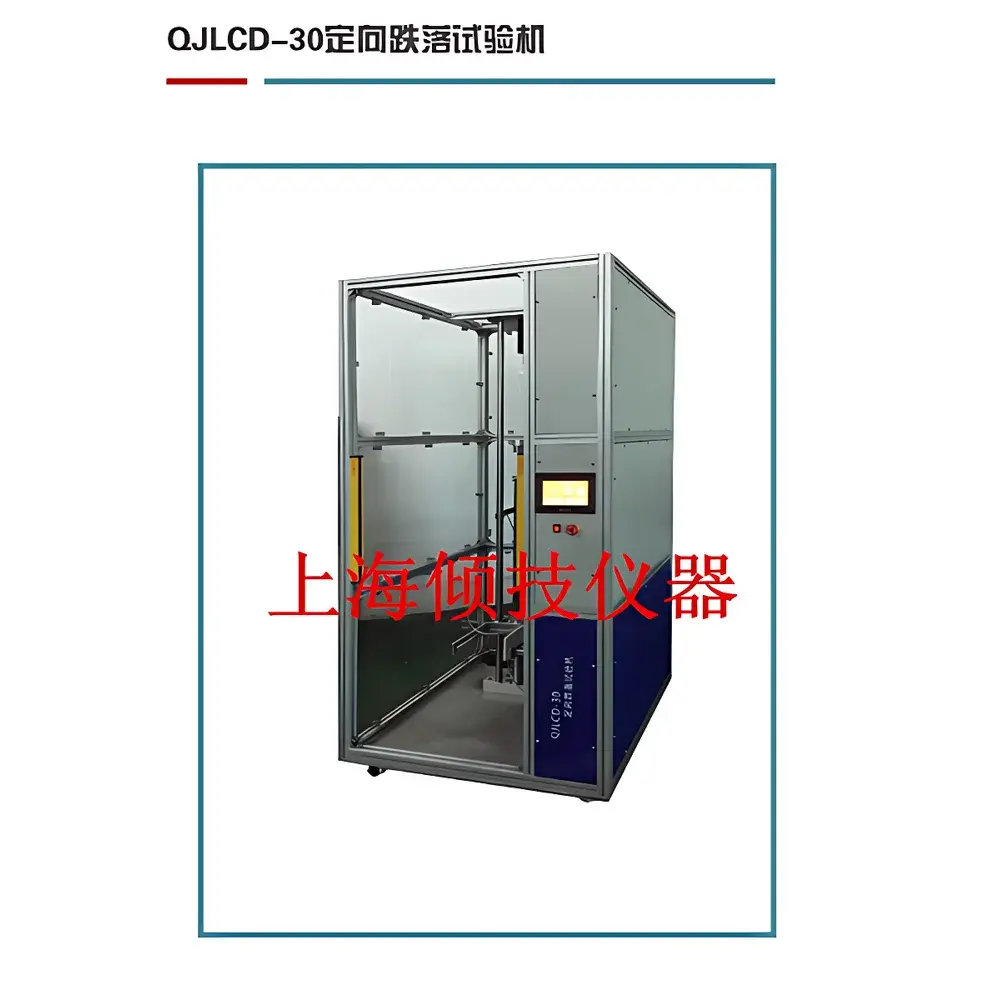
QJLCD-30 Touchscreen Controlled Directional Drop Tester
| Origin | Imported |
|---|---|
| Manufacturer Type | Authorized Distributor |
| Instrument Type | Electro-Hydraulic Servo Drop Tester |
| Control System | PLC + 7-inch HMI Touchscreen Interface |
| Drive Mechanism | Servo Motor + Timing Belt Transmission |
| Drop Height Range | 400–1800 mm (±0.5 mm positioning accuracy) |
| Drop Angles | 0°, 45°, 90° |
| Sample Weight Capacity | ≤700 g |
| Drop Surface Dimensions | 350 × 350 × 50 mm |
| Drop Surface Materials | Polished Granite or Cement Board (customizable) |
| Surface Roughness | Ra = 0.59 µm (granite), Ra = 1.29 µm (cement board) |
| Vacuum Suction Cups | Six Ø16 mm industrial-grade vacuum cups |
| Test Data Output | Drop height, impact acceleration (calculated), terminal velocity, test duration, cycle count |
| Compressed Air Requirement | ≥0.6 MPa, oil-free and dry |
| Power Supply | AC 220 V ±10%, 50 Hz |
| Rated Power | 400 W |
| Overall Dimensions | 800 × 900 × 2400 mm (W × D × H) |
| Net Weight | 270 kg |
| Compliance | IEC 60068-2-32 (Ed. 4.0, 2021) |
Overview
The QJLCD-30 Touchscreen Controlled Directional Drop Tester is an engineered solution for standardized mechanical shock evaluation of packaged consumer electronics, medical devices, handheld instruments, and small industrial components. Designed in strict accordance with IEC 60068-2-32 (Ed. 4.0, 2021), this electro-hydraulic servo-driven system executes repeatable, traceable free-fall impact tests under controlled orientation and height parameters. Unlike gravity-only drop towers, the QJLCD-30 integrates a high-precision servo motor coupled with a timing belt transmission system to achieve sub-millimeter vertical positioning repeatability (±0.5 mm) across its full 400–1800 mm stroke range. Its modular vacuum cup array—comprising six Ø16 mm industrial-grade suction units—enables secure, non-damaging sample fixation for face, edge, and corner impacts without adhesive residues or mechanical clamping distortion. The system supports three orthogonal release orientations (0°, 45°, 90°), allowing full coverage of all six faces, twelve edges, and eight vertices of rectangular test specimens up to 700 g mass.
Key Features
- 7-inch industrial HMI touchscreen interface with intuitive icon-based navigation and real-time parameter monitoring
- PLC-based control architecture ensuring deterministic logic execution, ESD immunity, and long-term operational stability
- Electro-hydraulic servo actuation delivering smooth, jerk-free lift and precise dwell-to-drop transition
- Dual-material drop surface option: polished granite (Ra = 0.59 µm) for high-reproducibility hardness benchmarking or cement board (Ra = 1.29 µm) for realistic shipping-floor simulation
- Integrated vacuum pressure monitoring and leak detection to validate cup adhesion integrity prior to each drop cycle
- Automated test logging with timestamped records of drop height, calculated terminal velocity, estimated peak acceleration, and cumulative cycle count
- Modular mechanical design supporting field-upgradable components including custom drop surface inserts and extended-height columns
Sample Compatibility & Compliance
The QJLCD-30 accommodates rigid and semi-rigid rectangular samples measuring up to 350 mm per side and weighing no more than 700 g. Its six independently controllable vacuum cups permit simultaneous multi-point attachment, minimizing torsional loading during lift and enabling stable orientation at non-vertical angles. The system satisfies the mechanical requirements of IEC 60068-2-32 for unpowered free-fall testing, including specified drop height tolerance (±1%), angular deviation limits (<±1°), and surface hardness verification (HRC ≥60 for granite base). Optional calibration certificates traceable to national metrology institutes (e.g., NIST, PTB) are available upon request. While not inherently compliant with FDA 21 CFR Part 11, the device’s data export functionality (CSV/USB) supports integration into validated laboratory information management systems (LIMS) operating under GLP/GMP frameworks when paired with appropriate audit trail software.
Software & Data Management
No proprietary closed-source software is embedded; all configuration, operation, and data retrieval occur via the on-device HMI interface. Test parameters—including target height, release angle, number of cycles per orientation, and dwell time—are stored in non-volatile memory with password-protected access levels (operator, technician, administrator). Raw test logs are exportable in comma-separated values (CSV) format via USB 2.0 port for downstream analysis in MATLAB, Python (Pandas), or statistical process control (SPC) platforms. The system does not perform real-time acceleration measurement but calculates theoretical terminal velocity (v = √(2gh)) and nominal impact energy (E = mgh) based on user-entered mass and confirmed drop height—values consistent with IEC 60068-2-32 Annex A guidance for comparative pass/fail assessment.
Applications
- Pre-shipment validation of smartphone, tablet, and wearable device packaging integrity
- Design verification of plastic housings, battery enclosures, and PCB-mounted connectors subjected to handling shocks
- Comparative durability screening of alternative packaging materials (corrugated board, molded pulp, foam inserts)
- Internal quality assurance testing per ISO 11607-1 for sterile barrier systems used in Class II/III medical devices
- Supplier qualification audits requiring documented evidence of mechanical robustness against distribution hazards
FAQ
Does the QJLCD-30 include built-in acceleration sensing?
No. It is a kinematic drop tester—not an instrumented impact system. Acceleration profiles must be measured externally using triaxial accelerometers mounted on the test specimen.
Can the drop surface be replaced with stainless steel or rubber?
Yes. The base plate is mechanically standardized (M6 threaded inserts, 50 mm pitch). Custom surfaces—including 316 stainless steel, EPDM rubber (Shore A 60), or textured aluminum—can be supplied as optional accessories.
Is firmware update capability supported?
Yes. Firmware revisions are distributed via encrypted USB stick and installed through the HMI’s maintenance menu. Each version includes revision history, safety interlock verification, and backward-compatible parameter mapping.
What maintenance intervals are recommended?
Vacuum cup inspection every 500 cycles; timing belt tension check every 6 months; compressed air filter replacement quarterly; annual calibration of height encoder and pressure transducer by authorized service partner.
Is CE marking applicable to this unit?
The base configuration complies with EU Machinery Directive 2006/42/EC and EMC Directive 2014/30/EU. CE documentation package—including risk assessment, wiring diagrams, and Declaration of Conformity—is provided with shipment for end-user registration.



