
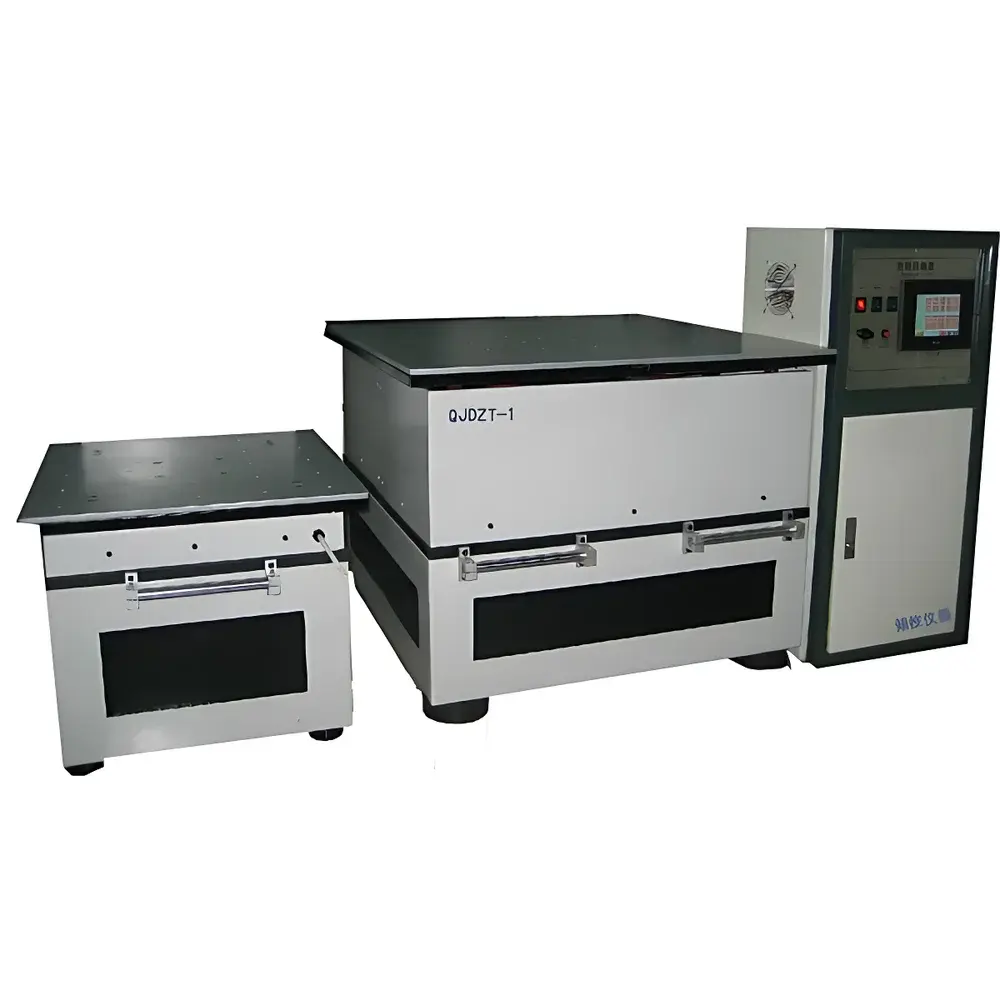
QJDZT-1 Electronic Transport Vibration Tester
| Origin | Shanghai, China |
|---|---|
| Manufacturer Type | Authorized Distributor |
| Origin Category | Domestic (PRC) |
| Model | QJDZT-1 |
| Price | USD 4,200 (approx.) |
| Instrument Type | Electromagnetic Universal Vibration Testing System |
| Frequency Range | 0.5–600 Hz (±0.1% accuracy) |
| Vibration Axis | Vertical (Y-axis, up-down only) |
| Control Modes | Standard Programmable Control (P-series: preset profiles |
| W-series | waveform-defined |
| T-series | time-swept) |
| Vibration Waveform | Selectable sine wave (full-cycle or half-cycle rectified) |
| Output Configuration | Dual independent vibration channels — configurable for synchronized dual-axis excitation, sequential activation, or isolated single-channel operation |
| Compliance | Designed to meet ISO 2247, ASTM D999, ISTA 3A/3E, and GB/T 4857.23 test standards |
Overview
The QJDZT-1 Electronic Transport Vibration Tester is an electromagnetically driven, microprocessor-controlled vibration simulation system engineered for quantitative assessment of product resilience under dynamic mechanical stress encountered during logistics handling and distribution. Unlike hydraulic or electrodynamic shakers intended for structural fatigue analysis, the QJDZT-1 implements a closed-loop servo-controlled electromagnetic actuator architecture optimized specifically for transport-condition replication—emphasizing repeatability, spectral fidelity, and long-term operational stability across extended duty cycles. Its core function is to replicate the broadband, low-amplitude, high-cycle vibration spectra typical of road, rail, and air freight environments, enabling accelerated life testing, early failure mode identification, and validation of packaging integrity per internationally recognized transport simulation protocols.
Key Features
- Electromagnetic drive system with zero oil contamination risk and minimal thermal drift—ideal for cleanroom-adjacent lab environments and regulated manufacturing settings.
- Dual-channel independent output capability: supports simultaneous vertical excitation at two distinct frequencies/amplitudes, or sequential profiling for multi-stage transport simulation (e.g., truck → warehouse handling → final delivery).
- Precision frequency control from 0.5 Hz to 600 Hz with ±0.1% setpoint accuracy, traceable to NIST-traceable calibration references.
- Three standardized control architectures: P-series (preloaded compliance profiles per ISTA/ASTM), W-series (user-defined waveform synthesis including clipped sine, trapezoidal, or burst-modulated inputs), and T-series (linear/logarithmic sweep functions for resonance scanning).
- Real-time amplitude monitoring via integrated accelerometer feedback loop—enabling automatic gain compensation and maintaining target displacement velocity (mm/s RMS) across variable load conditions.
- Rigid welded steel frame with reinforced base plate and adjustable leveling feet ensures mechanical isolation and minimizes floor-coupled energy loss during high-frequency operation.
Sample Compatibility & Compliance
The QJDZT-1 accommodates test specimens up to 50 kg (standard platform) with optional heavy-duty platforms supporting loads up to 100 kg. Fixture adaptability includes T-slot mounting surfaces, universal clamping brackets, and custom fixture interface plates compatible with ISO 17025-accredited calibration labs. The system is validated against key international transport simulation standards including ISO 2247 (vibration testing of packaged products), ASTM D999 (standard test methods for vibration testing of shipping containers), ISTA 3A (general simulation for parcel delivery systems), and ISTA 3E (engineered systems for mixed logistics networks). It also satisfies functional requirements outlined in GB/T 4857.23 (Chinese national standard for transport package vibration testing), making it suitable for both domestic regulatory submissions and export-oriented quality assurance workflows.
Software & Data Management
Control and data acquisition are managed through the QVibSoft v3.2 application—a Windows-based, CE-compliant software suite supporting USB 2.0 and Ethernet connectivity. The interface provides real-time spectral display (FFT-based), time-history logging (16-bit resolution, up to 20 kHz sampling), and automated report generation compliant with GLP documentation requirements. Audit trail functionality records all parameter changes, user logins, and test execution metadata—fully aligned with FDA 21 CFR Part 11 electronic record and signature expectations when deployed in pharmaceutical or medical device supply chain validation. Export formats include CSV, PDF, and XML for integration into LIMS or enterprise quality management systems (QMS).
Applications
- Package design validation: Correlation of cushioning performance, box compression resistance, and seal integrity under simulated transit vibration.
- Electronics reliability screening: Detection of solder joint fatigue, connector loosening, and MEMS sensor drift prior to field deployment.
- Automotive component qualification: Assessment of infotainment module mounting rigidity, wiring harness retention, and HVAC actuator durability.
- Pharmaceutical secondary packaging verification: Confirmation of blister pack delamination, vial stopper migration, and label adhesion stability during cold-chain logistics.
- Consumer goods pre-launch testing: Evaluation of assembly integrity for power tools, home appliances, and smart devices subjected to multi-modal distribution networks.
FAQ
What standards does the QJDZT-1 comply with for transport simulation testing?
The system is configured to execute test profiles defined in ISO 2247, ASTM D999, ISTA 3A/3E, and GB/T 4857.23. Full compliance documentation—including calibration certificates and profile validation reports—is provided with each unit.
Can the QJDZT-1 perform random vibration testing?
No. The QJDZT-1 is purpose-built for deterministic sinusoidal excitation and swept-sine profiles. Random vibration capability requires a separate electrodynamic shaker system with broadband power amplifier and dedicated PSD control firmware.
Is remote operation and monitoring supported?
Yes. Via Ethernet connection and QVibSoft’s TCP/IP API, users can initiate tests, monitor real-time acceleration metrics, and retrieve logs from external networked workstations—enabling integration into centralized lab automation frameworks.
What maintenance intervals are recommended for long-term reliability?
Annual preventive maintenance is advised, including electromagnetic coil impedance verification, suspension spring tension calibration, and feedback sensor linearity validation—all performed by certified field service engineers using OEM diagnostic tools.
Does the system support third-party fixture integration?
Yes. The platform features ISO-standard M6 threaded mounting holes on a 100 mm grid pattern, and mechanical interface drawings are supplied to facilitate custom fixture design and CNC fabrication in accordance with ASME Y14.5 GD&T specifications.
Related Products



