
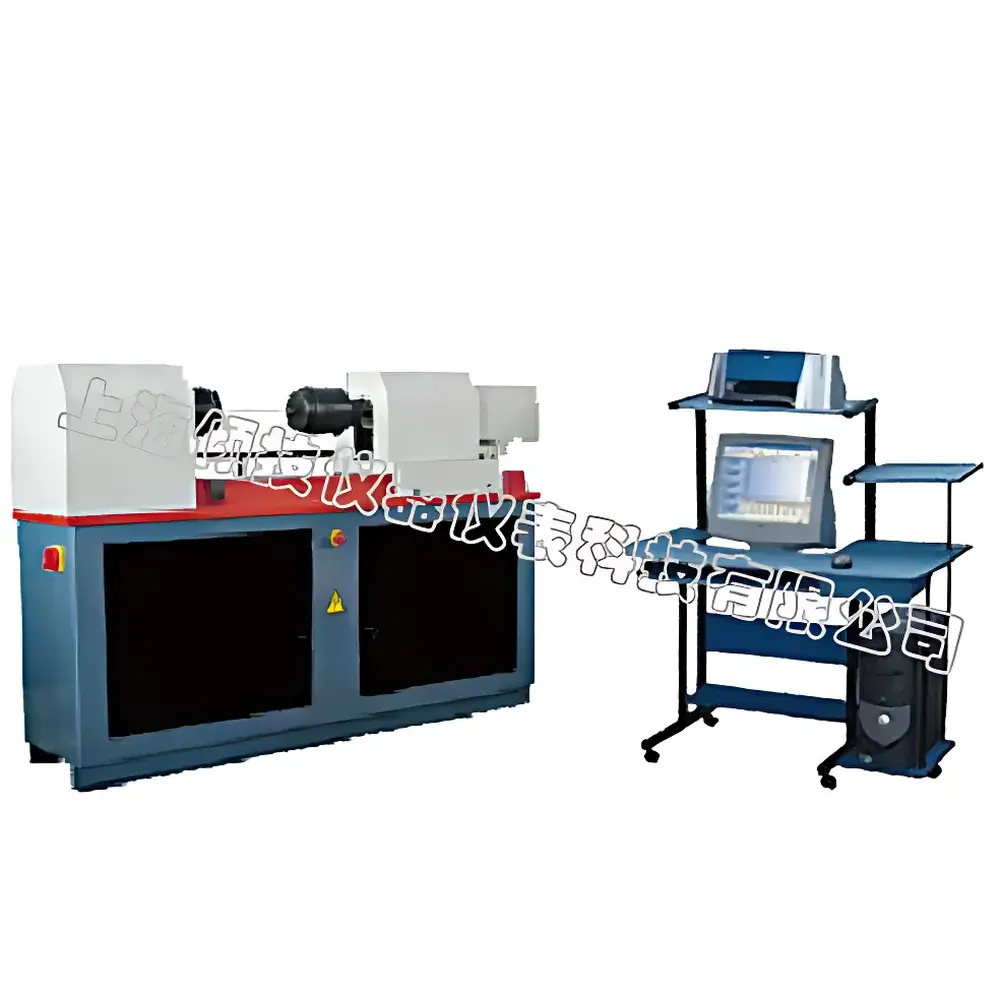
Qinji QT-Series Torsion Testing Machine for Springs and Mechanical Components
| Brand | Qinji |
|---|---|
| Origin | Shanghai, China |
| Model | QT-Series |
| Torque Measurement Range | 0–10,000 N·mm |
| Torque Measurement Accuracy | ±0.5% (typical) |
| Twist Angle Range | 0–100,000° (or continuous rotation) |
| Twist Angle Accuracy | ±0.5% (typical) |
| Angular Velocity Range | 0–1,000 °/min |
| Angular Velocity Accuracy | ±0.5% (typical) |
| Maximum Spacing Between Chucks | 300 mm |
| Sample Clamping Dimensions | Customizable per standard or specimen geometry |
Overview
The Qinji QT-Series Torsion Testing Machine is an electromechanical static testing system engineered for precise quantification of torsional mechanical behavior in helical springs, torsion bars, fasteners, shafts, and other rotationally loaded components. It operates on the principle of controlled angular displacement under applied torque, enabling direct measurement of torque–angle hysteresis loops, yield torsion, ultimate torsional strength, and elastic recovery characteristics. The system complies with fundamental torsion mechanics theory—based on Saint-Venant’s assumptions for prismatic members—and supports derivation of shear modulus (G) when coupled with high-resolution angular encoders and calibrated torque transducers. Designed for laboratory and quality control environments, it meets the functional requirements of static torsion testing as defined in ISO 6892-1 (for metallic materials), ASTM E143 (Shear Modulus Testing), and GB/T 10128 (Metallic Materials – Torsion Testing).
Key Features
- High-fidelity torque sensing via sealed, temperature-compensated strain-gauge transducers with full-scale resolution down to 0.01% of reading and repeatability better than ±0.3%.
- Optical rotary encoder with 0.01° angular resolution and real-time feedback control loop ensuring stable velocity regulation across the full 0–1,000 °/min range.
- Modular chuck system accommodating cylindrical, rectangular, and polygonal cross-sections; interchangeable jaw inserts support standardized spring ends (hook, loop, ground flat) per DIN 2095 and ISO 269.
- Integrated load frame with rigid C-frame architecture and precision-ground linear guides, minimizing parasitic bending moments during high-torque application (up to 10 N·m).
- Dual-channel synchronized data acquisition at up to 1 kHz sampling rate, capturing transient torsional relaxation and creep behavior without aliasing.
- Compliance with electromagnetic compatibility (EMC) standards IEC 61326-1 and safety requirements per IEC 61010-1 for laboratory equipment.
Sample Compatibility & Compliance
The QT-Series accommodates a broad spectrum of torsion-sensitive specimens: compression/tension helical springs (stainless steel, music wire, phosphor bronze), torsion springs (single/double leg, spiral), leaf springs, torsion bars, and miniature biomedical implants (e.g., orthodontic archwires). Specimen lengths up to 300 mm are supported between chucks, with axial alignment verified via integrated dial indicators (±0.02 mm tolerance). Test protocols adhere to international standards including ISO 10293 (springs), ASTM A370 (mechanical testing of steel products), JIS B2704 (helical compression springs), and GB/T 23935 (cylindrical coil springs). All calibration procedures follow ISO/IEC 17025 guidelines, and traceable certificates are issued using reference standards accredited to CNAS (China National Accreditation Service).
Software & Data Management
The machine is operated via Qinji’s proprietary TorsionTest Pro software (v4.2+), a Windows-based platform supporting multi-language UI, GLP-compliant audit trails, and electronic signatures per FDA 21 CFR Part 11. Software features include automated test sequencing (predefined or user-scripted), real-time torque–angle curve overlay, derivative analysis for τp (non-proportional shear stress) determination, and export of ASCII, CSV, and XML datasets compatible with MATLAB, Python (NumPy/Pandas), and statistical process control (SPC) platforms. Raw data files retain full metadata: operator ID, environmental conditions (optional temperature/humidity input), calibration history, and instrument firmware version—ensuring full traceability for internal audits or regulatory submissions.
Applications
- Quality assurance of automotive suspension springs and steering column torsion dampers.
- R&D validation of shape-memory alloy (SMA) torsional actuators under cyclic loading.
- Material characterization of polymer composites and additively manufactured lattice structures.
- Verification of torque–preload relationships in threaded fasteners per ISO 16047.
- Educational use in mechanical engineering labs for hands-on demonstration of torsional stiffness, ductility, and failure modes (shear fracture, surface yielding).
- Third-party certification testing for ISO/TS 16949 and IATF 16949 compliant suppliers.
FAQ
Does the QT-Series support closed-loop strain-controlled testing?
Yes—the system offers both torque-controlled and angle-controlled modes, with optional digital PID tuning for dynamic ramp-hold-relax profiles.
Can test data be exported to LIMS or ERP systems?
Yes—via ODBC-compliant database connectors or RESTful API integration (available under enterprise license).
Is third-party calibration service available outside China?
Yes—Qinji maintains authorized calibration partners in Germany, USA, and Singapore, all operating under ISO/IEC 17025 accreditation.
What maintenance intervals are recommended for long-term accuracy?
Torque transducer recalibration every 12 months; encoder verification every 6 months; mechanical alignment check prior to high-precision G-modulus measurements.
Are custom fixtures available for non-standard spring geometries?
Yes—Qinji provides engineering consultation and CNC-machined fixture design services, with lead time typically 3–4 weeks post-approval.



