
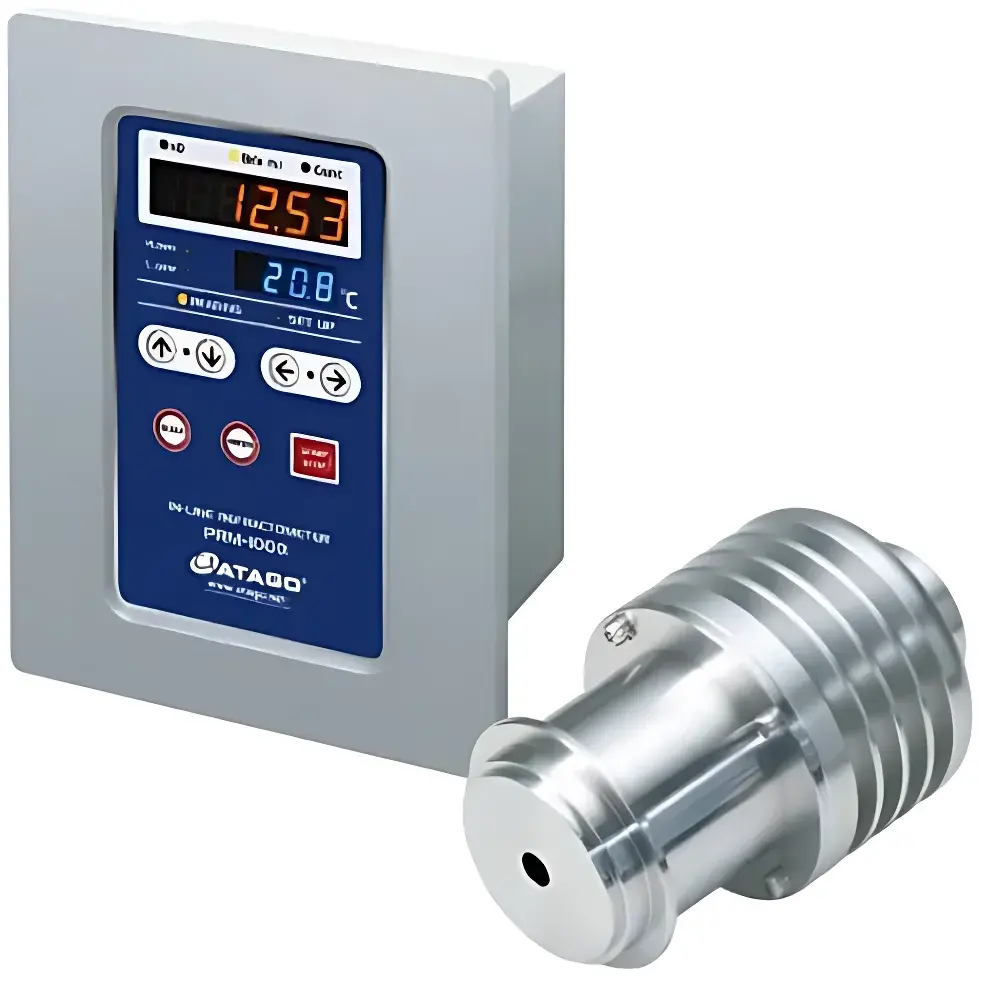
ATAGO PRM-100α DX In-line Refractometer for Real-time Brix and Refractive Index Monitoring
| Brand | ATAGO |
|---|---|
| Origin | Japan |
| Product Type | In-line Refractometer |
| Model | PRM-100α DX |
| Measurement Range | Refractive Index (nD): 1.32000–1.55700 |
| Brix | 0.00–100.00% (ATC) |
| Accuracy | nD ±0.00010 |
| Temperature Range | –5.0 to 160.0 °C |
| Auto-Temperature Compensation (ATC) | 5–100 °C |
| Display | 7-segment LED |
| Output | DC 4–20 mA, RS-232C |
| IP Rating | IP67 |
| Pressure Rating | 0.98 MPa (10 kgf/cm²) |
| Sample Cell Material | SUS316L |
| Prism Material | Synthetic Sapphire |
| Power Supply | AC 100–240 V, 50–60 Hz |
| Dimensions (Sensor) | 10.8 × 17.26 × 10.8 cm, 2.6 kg |
| Dimensions (Display Unit) | 19.2 × 10 × 24 cm, 3.3 kg |
| Cable Length | Standard 15 m (extendable to 200 m) |
| Resolution Options | nD 0.0001 / 0.00001 |
Overview
The ATAGO PRM-100α DX is a high-precision in-line refractometer engineered for continuous, real-time monitoring of refractive index (nD) and soluble solids concentration (Brix) in liquid process streams. Based on the fundamental optical principle of critical-angle refraction, the instrument measures the change in light refraction at the interface between a synthetic sapphire prism and the flowing sample—enabling non-invasive, flow-through concentration analysis without sampling, dilution, or reagent consumption. Designed for integration directly into sanitary or industrial piping systems (e.g., tri-clamp, flanged, or threaded connections), the PRM-100α DX operates under pressures up to 0.98 MPa and accommodates process temperatures from –5.0 °C to 160.0 °C. Its built-in automatic temperature compensation (ATC) algorithm—calibrated across 5–100 °C—ensures traceable Brix values compliant with ISO 2173 and AOAC Official Method 932.12, eliminating manual correction and supporting consistent quality control across variable thermal conditions.
Key Features
- High-resolution measurement capability: refractive index resolution down to 0.00001 (user-selectable) and Brix resolution to 0.01%, supporting both R&D validation and production-grade specification enforcement.
- Robust, hygienic construction: sample-wetted parts fabricated from electropolished SUS316L stainless steel; prism made of optically stable synthetic sapphire—resistant to abrasion, chemical corrosion, and thermal shock.
- IP67-rated electronics enclosure and pressure-rated sensor head (10 kgf/cm²), certified for use in washdown environments and hazardous area-adjacent installations.
- Dual-output interface standard: isolated 4–20 mA analog output for PLC/DCS integration and RS-232C serial communication for configuration, data logging, and remote diagnostics.
- Large-format 7-segment LED display with high-brightness color coding—optimized for legibility at distances exceeding 10 meters in ambient light up to 10,000 lux.
- Modular architecture: sensor and display units separated by up to 200 meters via shielded cable, enabling flexible installation in constrained or high-temperature zones.
Sample Compatibility & Compliance
The PRM-100α DX is validated for homogeneous, low-turbidity aqueous solutions—including syrups, juice concentrates, pharmaceutical buffers, cleaning agents, and industrial coolants—where suspended solids do not exceed 0.5% w/w and particle size remains below 5 µm. It complies with international standards governing optical metrology and process instrumentation: ISO 5725 (accuracy and precision), IEC 61326-1 (EMC for industrial environments), and FDA-relevant design controls per 21 CFR Part 11 when integrated with compliant SCADA or LIMS platforms. While not intrinsically safe, its electrical isolation and enclosure rating support deployment in Zone 2 classified areas when installed per IEC 60079-14 guidelines. Calibration traceability is maintained through NIST-traceable sucrose reference solutions (e.g., 5%, 20%, 60% Brix), and factory calibration certificates include uncertainty budgets per ISO/IEC 17025 requirements.
Software & Data Management
The PRM-100α DX operates as a standalone field device but supports full data governance within regulated workflows. The RS-232C interface enables bidirectional communication with host systems using ASCII-based command protocols—allowing remote zero/span calibration, ATC parameter adjustment, and real-time data polling at configurable intervals (default: 1 Hz). When connected to validated data acquisition software (e.g., LabVIEW, Ignition SCADA, or custom OPC UA clients), measurement timestamps, temperature readings, and raw nD/Brix values are logged with audit-trail integrity. For GLP/GMP environments, integration with electronic logbook systems ensures full 21 CFR Part 11 compliance—including user authentication, electronic signatures, and immutable record retention—provided the host platform meets predicate rule requirements.
Applications
- Food & beverage: Continuous Brix monitoring during juice concentration, syrup blending, dairy evaporation, and beer wort boiling—enabling closed-loop control of steam valves and feed rates.
- Pharmaceutical manufacturing: Real-time verification of buffer composition, API solution strength, and CIP rinse water conductivity equivalence (via refractive index correlation).
- Chemical processing: Concentration tracking of emulsions (e.g., metalworking fluids), acid/base solutions, and polymer dispersions where density-based methods lack sensitivity.
- Biotechnology: Fermentation broth monitoring (e.g., glucose depletion estimation in yeast cultures) and cell culture media preparation consistency checks.
- Quality assurance: End-of-line verification of fill concentration prior to packaging, reducing batch rejection and supporting statistical process control (SPC) charting.
FAQ
Is the PRM-100α DX suitable for viscous or particulate-laden fluids?
It is intended for clear to slightly hazy liquids with turbidity < 5 NTU and suspended solids 1000 cP), consult ATAGO’s PRM-200 series with enhanced flow-cell geometry.
Does the instrument require periodic recalibration?
Yes—recommended at least daily for GMP-critical lines or per ASTM D1218 if used for QC release testing. Calibration frequency should be justified by risk assessment and historical performance data.
Can Brix values be converted to other concentration units (e.g., % w/w, molarity)?
Yes—linear or polynomial conversion tables can be programmed into the display unit or external controller using published sucrose refractive index tables (ICUMSA, CRC Handbook) or customer-specific calibration curves.
What maintenance is required?
Routine inspection of prism surface cleanliness and seal integrity every 72 operating hours; annual verification of ATC algorithm performance using dual-temperature reference standards.
Is explosion-proof certification available?
No intrinsic safety or ATEX certification is provided; however, the sensor may be installed in pressurized purged enclosures meeting IEC 60079-13 for use in Zone 1/2 locations.





