
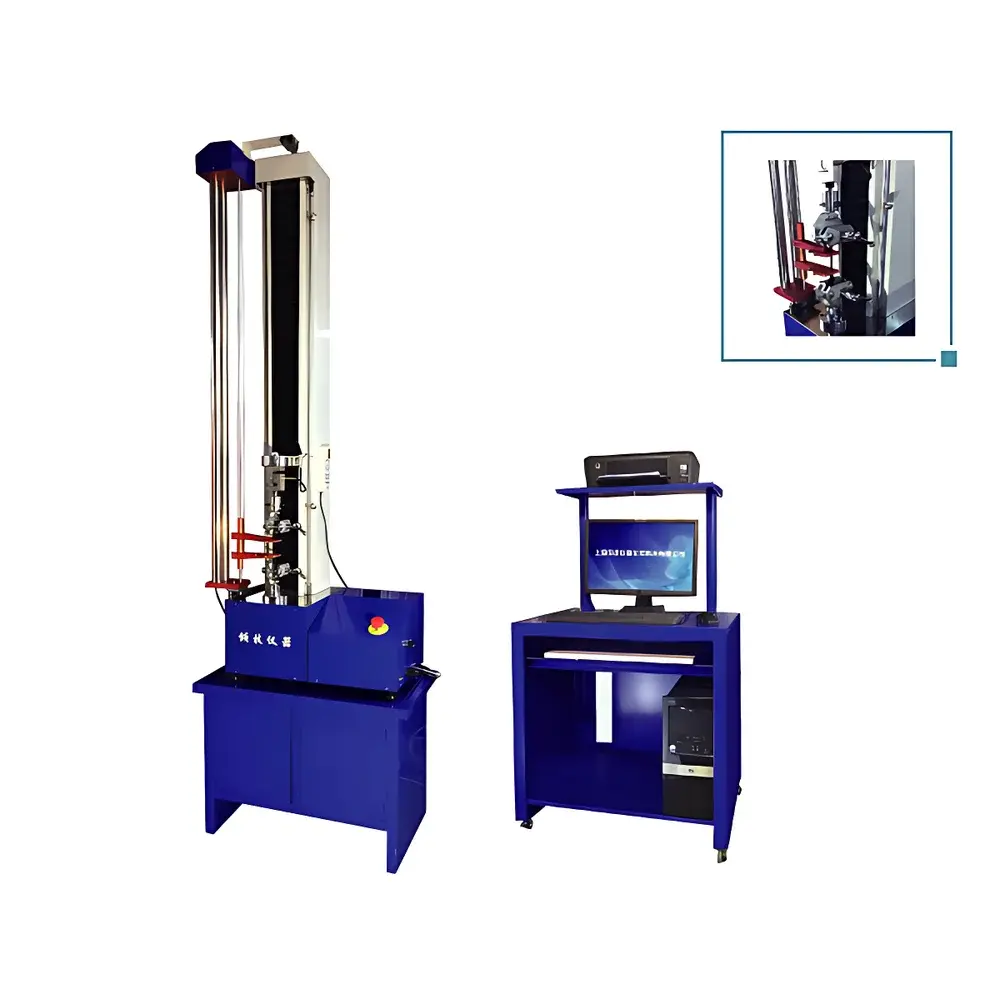
QJ210A Tensile Testing Machine by Qingji
| Brand | Qingji |
|---|---|
| Origin | Shanghai, China |
| Model | QJ210A |
| Max Test Load | 5 kN |
| Force Range | up to 5000 N |
| Force Accuracy | ±0.5% of reading |
| Travel Distance | 800 mm |
| Displacement Resolution | 0.001 mm |
| Effective Test Width | 150 mm |
| Speed Range | 0.01–500 mm/min |
| Speed Accuracy | ±0.5% of set value |
| Displacement & Deformation Accuracy | ±0.5% of reading |
| Load Cell | High-precision U.S.-sourced sensor |
| Controller | Panasonic full-digital AC servo system |
| Protection | Software diagnostics, electronic limit switches, overload protection (10% above capacity) |
| Power Supply | 200 V, 400 W |
| Dimensions (L×W×H) | 590 × 355 × 1640 mm |
| Weight | ~85 kg |
| Compliance | GB, ISO, ASTM, JIS, DIN, YB, YY, QC, HG, and other international & industry standards |
Overview
The QJ210A Tensile Testing Machine by Qingji is a microprocessor-controlled universal testing system engineered for precision mechanical property evaluation of flexible and semi-rigid materials. It operates on the principle of uniaxial static loading, applying controlled tensile, compressive, or flexural forces to specimens while continuously measuring load, displacement, and deformation in real time. Designed primarily for textile testing—including apparel, automotive interior fabrics, medical textiles, geotextiles, and industrial composites—the instrument delivers traceable, repeatable results compliant with standardized test protocols. Its modular architecture supports rapid fixture interchangeability, enabling seamless transition between tensile, peel, tear, shear, and puncture test modes without recalibration. The machine integrates high-fidelity force transduction via a U.S.-sourced load cell and closed-loop motion control using a Panasonic digital AC servo drive, ensuring consistent speed regulation and minimal hysteresis across its full 0.01–500 mm/min range.
Key Features
- Full-range force measurement capability from 5 N to 5000 N (5 kN), with automatic internal range switching and constant 500,000-count resolution—no manual scaling or external amplification required.
- High-resolution displacement detection at 0.001 mm, supported by optical encoder feedback and verified to ±0.5% accuracy per ISO 7500-1 and ASTM E4 calibration standards.
- Intuitive LCD interface with real-time graphical display of stress–strain curves, load–displacement plots, and peak/valley metrics—enabling immediate visual verification of specimen behavior during testing.
- Dual-speed crosshead actuation (fast positioning + fine adjustment) and programmable return-to-start functionality improve throughput and operator safety.
- Comprehensive hardware-based safeguards: electronic travel limits, software-driven fault diagnostics, and automatic overload cutoff at 110% of full-scale capacity.
- Robust structural design featuring extruded aluminum enclosure panels and electrostatic powder-coated finish, optimized for long-term stability in laboratory and QC environments.
Sample Compatibility & Compliance
The QJ210A accommodates specimens up to 150 mm wide and 800 mm in effective elongation length, making it suitable for woven/nonwoven textiles, polymer films, elastomeric bands, surgical sutures, packaging laminates, and coated fabrics. Fixture sets—including pneumatic, wedge-grip, peel, trouser-tear, and puncture configurations—are customizable to match sample geometry and clamping requirements. The system meets essential metrological and procedural requirements outlined in ISO 13934-1 (tensile properties of textiles), ISO 13936-2 (tear resistance), ASTM D2256 (yarn tensile), ASTM D638 (plastics tensile), GB/T 3923.1, YY/T 0148 (medical textiles), and JIS L1096. All measurement functions are traceable to national standards through factory calibration certificates issued per ISO/IEC 17025 guidelines.
Software & Data Management
The QJ210A supports direct USB or RS232 communication with Windows-based PCs running Qingji’s proprietary test control and analysis software. This platform enables full remote operation—including multi-step test sequencing, real-time curve overlay, statistical batch reporting, and export to CSV, PDF, or XML formats. Audit trail functionality records user actions, parameter changes, and calibration events in accordance with GLP and FDA 21 CFR Part 11 principles (when configured with electronic signature modules). Raw data files retain timestamped metadata, including environmental conditions (if connected to optional temperature/humidity sensors), operator ID, and equipment serial number—facilitating regulatory submissions and internal quality audits.
Applications
- Textile R&D labs evaluating breaking strength, elongation-at-break, and modulus of knits, wovens, and nonwovens under controlled humidity and temperature conditions.
- Medical device manufacturers validating suture tensile integrity, wound dressing peel adhesion, and barrier fabric burst resistance per ISO 10993 and YY/T 0681 series.
- Automotive suppliers conducting seatbelt webbing fatigue testing, airbag fabric tensile consistency checks, and interior trim seam strength verification.
- Quality control departments in packaging facilities assessing seal strength of pouches, puncture resistance of blister foils, and delamination thresholds of multilayer laminates.
- Educational institutions performing standardized mechanical property experiments aligned with ASTM D882 and ISO 527 curricula.
FAQ
What standards does the QJ210A support out of the box?
The system includes preconfigured test methods for ISO 13934-1, ASTM D2256, GB/T 3923.1, and YY/T 0148; additional standards can be loaded via software configuration files.
Can the machine perform cyclic or fatigue testing?
No—the QJ210A is designed for static monotonic tests only. For dynamic or fatigue applications, Qingji recommends the QJ212 series with electrodynamic actuation.
Is third-party calibration documentation provided with shipment?
Yes—each unit ships with a factory calibration certificate traceable to CNAS-accredited reference standards, valid for 12 months from date of dispatch.
What maintenance is required to sustain measurement accuracy?
Annual verification of force and displacement systems is recommended; Qingji offers certified service contracts including recalibration, mechanical inspection, and firmware updates.
Are custom fixtures available for non-standard specimens?
Yes—Qingji’s engineering team provides CAD-supported fixture design services based on client-supplied sample dimensions and grip interface specifications.



