
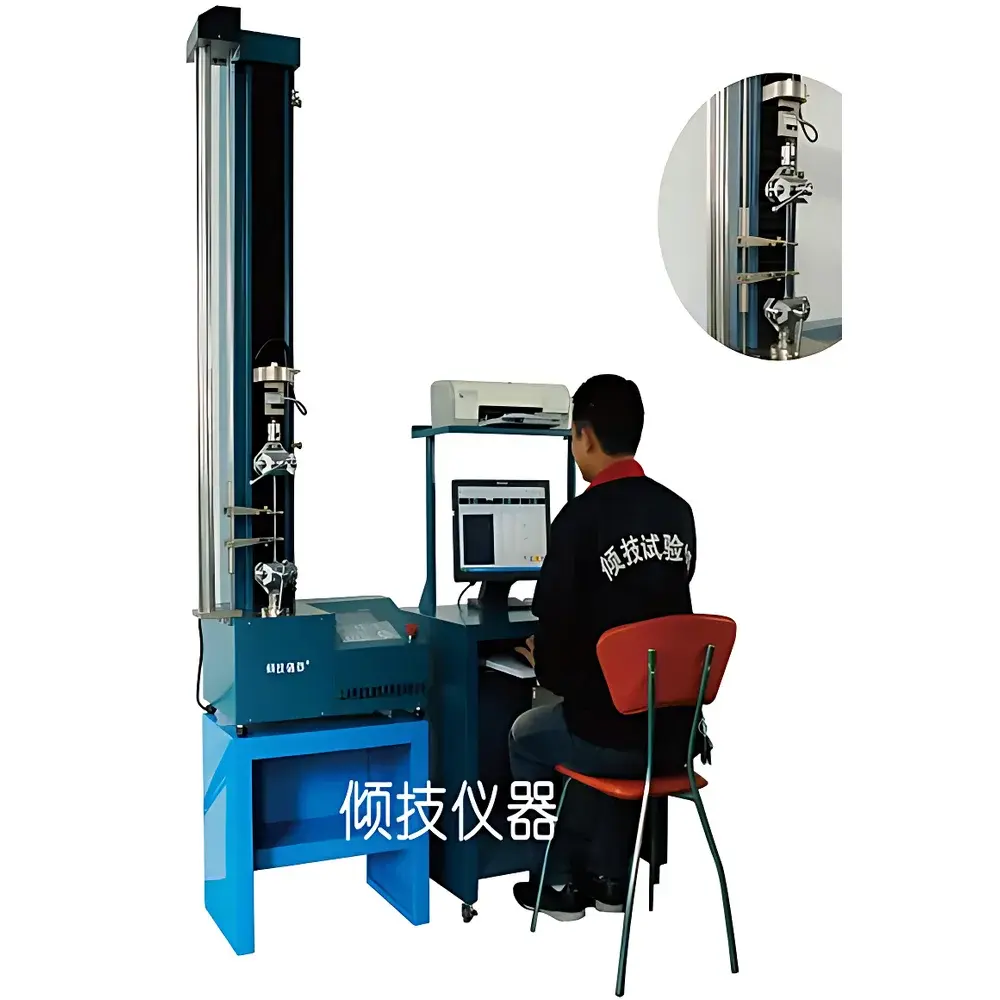
Qinji QJ2105000N Computer-Controlled Peel Strength Tester
| Brand | Qinji |
|---|---|
| Origin | Shanghai, China |
| Model | QJ2105000N |
| Maximum Load Capacity | 5000 N |
| Load Cell Accuracy | 0.01% |
| Test Accuracy | < ±1% |
| Effective Width | 150 mm |
| Effective Stroke | 800 mm (extendable) |
| Test Speed Range | 1–300 mm/min |
| Speed Accuracy | ±1% |
| Displacement Measurement Accuracy | ±1% |
| Strain Measurement Accuracy | ±1% |
| Safety Features | Electronic Limit Switches, Emergency Stop Button |
| Weight | ~85 kg |
Overview
The Qinji QJ2105000N Computer-Controlled Peel Strength Tester is a precision electromechanical universal testing system engineered for quantitative mechanical characterization of adhesive bonds, laminated structures, and flexible packaging materials. It operates on the principle of controlled uniaxial tension—applying calibrated force to separate two bonded substrates at a defined angle and rate—thereby measuring peel resistance in accordance with standardized test geometries (e.g., 90° and 180° peel per ASTM D903, ISO 8510-2, and GB/T 2790). Unlike legacy analog testers, this system integrates a high-resolution load cell (0.01% full-scale accuracy), closed-loop servo control, and real-time data acquisition synchronized with displacement and time. Its modular architecture supports not only peel testing but also tensile, compression, flexural, puncture, and elastic modulus evaluation—making it suitable for QC laboratories, R&D centers, and contract testing facilities requiring multi-test capability within a single platform.
Key Features
- High-fidelity load measurement using a precision 0.01% FS load cell, traceable to national metrological standards
- Adjustable crosshead speed from 1 to 300 mm/min with ±1% speed fidelity across the full range
- Real-time dynamic display of force–displacement curves, stress–strain plots, and peak load events via proprietary Windows-based software
- Configurable test parameters—including pre-load threshold, break detection criteria, and auto-return positioning—via intuitive GUI interface
- Rigid aluminum extrusion frame with powder-coated finish ensures long-term dimensional stability and vibration damping
- Dual-safety architecture: hardware-based electronic limit switches plus front-panel emergency stop compliant with IEC 60204-1
- Standard RS232 and USB interfaces for seamless integration with LIMS or enterprise QA databases
Sample Compatibility & Compliance
The QJ2105000N accommodates specimens up to 150 mm wide and 800 mm active stroke length, supporting common peel configurations such as tape-on-metal, film-to-film lamination, foil-to-paper composites, and medical device backing layers. Fixture options include pneumatic grip systems, peel arms (90°/180°), and custom jaw inserts for low-force thin films (<1 N) or high-stiffness composites. The system complies with essential regulatory and methodological frameworks including ASTM D3330 (pressure-sensitive tape adhesion), ISO 11339 (peel resistance of laminates), and GB/T 2792 (peel strength of adhesives). Data integrity meets GLP and GMP expectations through audit-trail-enabled software logging, user-access controls, and exportable .csv/.pdf reports compatible with FDA 21 CFR Part 11 requirements when deployed with validated configurations.
Software & Data Management
The included QTest v3.2 software provides full instrument control, automated test sequencing, and post-processing analytics. It records raw sensor data at ≥100 Hz sampling rate, applies digital filtering for noise suppression, and calculates standard metrics—including average peel force, maximum load, energy to peel (area under curve), and interfacial failure mode classification (cohesive vs. adhesive). All test files are timestamped, user-ID tagged, and stored in an encrypted local database with optional network backup. Report templates conform to ISO/IEC 17025 documentation requirements, featuring embedded calibration certificates, environmental condition logs (optional external sensor input), and statistical summaries (n ≥ 5 replicates). Export formats include PDF (print-ready), Excel (.xlsx), and XML for third-party SPC platforms.
Applications
- Quality assurance of pressure-sensitive adhesives in labeling, medical tapes, and electronic die-cut components
- Development and validation of barrier laminates used in food and pharmaceutical packaging
- Mechanical screening of battery electrode coatings during roll-to-roll manufacturing
- Adhesion performance benchmarking of automotive interior trim bonding systems
- Evaluation of delamination resistance in flexible printed circuit boards (FPCBs)
- Research-grade quantification of interfacial fracture toughness in nanocomposite films
FAQ
Is the QJ2105000N suitable for testing ultra-thin films (<25 µm)?
Yes—when equipped with low-force load cells (e.g., 100 N range) and micro-grip fixtures, the system achieves stable data acquisition down to 0.05 N resolution.
Can test methods be validated per ISO/IEC 17025?
Yes—the system supports method validation documentation packages, including repeatability studies, uncertainty budgets, and equipment qualification protocols (IQ/OQ/PQ).
Does the software support multi-user role-based access?
Yes—administrator, technician, and reviewer profiles enforce separation of duties and prevent unauthorized parameter modification.
What maintenance is required during the first year of operation?
Annual calibration verification is recommended; routine checks include belt tension, guide rail lubrication, and encoder alignment—documented in the provided maintenance logbook.
Is remote diagnostics supported?
Yes—optional secure remote access enables technical support engineers to perform firmware updates and troubleshooting without onsite visits.



