
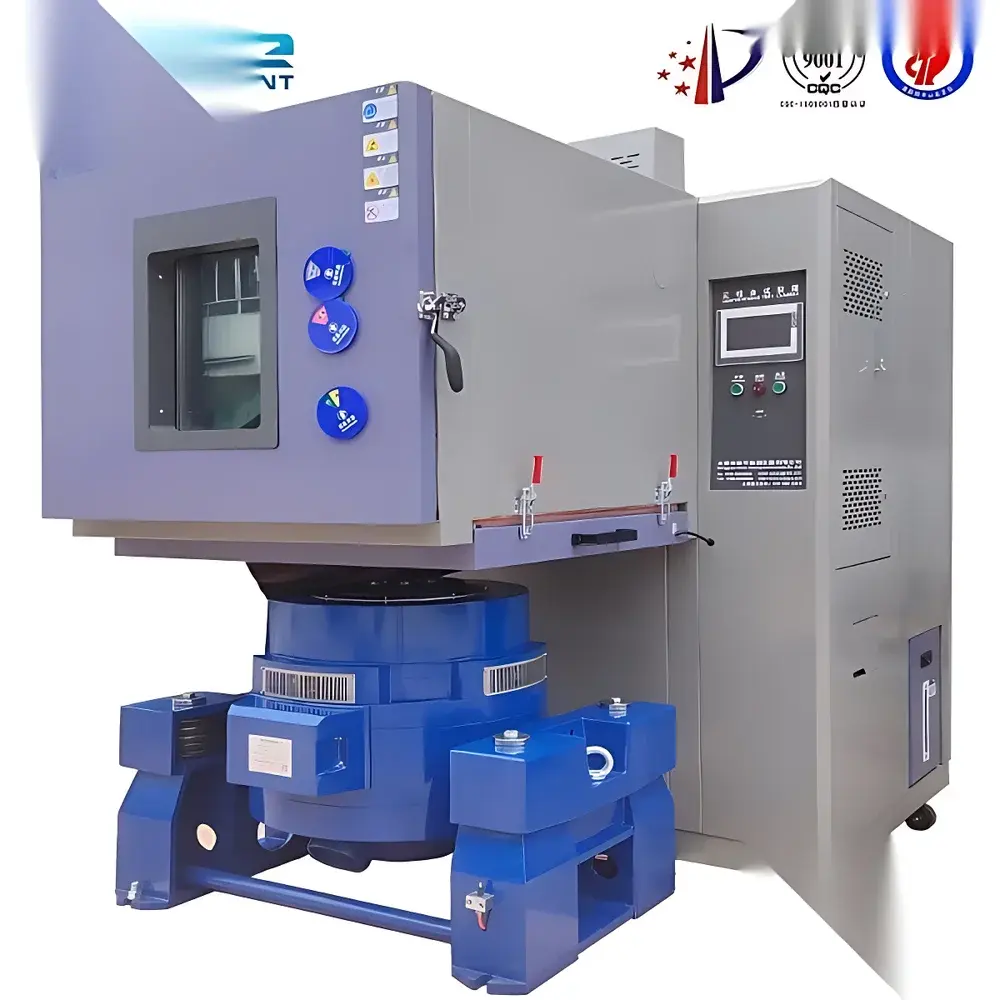
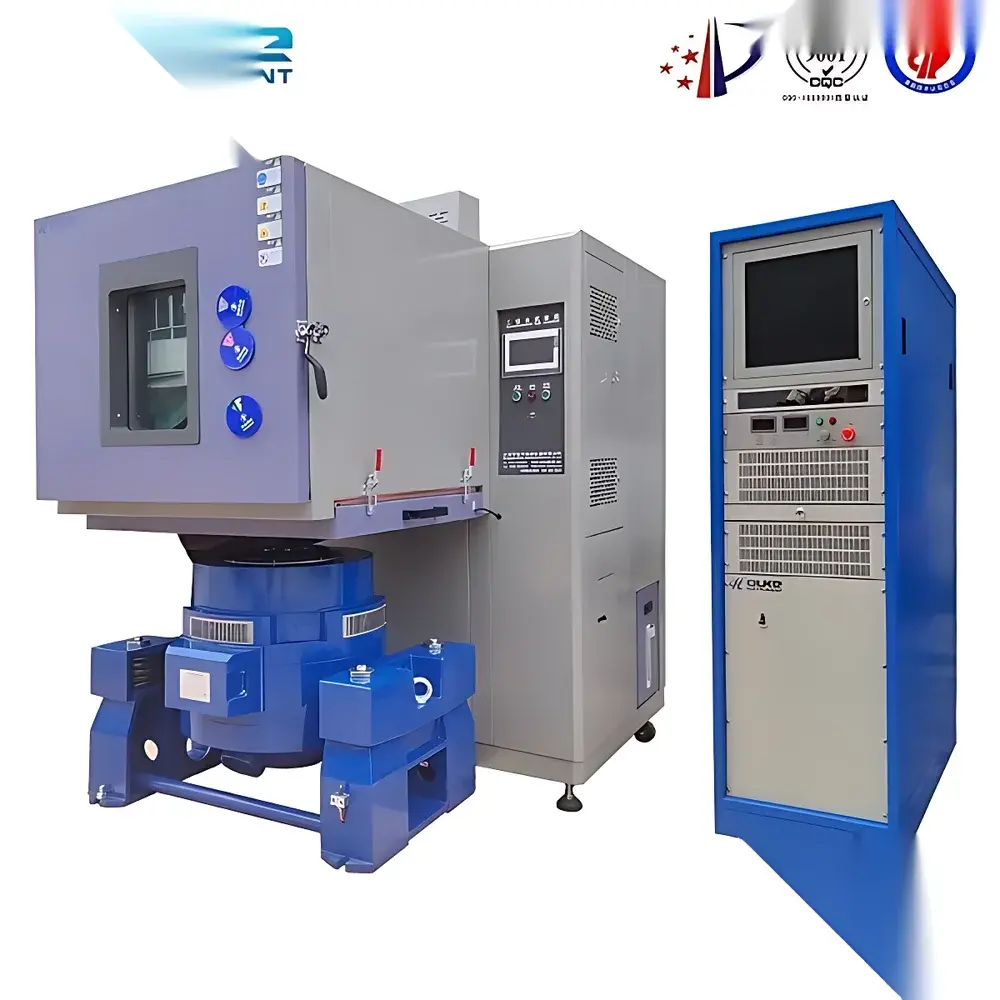
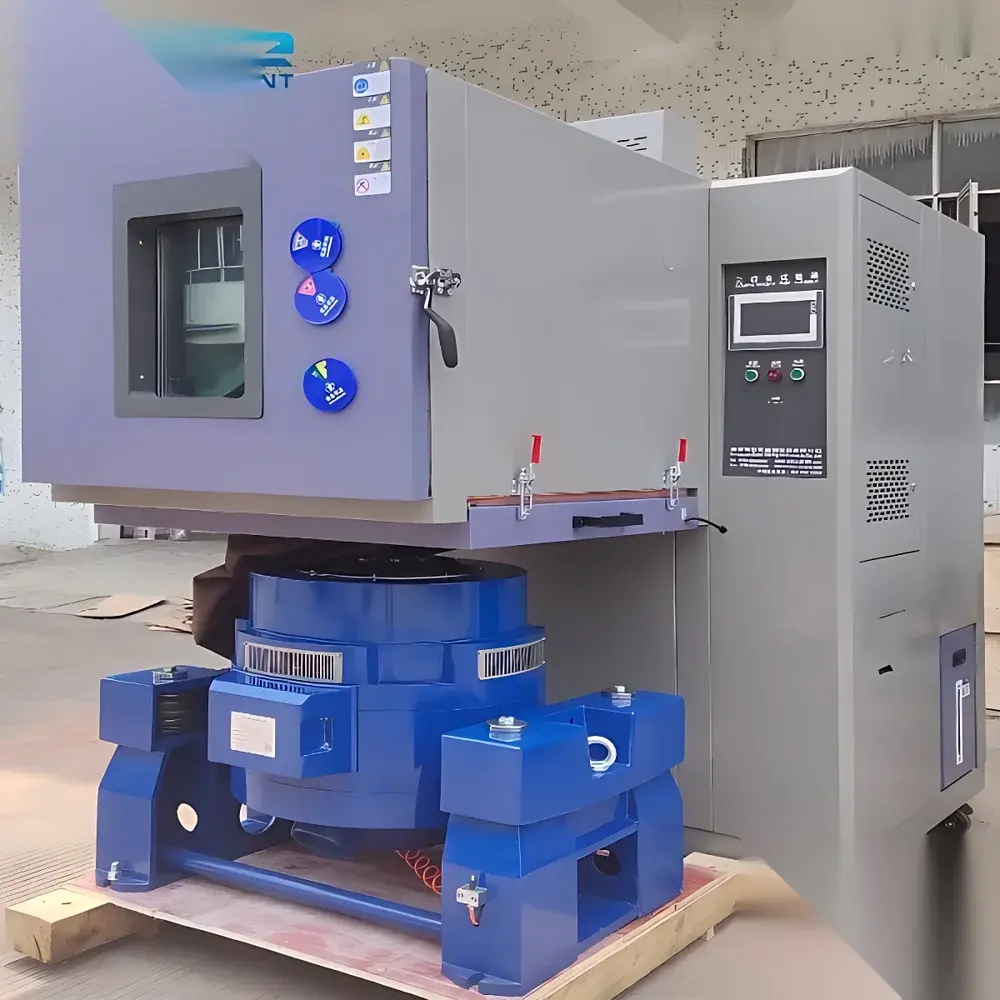
Combined Temperature-Humidity-Vibration Environmental Test Chamber – OK-ZTH Series by OEM Manufacturer
| Key | Temperature Range: -20 °C to 150 °C |
|---|---|
| Optional Ranges | -40 °C to 150 °C |
| Temp. Uniformity | ≤ ±2 °C |
| Temp. Fluctuation | ±0.5 °C |
| Temp. Deviation | ≤ ±2 °C |
| Ramp Rate | 0.7–1.0 °C/min |
| Time Setting Range | 0–9999 h |
| Vibration Force (Sine) | 2.94 kN (300 kgf) |
| Frequency Range | 5–500 Hz |
| Max. Acceleration | 980 m/s² (100 g) |
| Max. Velocity | 1.1 m/s |
| Max. Displacement | 25 mm p-p |
| Moving Mass | 2.7 kg |
| Payload Capacity | 120 kg |
| Tabletop Size | 150 mm × 150 mm |
| Vibration Axis | Vertical (Z-axis) |
| Power Supply | AC 380 V ±10%, 50 Hz, 3-phase 5-wire |
| Refrigeration | Dual-stage cascade system with Copeland/Tecumseh-compatible compressors, Danfoss filter-driers, and Castel solenoid valves |
| Internal Dimensions (L×W×H) | 500×600×750 mm (OK-ZTH-225) |
Overview
The OK-ZTH Series Combined Temperature-Humidity-Vibration Environmental Test Chamber is an integrated reliability validation platform engineered for simultaneous exposure of test specimens to controlled thermal, hygrothermal, and dynamic mechanical stress conditions. It operates on the principle of synchronized multi-stress acceleration—combining precision climate control (via dual-stage refrigeration and steam-based humidification) with high-fidelity electrodynamic vibration excitation (vertical Z-axis only). This triaxial stress coupling enables accelerated life testing per industry standards including MIL-STD-810H Method 520.3 (Combined Environments), RTCA DO-160 Section 25 (Environmental Conditions and Test Procedures for Airborne Equipment), and IEC 60068-2-64 (Random Vibration) and IEC 60068-2-52 (Salt Mist + Humidity + Temperature Cycling). The chamber is designed for laboratory and production-line use in aerospace component qualification, automotive ECUs, avionics packaging, and high-reliability PCB assemblies where failure modes are triggered synergistically—not in isolation.
Key Features
- Triple-stress integration architecture: Independent yet synchronized control of temperature (−60 °C to +150 °C), relative humidity (10–98% RH), and vertical vibration (5–500 Hz, up to 100 g peak acceleration).
- Dual-stage cascade refrigeration system utilizing hermetic compressors compliant with ISO 5149 safety requirements; includes oil separation (GuanYa), desiccant filtration (Emerson/AIGAO), and precision expansion control (Castel solenoid valves).
- Uniform airflow management via multi-blade centrifugal circulation fans and optimized duct geometry—achieving ≤ ±2 °C temperature uniformity across full working volume per IEC 60068-3-5.
- Electrodynamic shaker subsystem with force rating of 2.94 kN (300 kgf) sine, 25 mm p-p displacement limit, and real-time closed-loop acceleration control using IEPE-accelerometer feedback.
- Modular internal construction with stainless-steel chamber walls, insulated double-glass observation window, and IP54-rated electrical cabinet conforming to EN 60529.
- Comprehensive safety interlocks: over-temperature cutoff, refrigerant pressure monitoring, vibration overload protection, door-open emergency stop, and dry-run prevention for humidifier.
Sample Compatibility & Compliance
The OK-ZTH series accommodates test specimens up to 120 kg mass and dimensions compatible with standard mounting fixtures (e.g., ISO 10816-3 compliant adapters). Its vertical-only vibration axis aligns with common mounting configurations for printed circuit board assemblies, sensor modules, and enclosure-integrated electronics. The system meets electromagnetic compatibility requirements per EN 61326-1 (industrial environment) and is configured for compliance-ready operation under GLP and GMP frameworks—including audit-trail-enabled event logging, user-access level controls, and calibration traceability documentation. While not pre-certified to FDA 21 CFR Part 11, the controller firmware supports optional electronic signature modules and ALCOA+ data integrity protocols when deployed with validated IT infrastructure.
Software & Data Management
Equipped with a Windows-based HMI controller running proprietary real-time OS, the system provides synchronized waveform generation (sine, random, shock, and profile-based vibration), programmable ramp/soak/humidity cycles, and concurrent data acquisition at ≥100 Hz sampling rate. All operational parameters—including chamber temperature, chamber humidity, shaker acceleration, velocity, displacement, and power supply metrics—are logged with UTC timestamps and stored in CSV/SQLite format. Exported datasets comply with ASTM E2925 for environmental test reporting and support post-processing in MATLAB, Python (SciPy/Pandas), or commercial FEA tools for correlation with finite element fatigue models. Remote monitoring via Ethernet (TCP/IP) enables integration into centralized MES or PLM platforms using Modbus TCP or OPC UA interfaces.
Applications
- Aerospace: Qualification of flight-critical sensors, inertial measurement units (IMUs), and satellite payload housings under combined thermal cycling and launch-vibration spectra.
- Automotive: Validation of ADAS domain controllers, battery management systems (BMS), and radar front-end modules per ISO 16750-4 and LV-124.
- Medical Devices: Reliability screening of implantable pulse generators and diagnostic imaging subsystems per ISO 14971 risk management and IEC 60601-1 environmental clauses.
- Consumer Electronics: Stress screening of foldable display hinges, MEMS microphones, and 5G mmWave antenna arrays exposed to condensation-prone thermal transients.
- Research & Development: Mechanistic studies of solder joint fatigue, conformal coating delamination, and polymer creep under coupled thermo-hygro-mechanical loading.
FAQ
What standards does this chamber support for combined environment testing?
It is configured to execute test profiles aligned with MIL-STD-810H Method 520.3, RTCA DO-160 Section 25, IEC 60068-2-64 (random vibration), and IEC 60068-2-52 (cyclic salt/humidity/temperature), though final validation requires customer-specific test plan review.
Can the vibration system operate independently of climate control?
Yes—each subsystem (temperature/humidity, vibration, and data acquisition) can be operated in standalone mode or fully synchronized via master-slave timing triggers.
Is calibration certification included with shipment?
A factory calibration report (traceable to NIST or equivalent national metrology institute) is provided; on-site ISO/IEC 17025 accredited calibration is available as an optional service.
What maintenance intervals are recommended for the refrigeration system?
Compressor oil and filter-drier replacement every 24 months or 8,000 operating hours—whichever occurs first—under normal usage conditions (≤70% duty cycle, ambient ≤30 °C).
Does the controller support custom test script programming?
Yes—TCL/Python-based scripting interface is available via optional SDK license, enabling conditional logic, external sensor input triggering, and automated pass/fail evaluation against user-defined thresholds.



