
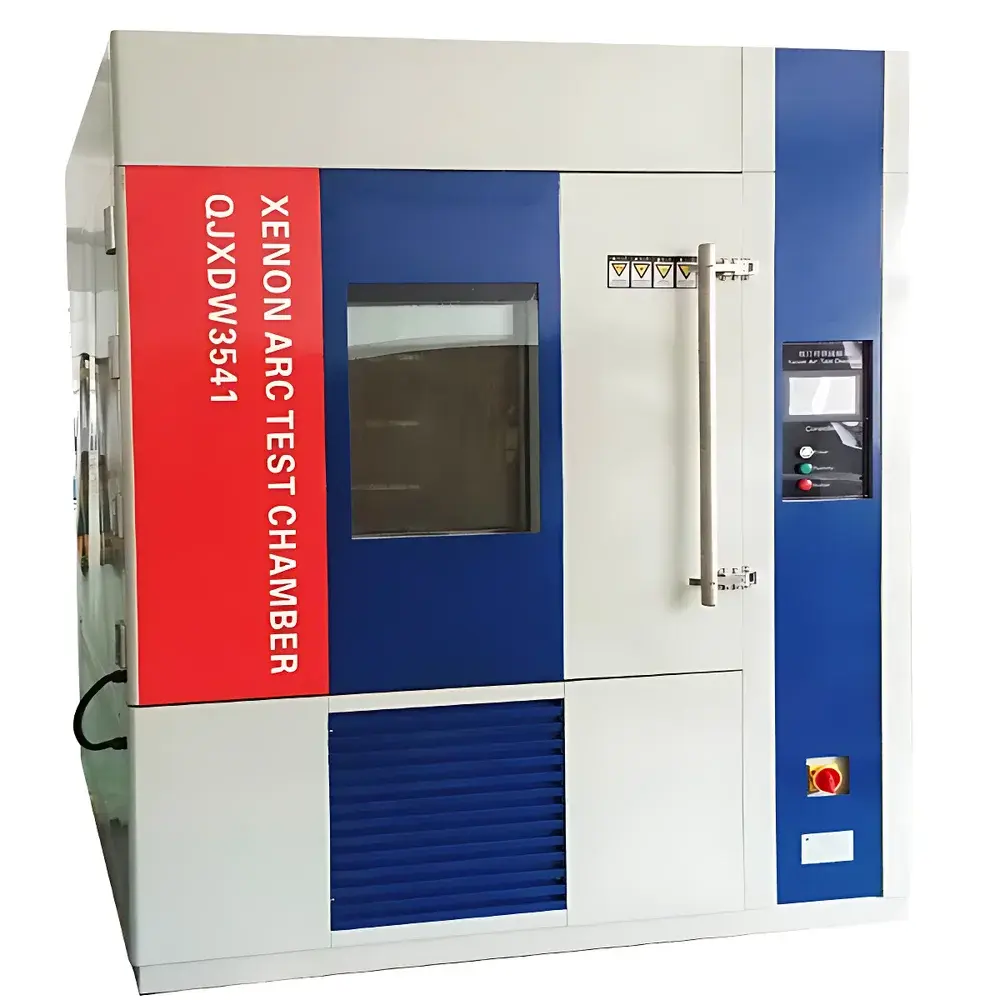
QJXDW3541 Xenon Arc Weathering Test Chamber
| Origin | Shanghai, China |
|---|---|
| Manufacturer Type | Authorized Distributor |
| Origin Category | Domestic (PRC) |
| Model | QJXDW3541 |
| Price | USD 9,400 (FOB Shanghai) |
| Xenon Lamp Power | 6 kW |
| Spectral Irradiance | 550 W/m² (300–800 nm) |
| Light Exposure Cycle | 0–240 min (adjustable on/off intervals) |
| Humidity Control Range | RT+10°C to 80°C ±1°C |
| Rainfall Duration | 0–9999 min (adjustable) |
| Rainfall Interval | 0–240 min (adjustable) |
| Lamp Lifetime | ~2000 h |
| Sample Holder Rotation Speed | 5 rpm |
| Sample Holder Radii | Inner 100 mm / Outer 220 mm |
| Center-to-Center Distance | 165 mm |
| Sample Holder Height | 420 mm |
| Chamber Interior Dimensions | 500 × 500 × 600 mm (L×W×H) |
| Spectral Range | 290–800 nm |
| Temperature Uniformity | ≤2°C |
Overview
The QJXDW3541 Xenon Arc Weathering Test Chamber is an engineered environmental simulation system designed to accelerate the evaluation of material degradation under controlled exposure to solar radiation, thermal cycling, and moisture—key stressors in real-world outdoor service life. It operates on the principle of xenon arc irradiation, which delivers a spectral power distribution closely matching natural sunlight (290–800 nm), including critical UV, visible, and near-infrared bands. Unlike UV fluorescent or metal halide sources, xenon arc lamps provide broad-spectrum fidelity essential for replicating photochemical degradation mechanisms in polymers, coatings, automotive glazing, architectural composites, and aerospace substrates. The chamber integrates irradiance-controlled light exposure with precise temperature regulation (RT+10°C to 80°C ±1°C), programmable condensation cycles, and calibrated rainfall simulation—enabling ISO 4892-2, ASTM G155, SAE J2527, and GB/T 16422.2-compliant test protocols.
Key Features
- 6 kW water-cooled xenon lamp assembly with spectral output calibrated to CIE No. 85 reference, delivering 550 W/m² irradiance across 300–800 nm band
- Dual-mode humidity control: condensation via saturated air cooling + programmable spray cycle (0–9999 min duration, 0–240 min interval)
- Rotating sample holder (5 rpm) with dual-radius configuration (100 mm inner / 220 mm outer) ensuring uniform irradiance distribution per ISO 4892-2 Annex B
- Digital irradiance monitoring with real-time display and integrated radiometric积分 (accumulated energy in kJ/m²)
- Intelligent PID-controlled thermal system with ≤2°C spatial uniformity across 500 × 500 × 600 mm test volume
- Modular sample tray design accommodating standard ISO 105-B02, AATCC TM16, and ASTM D2244-compliant specimen frames
- Compliance-ready architecture supporting audit trails, user access levels, and calibration logging per GLP/GMP requirements
Sample Compatibility & Compliance
The QJXDW3541 accommodates flat-panel specimens up to 420 mm height and supports both rigid and flexible substrates—including automotive safety glass laminates, powder-coated aluminum composite panels (ACPs), polymeric roofing membranes, marine-grade PVC, and aerospace-grade thermoplastics. Its test methodology aligns with internationally recognized standards: ISO 4892-2 (plastics), ISO 11341 (paints and varnishes), ASTM D4329 (plastic laboratory weathering), ASTM D4459 (interior plastics), SAE J2412/J2527 (automotive exterior materials), and GB/T 16422.2 (Chinese national standard). All irradiance sensors are NIST-traceable; temperature and humidity transducers meet IEC 60751 Class B accuracy specifications. The system supports full traceability for FDA 21 CFR Part 11–compliant validation when paired with optional software modules.
Software & Data Management
Equipped with embedded industrial-grade controller featuring 7-inch capacitive touchscreen interface, the QJXDW3541 enables fully programmable multi-step test sequences—including simultaneous modulation of irradiance setpoints, black panel temperature, chamber humidity, spray duration/frequency, and dark-cycle cooling profiles. Data logging records irradiance (W/m²), chamber temperature (°C), relative humidity (%RH), and elapsed exposure time at user-defined intervals (1 s to 60 min resolution). Export formats include CSV and XML for integration into LIMS platforms. Optional PC-based software provides advanced analysis tools: spectral mismatch correction, Arrhenius-based lifetime projection, and comparative degradation kinetics across multiple test runs—supporting root-cause analysis of yellowing, chalking, gloss loss, or tensile strength reduction.
Applications
- Accelerated aging validation of automotive interior/exterior trim components per OEM specifications (Ford WERCS, GMW14124, VW TL226)
- Formulation screening for UV-stabilized polyolefins, acrylic resins, and fluoropolymer coatings
- Qualification testing of photovoltaic encapsulants and backsheet materials per IEC 61215
- Regulatory compliance verification for medical device packaging (ISO 11607) and pharmaceutical secondary packaging (ICH Q1B)
- Correlation studies between accelerated test data and field exposure in diverse climatic zones (Arizona desert, Florida subtropics, Nordic maritime)
- Failure mode analysis of adhesives, sealants, and structural composites subjected to thermo-photo-oxidative stress
FAQ
What spectral range does the xenon lamp cover, and how is it filtered?
The lamp emits from 290 nm to 800 nm. Standard operation uses borosilicate inner and outer filters (e.g., Daylight-Q/B) to replicate terrestrial solar UV cutoff and visible/NIR balance per ISO 4892-2.
Is the irradiance value of 550 W/m² adjustable?
Yes—the system supports irradiance setpoints from 300 to 800 W/m² (300–800 nm) via closed-loop feedback control using a calibrated broadband sensor.
How is temperature uniformity validated across the test chamber?
Uniformity is verified per ASTM E145 Annex A using nine calibrated PT100 probes placed at defined locations within the working volume during qualification.
Does the system support rain simulation with controlled water resistivity?
Yes—integrated deionized water reservoir (≥1 MΩ·cm resistivity) and pressure-regulated nozzles ensure consistent droplet size and impact velocity per ASTM G155 Cycle 1–5 specifications.
What maintenance intervals are recommended for the xenon lamp and optical filters?
Lamp replacement is advised every ~2000 hours of operation; quartz outer filters require cleaning after each 100-hour cycle and replacement every 500 hours; inner filters per manufacturer’s spectral drift calibration schedule.



