
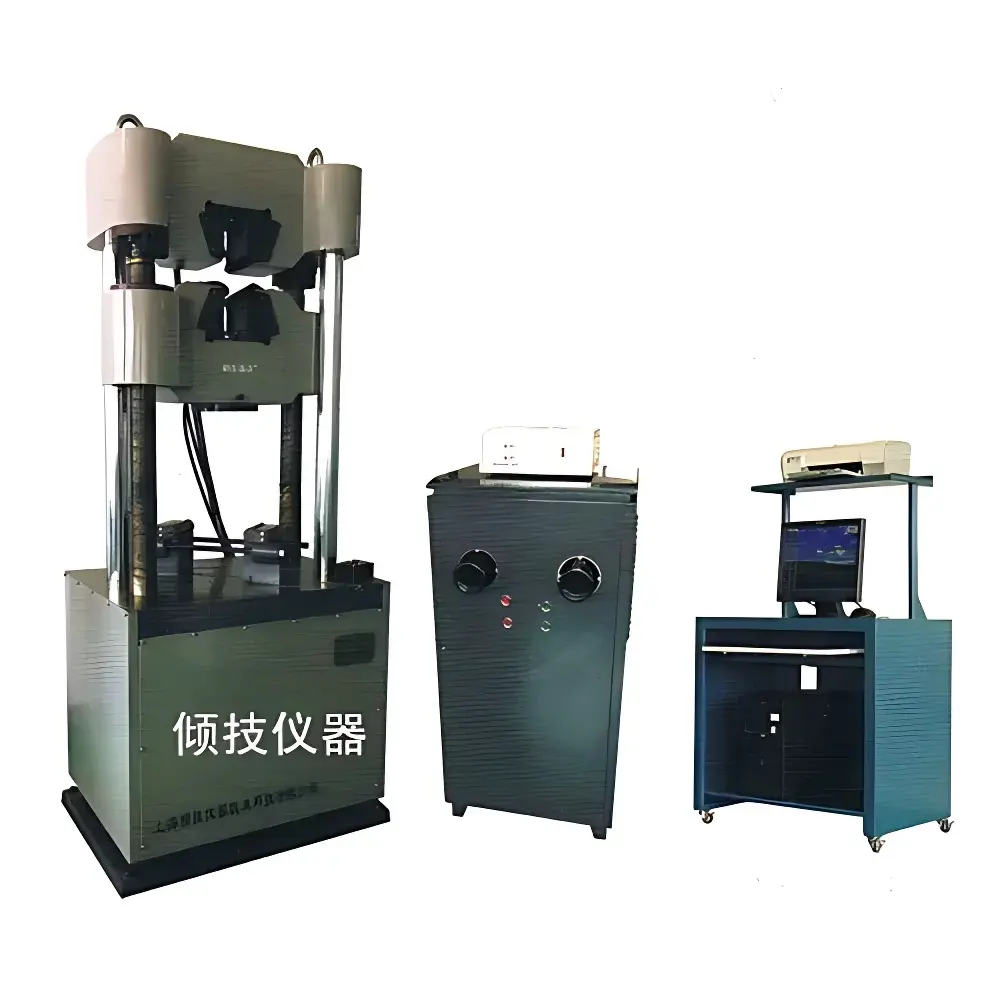
Qinji QJWE2000 Hydraulic Universal Testing Machine
| Brand | Qinji |
|---|---|
| Origin | Shanghai, China |
| Model | QJWE2000 |
| Maximum Load Capacity | 2000 kN |
| Test Types | Tensile, Compression, Bending, Shear |
| Loading System | Bottom-mounted hydraulic actuator with adjustable test space |
| Control System | Microprocessor-based electro-hydraulic servo (proportional) closed-loop control |
| Load Measurement | Imported high-precision load cell |
| Accuracy | ±0.5% of full scale |
| Resolution | ≤0.5% of full scale |
| Compression Space | up to 510 mm |
| Tensile Space | up to 610 mm |
| Round Specimen Grip Range | φ25–70 mm |
| Flat Specimen Grip Thickness | 0–40 mm |
| Piston Stroke | 170 mm |
| Max. Distance Between Bending Supports | 100–500 mm |
| Shear Specimen Diameter | φ10–30 mm |
| Dimensions (W×D×H) | 950×650×2220 mm |
| Motor Power | 2.1 kW, 3-phase |
| Weight | 2500 kg |
| Compliance | ASTM E4, ASTM E8, ISO 6892-1, ISO 37, GB/T 228.1 |
Overview
The Qinji QJWE2000 Hydraulic Universal Testing Machine is a heavy-duty, floor-standing electro-hydraulic servo-controlled system engineered for high-force mechanical characterization of structural and engineering materials. Operating on the principle of controlled hydraulic actuation with real-time closed-loop feedback, it delivers precise force application across tensile, compressive, flexural, and shear loading modes — all traceable to international standards including ASTM E4 (verification of force-measuring instruments), ASTM E8/E21 (tensile testing of metallic materials), ISO 6892-1 (metallic materials – tensile testing at ambient temperature), and ISO 37 (rubber – determination of tensile strength). With a nominal capacity of 2000 kN (204 metric tons), the machine accommodates large-scale specimens typical in civil infrastructure, aerospace component validation, and metallurgical quality assurance. Its bottom-mounted cylinder design provides an open-front workspace, enabling straightforward specimen installation and alignment — critical for maintaining axial load fidelity during high-force testing.
Key Features
- Electro-hydraulic servo (proportional) closed-loop control architecture ensures stable, programmable loading rates from 0.001 to 100 mm/min, supporting quasi-static and creep-compatible protocols.
- Imported high-accuracy load cell calibrated to ±0.5% of full scale, with resolution better than 0.5% FS, meeting Class 1 accuracy requirements per ISO 7500-1.
- Adjustable test space configuration: compression height up to 510 mm; tensile gauge length up to 610 mm; bending support span configurable from 100 to 500 mm.
- Dual-mode gripping system: wedge-action hydraulic clamps for round specimens (φ25–70 mm) and flat specimens (up to 40 mm thick), minimizing slippage and stress concentration.
- Integrated displacement measurement via linear variable differential transformer (LVDT) and extensometer-ready interfaces for strain-controlled testing per ASTM E83 or ISO 9513.
- Robust cast-iron frame with reinforced crosshead and guide columns ensures minimal deflection (<0.1 mm under full load), preserving geometric integrity during multi-cycle tests.
Sample Compatibility & Compliance
The QJWE2000 accommodates a broad spectrum of standardized and custom specimens: metallic rods and plates (per ASTM E8, ISO 6892-1), concrete cylinders (ASTM C39, EN 12390-3), cementitious composites, polymer sheets (ISO 527), rubber compounds (ISO 37), and structural timber (ASTM D143). All test configurations comply with GLP-aligned documentation practices, and raw data acquisition supports audit-ready export formats (CSV, XML) compatible with FDA 21 CFR Part 11-compliant LIMS integration when paired with validated software modules. Mechanical safety conforms to ISO 12100 and EN 698 (hydraulic press safety requirements).
Software & Data Management
The system operates with Qinji’s proprietary WinTest Pro v5.x software — a Windows-based platform supporting real-time curve overlay, multi-channel synchronization (load, displacement, extensometer, environmental inputs), and automated test sequencing. It generates compliant reports conforming to ASTM E4, ISO 7500-1, and GB/T 228.1 templates, including graphical stress–strain curves, modulus calculation (secant/tangent), yield point identification (0.2% offset), ultimate tensile strength, elongation at break, and reduction of area. Data files include embedded metadata (operator ID, calibration timestamp, environmental conditions) and support digital signature workflows. Export options include PDF, Excel, and ASCII-delimited formats suitable for third-party statistical analysis (e.g., Minitab, JMP).
Applications
- Mechanical validation of structural steel grades (S355, A572, ASTM A615) under static and cyclic loading conditions.
- Compressive strength evaluation of precast concrete elements, grouts, and high-performance cement blends.
- Bending stiffness and fracture toughness assessment of fiber-reinforced polymer (FRP) laminates per ASTM D7264.
- Shear resistance testing of bolted joints, welds, and adhesive bonds using standardized double-shear fixtures.
- Quality conformance verification for offshore pipeline girth welds, pressure vessel forgings, and rail axle components.
- R&D support for material substitution studies, including aluminum alloys (AA6061-T6, AA7075-T73) and titanium grades (Ti-6Al-4V).
FAQ
What standards does the QJWE2000 support out-of-the-box?
It natively supports test methods defined in ASTM E4, E8, E21, C39, D143; ISO 6892-1, 37, 7500-1, 9513; EN 12390-3; and GB/T 228.1, with preloaded method templates and report structures.
Is the system compatible with external extensometers?
Yes — the controller features analog and digital input channels for third-party clip-on or non-contact extensometers (e.g., HBM, MTS, Zwick), with automatic zeroing and calibration import.
Can test data be integrated into enterprise LIMS or ERP systems?
Raw data exports (CSV/XML) and structured PDF reports are fully scriptable; optional OPC UA or REST API add-ons enable direct integration with LabWare, Thermo Fisher SampleManager, or SAP QM modules.
What maintenance intervals are recommended for hydraulic oil and filters?
Hydraulic oil should be replaced every 2,000 operating hours or biannually (whichever occurs first); suction and pressure filters require inspection every 500 hours and replacement as needed per ISO 4406 cleanliness codes.
Does the system support multi-step load–hold–unload profiles for creep or relaxation testing?
Yes — WinTest Pro enables user-defined multi-segment ramp/hold sequences with programmable dwell times, load thresholds, and conditional branching based on real-time strain or displacement feedback.



