
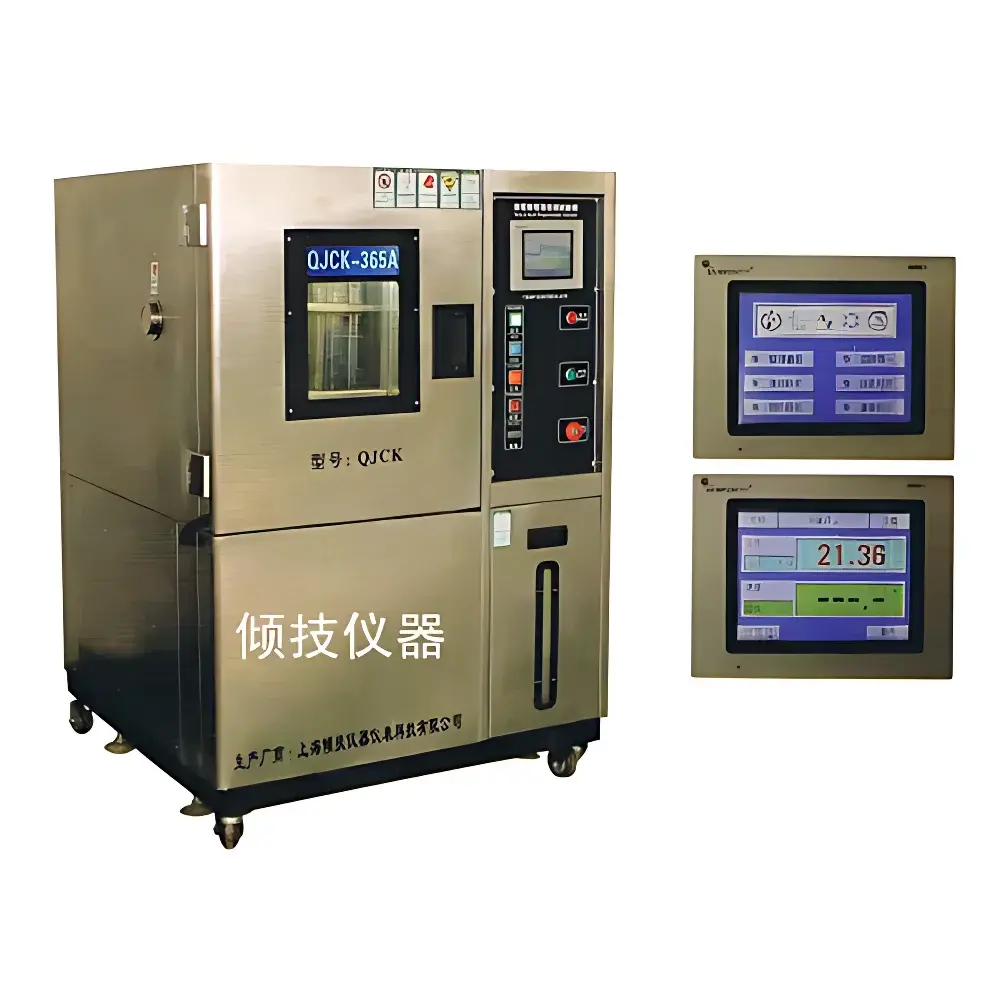
Qingji QJCK-350 Temperature and Humidity Controlled Environmental Chamber for Refractory Material Curing
| Brand | Qingji |
|---|---|
| Origin | Shanghai, China |
| Model | QJCK-350 |
| Temperature Range | −40 °C to +150 °C |
| Humidity Range | 10 %RH to 99.9 %RH |
| Temperature Resolution | 0.01 °C |
| Humidity Resolution | 0.01 %RH |
| Temperature Uniformity | ±2.0 °C |
| Humidity Uniformity | ±3.0 %RH |
| Temperature Accuracy | ±0.5 °C |
| Humidity Accuracy | ±2.5 %RH |
| Programmable Steps | 120 programs / 1200 segments |
| Internal Dimensions (H×W×D) | 450 × 400 × 350 mm |
| External Dimensions (H×W×D) | 1550 × 920 × 820 mm |
| Power Supply | 220 V AC |
| Rated Power | 2.0 kW |
| Net Weight | ~180 kg |
| Configuration | Vertical upright chamber |
| Compliance | Designed for ISO 5725 (accuracy & reproducibility), ASTM E145 (standard practice for gravity-convection and forced-ventilation ovens), and GB/T 2423.3–2016 (IEC 60068-2-78) for damp heat testing |
Overview
The Qingji QJCK-350 Temperature and Humidity Controlled Environmental Chamber is an engineered solution for standardized conditioning and long-term curing of refractory materials under precisely regulated thermal and hygroscopic conditions. Designed in accordance with international standards for environmental simulation—including ISO 5725 (accuracy and precision of measurement methods), ASTM E145 (classification and performance requirements for laboratory ovens and chambers), and GB/T 2423.3–2016 (equivalent to IEC 60068-2-78 for damp heat, steady-state testing)—this vertical upright chamber provides stable, repeatable control over temperature (−40 °C to +150 °C) and relative humidity (10 %RH to 99.9 %RH). Its primary function is to replicate service environments where refractory ceramics, monolithic linings, insulating castables, and high-alumina bricks undergo hydration, carbonation, or thermal stabilization prior to mechanical or thermal property evaluation. The chamber employs a dual-loop PID control architecture with independent regulation of refrigeration, heating, and humidification subsystems, ensuring minimal cross-coupling between temperature and humidity setpoints during extended dwell cycles.
Key Features
- High-stability dual-channel PID control system with real-time feedback from calibrated platinum resistance thermometers (PT100) and capacitive RH sensors
- Forced-air convection design with adjustable air velocity and directional baffling to ensure uniform thermal distribution (±2.0 °C) and humidity homogeneity (±3.0 %RH) across the working volume
- Programmable test profiles supporting up to 120 multi-step programs (1200 total segments), enabling complex sequences such as ramp-hold-soak cycles, cyclic humidity sweeps, and accelerated aging protocols
- Stainless steel interior chamber (SUS304) with seamless welding and rounded corners to prevent condensate accumulation and support cleaning validation per GLP-compliant laboratories
- Insulated double-wall construction with high-density polyurethane foam (≥100 mm thickness) and vacuum-sealed door gasket to minimize thermal leakage and energy consumption
- Integrated safety interlocks including over-temperature cutoff, compressor high-pressure protection, and humidity sensor self-diagnostic monitoring
Sample Compatibility & Compliance
The QJCK-350 accommodates standard refractory specimen configurations—including 230 mm × 114 mm × 65 mm firebrick samples, 150 mm cube castables, and 50 mm diameter cylindrical cores—within its 63 L internal workspace (450 × 400 × 350 mm). It meets the physical and operational requirements of key industry standards: ASTM C1534 (test method for drying shrinkage of refractory plastic and ramming mixes), ISO 2245 (refractories — determination of permanent linear change on heating), and EN 993-4 (determination of cold crushing strength). All control algorithms and calibration traceability comply with ISO/IEC 17025:2017 clause 6.4.10 (equipment verification), and the chamber supports audit-ready documentation for GMP and GLP environments when paired with optional data logging hardware.
Software & Data Management
The embedded controller features a 7-inch TFT-LCD touchscreen interface with multilingual support (English, Chinese, Spanish) and built-in USB data export capability. Real-time trend graphs for temperature and humidity are continuously logged at user-selectable intervals (1 s to 60 min), with timestamped CSV files compatible with LIMS integration. Optional Ethernet connectivity enables remote monitoring via Modbus TCP or OPC UA protocols, allowing centralized supervision in multi-chamber test facilities. For regulatory compliance, optional 21 CFR Part 11-compliant software add-ons provide electronic signatures, role-based access control, and immutable audit trails—fully aligned with FDA expectations for electronic records in material qualification workflows.
Applications
- Curing of low-cement and ultra-low-cement refractory castables under controlled humidity to optimize hydraulic bond development
- Conditioning of ceramic fiber modules prior to hot-face exposure testing per ASTM C892
- Simulating tropical or desert storage environments for refractory preforms used in petrochemical furnace linings
- Accelerated moisture absorption/desorption cycling to assess microcracking susceptibility in alumina-silica composites
- Pre-test stabilization of specimens before compressive strength (ASTM C133), modulus of rupture (ASTM C704), or thermal conductivity (ASTM C201) measurements
- Validation of binder burnout schedules in carbon-bonded magnesia-carbon bricks through programmed humidity ramps
FAQ
What standards does the QJCK-350 chamber comply with for refractory material testing?
It is engineered to meet ASTM E145, ISO 5725, GB/T 2423.3–2016, and supports method validation per ASTM C1534 and ISO 2245.
Can the chamber maintain both temperature and humidity simultaneously during extended dwell periods?
Yes—its independent dual-loop control system ensures stable co-regulation for durations exceeding 168 hours without drift beyond specified accuracy limits.
Is the internal chamber suitable for corrosive atmospheres generated during refractory curing?
The SUS304 stainless steel interior and sealed humidification reservoir resist chloride-induced pitting and alkali attack typical in calcium aluminate cement systems.
Does the system support third-party calibration and traceable certification?
All factory calibrations are traceable to NIM (National Institute of Metrology, China) standards; optional UKAS-accredited calibration certificates are available upon request.
What maintenance intervals are recommended for sustained accuracy?
Humidity sensor recalibration every 6 months and full system verification annually—aligned with ISO/IEC 17025 preventive maintenance guidelines.



