
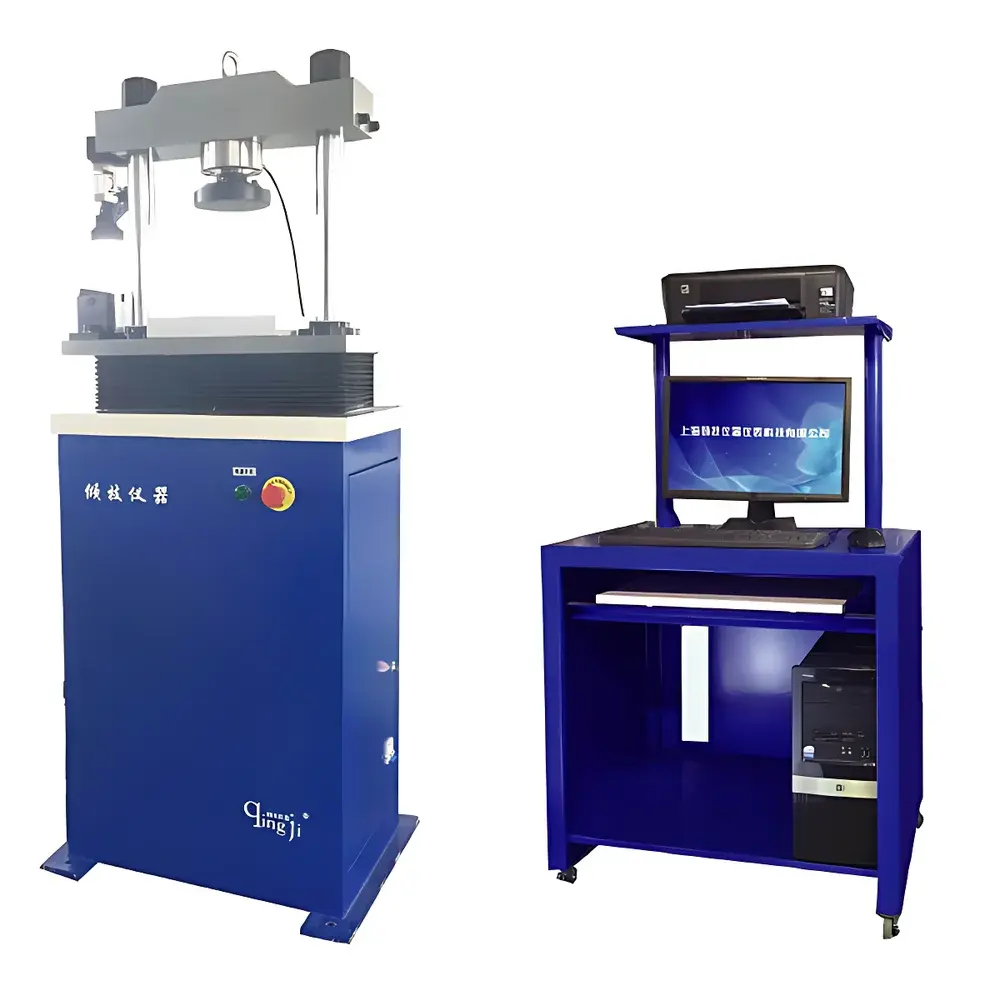
QJYL872 Universal Compression and Flexural Testing Machine
| Origin | Shanghai, China |
|---|---|
| Manufacturer Type | Authorized Distributor |
| Origin Classification | Domestic (China) |
| Model | QJYL872 |
| Price | USD 4,950 (FOB Shanghai) |
| Max. Compression Load Capacity | 300 kN |
| Flexural Load Capacity | 10 kN |
| Load Application Rate (Compression) | 0–10 kN/s |
| Load Application Rate (Flexure) | 0–0.075 kN/s |
| Maximum Platen Spacing | 500 mm |
| Platen Dimensions | Customizable per application requirement |
| Indicated Relative Error | ±1.0% |
Overview
The QJYL872 Universal Compression and Flexural Testing Machine is an electromechanical static testing system engineered for high-reproducibility mechanical characterization of construction materials under uniaxial compressive and three-point bending loads. Based on servo-controlled hydraulic actuation with closed-loop load feedback, the system complies with fundamental principles of ASTM E4, ISO 7500-1, and GB/T 2611—ensuring traceable force calibration and consistent loading profiles. Designed specifically for routine quality control and conformity assessment in cementitious systems, masonry units, and precast concrete elements, it delivers synchronized dual-mode operation: compression testing per GB/T 50081–2002 (equivalent to ASTM C39/C109), flexural strength evaluation per GB/T 17671–1999 (identical to ISO 679), and structural brick verification per GB 13544–2000 (aligned with EN 772-1). Its rigid four-column frame, precision-ground platens, and integrated displacement transducer support stable load-path alignment and minimal parasitic bending moments—critical for achieving ≤1.0% indicated relative error across its full 300 kN compression and 10 kN flexural range.
Key Features
- Integrated dual-function architecture supporting both compression and three-point flexural testing without hardware reconfiguration
- Servo-hydraulic loading system with real-time digital PID control enabling programmable ramp rates from 0.01 to 10 kN/s (compression) and 0.001 to 0.075 kN/s (flexure)
- High-stiffness, low-deflection four-post frame with hardened steel guide columns and self-aligning upper platen assembly
- Adjustable vertical clearance up to 500 mm accommodates standard and oversized specimens—including prismatic cement mortar bars (40 × 40 × 160 mm), concrete cubes (150 × 150 × 150 mm), and clay bricks (240 × 115 × 53 mm)
- Customizable platen dimensions (standard base: 200 × 200 mm; optional configurations available upon request) to meet specimen geometry requirements per ISO 4012 or ASTM C140
- Onboard digital controller with tactile interface, real-time load–displacement curve display, and automatic peak-hold capture for ultimate strength determination
Sample Compatibility & Compliance
The QJYL872 is validated for standardized mechanical testing of brittle and quasi-brittle construction materials including Portland cement mortars, autoclaved aerated concrete (AAC), fired clay bricks, concrete paving blocks, and lightweight aggregate units. All test routines adhere to national and international regulatory frameworks governing civil infrastructure materials: GB/T 17671–1999 (cement flexural/compressive strength), GB/T 50081–2002 (concrete mechanical properties), GB 13544–2000 (burnt clay bricks), and GB/T 2542–2012 (masonry unit testing). When equipped with optional accessories—such as flexural support rollers (10 mm diameter, 100 mm span), compression platens with spherical seating, or steel bearing plates—the machine satisfies GLP-aligned laboratory practices and supports audit-ready documentation for QA/QC departments in ready-mix plants, third-party inspection agencies, and university materials laboratories.
Software & Data Management
While the base configuration includes embedded firmware for standalone operation, optional PC-based software (QTest v3.2) provides expanded functionality including multi-step test sequencing, real-time data logging at ≥10 Hz sampling rate, automated report generation in PDF/Excel formats, and export-compatible ASCII output for LIMS integration. The software conforms to data integrity requirements outlined in FDA 21 CFR Part 11 through user-level access control, electronic signature capability, and immutable audit trails for all test parameter modifications and result exports. Calibration records, operator logs, and environmental metadata (e.g., ambient temperature, humidity) are time-stamped and archived alongside raw force–displacement datasets—enabling full traceability for ISO/IEC 17025 accreditation submissions.
Applications
- Routine compressive strength verification of cement paste, mortar, and normal-weight concrete per ASTM C109 and EN 196-1
- Three-point flexural testing of cement mortar beams to determine flexural modulus and fracture toughness indices
- Compliance validation of load-bearing masonry units against compressive strength thresholds specified in ASCE 5/ACI 530
- Quality assurance screening of precast architectural cladding panels and fiber-reinforced cement composites
- Educational use in civil engineering curricula for hands-on demonstration of stress–strain behavior, elastic modulus derivation, and failure mode analysis
- Research applications involving comparative studies of admixture effects on early-age strength development
FAQ
Does the QJYL872 comply with ISO/IEC 17025 requirements for accredited testing laboratories?
Yes—when operated with certified calibration certificates, documented maintenance logs, and the optional QTest software enabled for audit-trail recording, the system meets essential metrological and procedural criteria defined in ISO/IEC 17025:2017 Clause 6.4 and 6.5.
Can the machine perform split tensile (Brazilian) tests on cylindrical concrete specimens?
Not natively—the QJYL872 is configured for uniaxial compression and three-point bending only. Split tensile testing requires a specialized fixture and lateral load distribution geometry not included in standard delivery; however, custom fixture design services are available upon technical consultation.
What is the recommended recalibration interval for the load cell and displacement transducer?
Per GB/T 2611 and manufacturer guidelines, annual recalibration by an accredited metrology institute is required; interim verification using certified reference load standards should be performed quarterly in high-throughput environments.
Is remote diagnostics or firmware update support available?
Yes—via secure SSH-enabled connection, authorized service engineers can conduct remote health checks, parameter optimization, and firmware patch deployment subject to end-user consent and network security policy compliance.



