
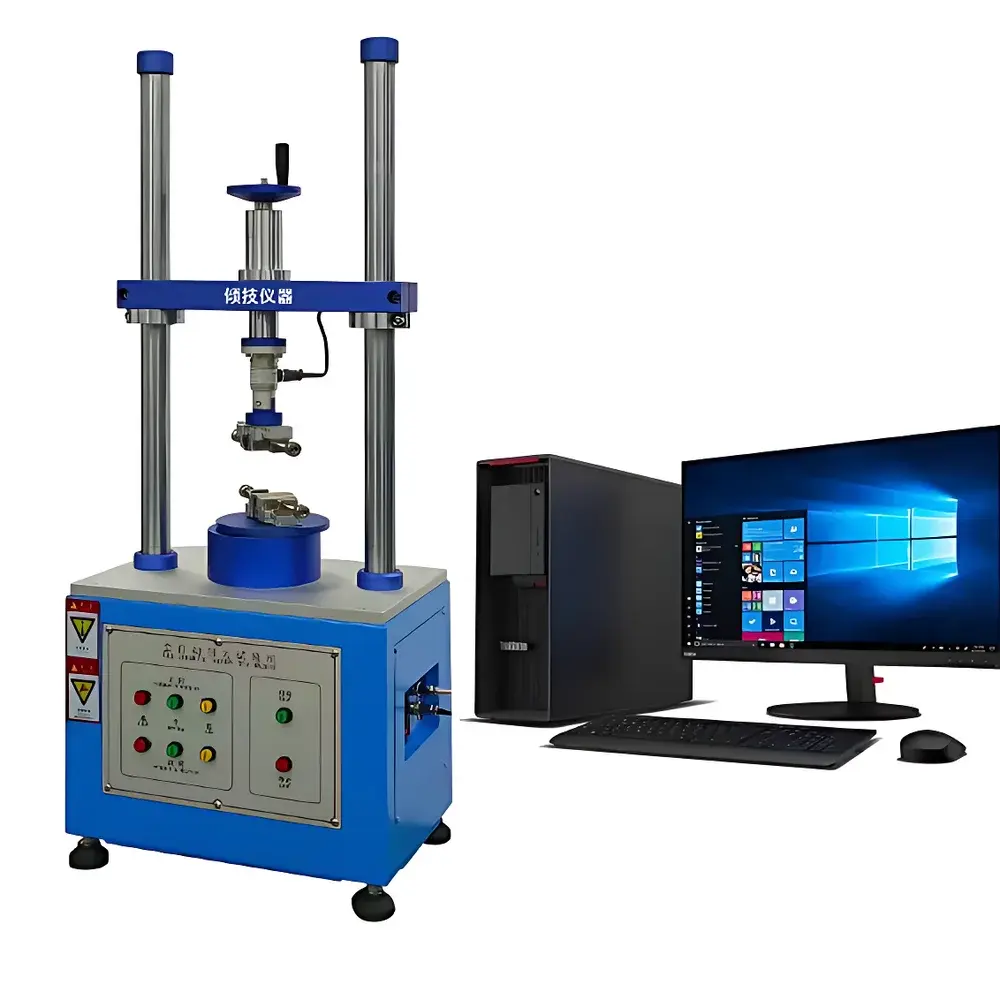
Qinji QJNZ-10 Vertical Torsion Testing Machine
| [Brand | Qinji |
|---|---|
| Origin | Shanghai, China |
| Model | QJNZ-10 |
| Max Torque | 10 (50) N·m |
| Torque Measurement Range | 10 (50) N·m |
| Torque Resolution | 500,000 counts at full scale |
| Accuracy Class | 0.5 |
| Torque Indication Error | ≤ ±1% |
| Repeatability Error | ≤ 1% |
| Measurable Torque Range | 2–100% of full scale |
| Angular Resolution | 0.01° |
| Torsion Speed | 0–15,120°/min (adjustable) |
| Power Supply | AC 220 V, 50 Hz, 2 kVA |
| Dimensions (L×W×H) | 430 × 290 × 1050 mm |
| Weight | 65 kg |
| Effective Test Width | ~240 mm |
| Adjustable Vertical Travel | 100 mm |
| Drive System | Panasonic AC servo motor + LIMING gear reducer |
| Data Acquisition | STC300 digital controller |
| Software | Windows-based torsion test software with Chinese GUI |
| Compliance | ISO 7500-1, ASTM E143, GB/T 10128] |
Overview
The Qinji QJNZ-10 Vertical Torsion Testing Machine is a precision-engineered, benchtop-scale static torsion testing system designed for quantitative mechanical characterization of structural components, fasteners, shafts, springs, and elastic elements under controlled angular displacement and torque loading. Unlike horizontal torsion testers, its vertical configuration optimizes footprint efficiency and facilitates ergonomic sample mounting—particularly advantageous in quality control laboratories and R&D environments where space is constrained. The system operates on the principle of controlled rotational actuation via a closed-loop servo-driven mechanism, enabling precise application of torsional load while simultaneously measuring real-time torque and angular deformation. It conforms to internationally recognized calibration and performance standards including ISO 7500-1 (static uniaxial testing machines), ASTM E143 (shear modulus determination), and China’s national standard GB/T 10128 (metallic materials—torsion testing). Its architecture integrates high-fidelity signal acquisition, low-inertia mechanical transmission, and deterministic motion control to ensure traceable, repeatable, and metrologically sound torsion data.
Key Features
- Vertical benchtop design with compact footprint (430 × 290 × 1050 mm) and 65 kg operational mass—ideal for integration into ISO-classified labs or shared instrumentation facilities.
- High-accuracy torque measurement using a calibrated 10 (50) N·m load cell with 500,000-count resolution across full scale, maintaining consistent resolution without range switching.
- Panasonic AC servo motor coupled with a Taiwan LIMING precision planetary gear reducer ensures smooth, non-impact torque application and stable speed regulation from 0 to 15,120°/min.
- STC300 digital data acquisition and control system provides synchronized sampling of torque, angle, and time at configurable rates—supporting both open-loop speed control and closed-loop torque/angle feedback modes.
- Optical encoder-based angular measurement delivers 0.01° resolution and traceable angular positioning—critical for evaluating yield torsion, plastic deformation onset, and fracture angle.
- Compliance with accuracy class 0.5 per ISO 7500-1: torque indication error ≤ ±1%, repeatability error ≤ 1%, and effective measurement range spanning 2–100% of full scale.
- Modular夹具 system accommodates custom-designed fixtures (provided per user specifications), supporting specimens with diameters adaptable to standard clamping geometries.
Sample Compatibility & Compliance
The QJNZ-10 supports torsional evaluation of metallic rods, cylindrical fasteners, helical springs, polymer shafts, and composite drive components with nominal diameters compatible with standard fixture sets (custom tooling available upon engineering drawing submission). Its 240 mm effective test width and 100 mm vertically adjustable crosshead travel accommodate diverse specimen lengths and mounting configurations. All hardware and firmware comply with electromagnetic compatibility (EMC) requirements per IEC 61326-1 and electrical safety standards per IEC 61010-1. While the base system operates under GLP-aligned workflows, optional audit-trail-enabled software modules can be configured to meet FDA 21 CFR Part 11 requirements for electronic records and signatures in regulated QC environments.
Software & Data Management
The included Windows-native torsion testing software provides a localized Chinese interface with dual-language documentation support. It enables real-time graphical display of torque–angle curves, automatic yield point detection (using ASTM E143-compliant secant offset method), and generation of standardized reports compliant with ISO 14286 and GB/T 10128. Raw data exports are supported in CSV and XML formats for downstream statistical analysis in JMP, Minitab, or MATLAB. The software logs all operator actions, parameter changes, and calibration events with timestamped entries—facilitating internal audit readiness and traceability. Firmware updates and configuration backups are managed through secure USB-based protocols, eliminating network dependency and enhancing data integrity in isolated lab networks.
Applications
- Quality assurance of threaded fasteners (e.g., torque-tension correlation, proof torque verification)
- Mechanical validation of torsional stiffness and damping behavior in automotive driveline components
- Characterization of shear modulus and yield behavior in metallic and polymeric materials per ASTM E143
- Failure mode analysis of torsion springs, coil assemblies, and miniature actuators
- Educational demonstration of Hooke’s law in torsion, Saint-Venant’s principle, and polar moment of inertia effects
- Process validation for cold forging, heat treatment, and surface coating applications affecting torsional strength
FAQ
What is the difference between the “10” and “50” values listed for maximum torque?
The dual rating reflects two calibrated operating ranges: 10 N·m (standard range) and 50 N·m (extended range), selectable via software configuration and sensor calibration. Both ranges maintain 0.5-class accuracy and 500,000-count resolution.
Does the system support automated test sequences for batch testing?
Yes—the software supports programmable multi-step test profiles, including pre-load conditioning, ramp-hold cycles, and failure-triggered termination, with pass/fail logic based on user-defined torque-angle thresholds.
Is third-party calibration certification available?
Factory calibration is performed using NIST-traceable torque standards. Optional UKAS-accredited calibration certificates (ISO/IEC 17025) can be arranged through authorized regional metrology partners.
Can the machine be integrated into an existing MES or LIMS environment?
Raw data streams (via TCP/IP or RS-232) and structured report exports (CSV/XML) enable interoperability with common laboratory informatics platforms. API documentation is provided under NDA for custom integration projects.
What maintenance intervals are recommended for long-term accuracy retention?
Biannual verification of torque transducer linearity and encoder zero drift is advised. Gear reducer lubrication and servo motor thermal monitoring should follow manufacturer-specified service schedules—typically every 2,000 operational hours.



