
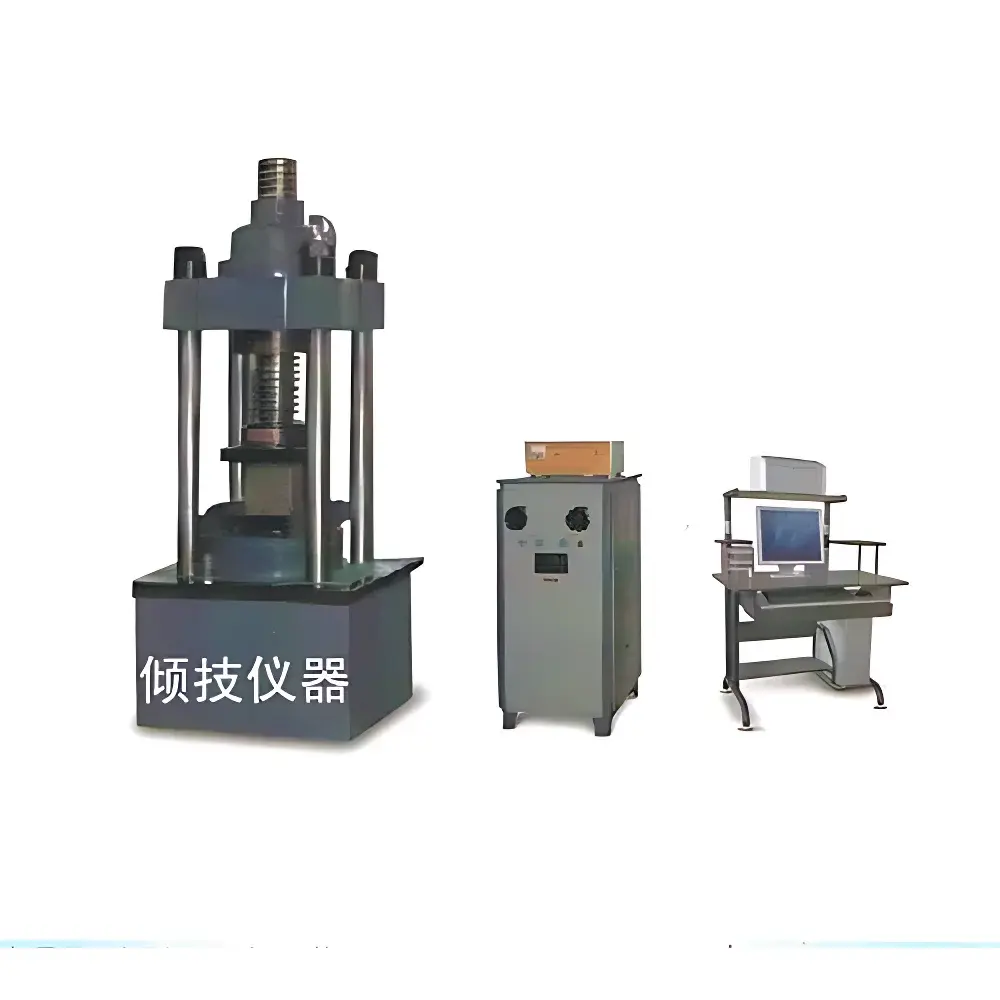
Qinji QJYL-3000 Constant-Stress Compression Testing Machine
| Brand | Qinji |
|---|---|
| Origin | Shanghai, China |
| Model | QJYL-2000 / QJYL-3000 |
| Max Load Capacity | 2000 kN / 3000 kN |
| Accuracy Class | Class I (per ISO 7500-1 & ASTM E4) |
| Force Range | 10–3000 kN |
| Loading Speed | 1–15 mm/s (adjustable) |
| Internal Clear Distance | 320 mm |
| Compression Platens | 320 × 320 mm or 400 × 400 mm |
| Motor Power | 0.75 / 1.1 / 2.2 kW |
| Net Weight | 1000 kg / 1500 kg |
| Overall Dimensions | ~520 × 450 × 1350 mm or 700 × 540 × 1800 mm |
Overview
The Qinji QJYL-3000 Constant-Stress Compression Testing Machine is a high-precision, servo-controlled mechanical testing system engineered for standardized uniaxial compression testing of construction materials—including concrete cubes and cylinders, fired clay bricks, natural stone specimens, and cementitious composites. Designed in strict compliance with international mechanical testing standards—including ISO 7500-1 (static calibration of force-proving instruments), ISO 376 (calibration of reference load cells), ASTM C39/C39M (compressive strength of cylindrical concrete specimens), ASTM C67 (testing of brick and structural clay tile), and EN 12390-3—the machine delivers repeatable, traceable, and auditable test results under controlled stress-rate conditions. Its closed-loop hydraulic-servo architecture enables true constant-stress loading profiles, where the control system continuously adjusts actuator displacement to maintain user-defined stress ramp rates—critical for evaluating material behavior beyond peak load, including post-peak softening response and deformation recovery characteristics.
Key Features
- Servo-controlled proportional hydraulic system with real-time PID feedback for precise stress-rate regulation (e.g., 0.05–0.5 MPa/s per ASTM C39)
- Computer-integrated operation via dedicated Windows-based control software supporting multi-step test protocols: constant-stress → constant-strain, constant-stress → constant-displacement, and constant-strain → constant-load sequences
- High-rigidity dual-column frame with precision-ground guide rails and preloaded ball screws for minimal deflection (<0.02 mm under full load)
- Interchangeable platen sets (320 × 320 mm and 400 × 400 mm) conforming to ISO 7500-1 platen parallelism tolerances (≤0.01 mm/m)
- Dual-range load cell with automatic range switching, calibrated to Class I accuracy per ISO 7500-1 (±0.5% of reading from 1% to 100% FS)
- Integrated displacement transducer (LVDT) with ±0.005 mm resolution and thermal drift compensation
- Real-time dynamic plotting of stress–strain, load–displacement, and time-history curves during test execution
Sample Compatibility & Compliance
The QJYL-3000 accommodates standard civil engineering specimens as defined by major national and international standards: concrete cylinders (Ø100 × 200 mm, Ø150 × 300 mm), cubes (100 × 100 × 100 mm, 150 × 150 × 150 mm), solid/hollow bricks (240 × 115 × 53 mm), and dimension stone blocks (up to 400 × 400 × 400 mm). All test routines support audit-ready data generation compliant with ISO/IEC 17025 requirements for testing laboratories. The system meets mechanical safety requirements per EN 697 (machinery for testing of construction materials) and electromagnetic compatibility per EN 61326-1. Optional configuration supports GLP/GMP-aligned electronic records with 21 CFR Part 11-compliant user authentication, audit trails, and electronic signatures.
Software & Data Management
The embedded control and analysis platform provides full test lifecycle management—from method definition and instrument calibration logging to raw data export (CSV, XML, PDF) and report generation. Calibration certificates are digitally linked to each test record; all parameter changes, operator logins, and test interruptions are timestamped and stored in an immutable audit trail. Raw force and displacement data are sampled at ≥100 Hz and retained without interpolation. Export formats include ASTM E1228-compliant test summary files and ISO 10360-5–compatible measurement uncertainty reports. Software supports batch processing of identical specimen sets with auto-populated metadata (batch ID, curing age, mix design code), enabling seamless integration into LIMS environments.
Applications
- Compressive strength validation of ready-mix concrete per ASTM C39, EN 12390-3, and GB/T 50081
- Quality assurance testing of masonry units (clay bricks, concrete blocks) per ASTM C67 and ISO 7267
- Structural assessment of recycled aggregate concrete and supplementary cementitious material blends
- Long-term compressive creep and relaxation studies under sustained loading (with optional hold-step functionality)
- Calibration verification of field rebound hammers and ultrasonic pulse velocity devices using reference specimens
- Research-grade investigation of fracture energy, modulus of elasticity, and Poisson’s ratio in brittle geomaterials
FAQ
What standards does the QJYL-3000 comply with for calibration and testing?
It conforms to ISO 7500-1 (force measurement accuracy), ISO 376 (load cell calibration), ASTM E4 (load verification), and application-specific standards including ASTM C39, C67, and EN 12390-3.
Can the system perform tests requiring sustained load holding (e.g., creep evaluation)?
Yes—via programmable hold steps within multi-stage test protocols, enabling controlled dwell periods at specified stress levels up to 3000 kN.
Is third-party certification available for metrological traceability?
Yes—factory calibration includes NIST-traceable certificate (optional CNAS-accredited calibration upon request).
How is software validation handled for regulated environments?
The control software supports IQ/OQ documentation packages and can be configured for 21 CFR Part 11 compliance, including role-based access control and electronic audit logs.
What maintenance intervals are recommended for long-term reliability?
Preventive maintenance is advised every 12 months or after 5,000 test cycles—covering hydraulic oil replacement, seal inspection, load cell recalibration, and mechanical alignment verification.



