
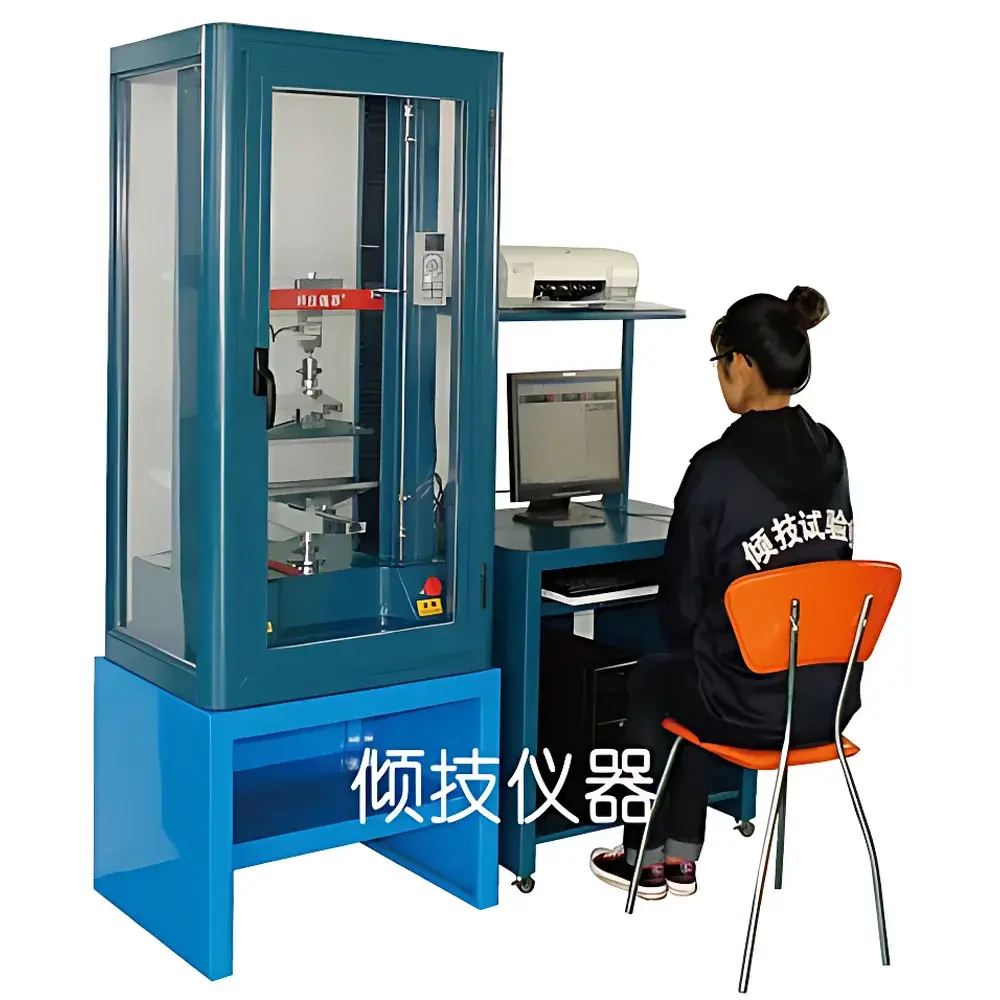
Qinji QJ211S Glass ROR Testing Machine – Electronic Universal Testing System
| Brand | Qinji |
|---|---|
| Model | QJ211S |
| Type | Electronic Universal Testing Machine |
| Max Load Capacity | 10 kN |
| Accuracy Class | 0.5 |
| Effective Test Width | 320 mm |
| Stroke (Tensile Space) | 500 / 800 mm |
| Speed Range | 0.01–300 mm/min |
| Speed Accuracy | ±0.5% of reading |
| Force Resolution | 500,000 counts (full-scale, no range switching) |
| Displacement & Strain Measurement Accuracy | ±0.5% of reading |
| Load Cell | High-precision U.S.-sourced sensor |
| Controller | Panasonic全数字 AC servo controller |
| Control System | Full-digital closed-loop system supporting constant stress, constant strain, and constant displacement modes |
| Safety Protection | Software-based overload diagnosis, electronic travel limit, auto-return function, 110% over-load cut-off |
| Weight | ~145 kg |
| Compliance | GB, ISO, ASTM, JIS, DIN, EN, YB, JT, JG, QC, YY, YD, HG, SL, SY, BB, QB standards |
Overview
The Qinji QJ211S Glass ROR Testing Machine is a high-precision electronic universal testing system engineered specifically for the mechanical characterization of brittle and semi-brittle transparent substrates—including chemically strengthened glass, tempered display panels (smartphone, tablet, monitor, and TV), optical lenses, and architectural glazing. “ROR” denotes *Ring-on-Ring*—a standardized biaxial flexure test method widely adopted in ISO 178, ASTM C1499, and EN 1288-3 for evaluating fracture strength, modulus of rupture (MOR), and elastic modulus under controlled multi-point loading conditions. Unlike conventional three- or four-point bending fixtures, the ROR configuration applies uniform radial stress distribution across circular specimens, minimizing edge effects and enabling statistically robust Weibull analysis of strength variability. The QJ211S integrates a rigid dual-column frame, high-fidelity force transduction, and real-time closed-loop motion control to deliver repeatable, traceable results required for quality assurance, material development, and regulatory validation in display manufacturing and optical component supply chains.
Key Features
- Modular fixture architecture supporting ROR, 3-point bending, 4-point bending, tensile, compression, shear, and puncture testing—configurable per specimen geometry and standard requirements.
- 0.5-class accuracy certified force measurement with 500,000-count resolution across full 10 kN range—no manual range switching ensures consistent signal fidelity from 0.2% to 100% of capacity.
- Panasonic digital AC servo drive system delivering precise speed control (0.01–300 mm/min) with ±0.5% speed linearity and sub-micron positioning repeatability.
- Dual-mode actuation: motorized fast approach (for rapid setup) and fine-adjustment slow mode (for controlled preloading and crack initiation studies).
- Integrated safety protocols including software-based overload detection (110% threshold), hardware-implemented electronic end-limit switches, and automatic return-to-home after test completion.
- Real-time dynamic display of load, displacement, strain, and time on industrial-grade LCD panel; simultaneous data streaming to host PC via USB 2.0 or Ethernet interface.
Sample Compatibility & Compliance
The QJ211S accommodates circular glass specimens up to Ø150 mm for ROR testing and rectangular coupons up to 320 mm wide × 500/800 mm stroke length. Fixture kits are supplied per ISO 178 (flexural properties), ASTM C1499 (biaxial strength), ASTM D638/D790 (tensile/flexural behavior), and EN 1288-3 (glass strength classification). All calibration procedures follow ISO/IEC 17025 guidelines, and system verification reports include traceability to NIST-traceable reference standards. The instrument supports GLP-compliant audit trails when operated under validated software configurations compliant with FDA 21 CFR Part 11 requirements (electronic signatures, user access levels, and immutable test record archiving).
Software & Data Management
The Windows-based QTest Pro software provides full digital control of test parameters, real-time curve visualization (load–displacement, stress–strain, time-series), and post-test analytics including peak load extraction, modulus calculation, offset yield determination, and Weibull probability plotting. Users may perform curve overlay, zoom, interpolation, baseline correction, and export ASCII/CSV/XLSX files directly. All raw data and metadata—including operator ID, environmental conditions (optional sensor input), calibration timestamps, and version-controlled firmware logs—are embedded within each test file. Automated report generation complies with ISO 5893 and ASTM E4 templates, supporting configurable headers, footers, company logos, and bilingual (English/Chinese) output.
Applications
- Fracture strength evaluation of cover glass in consumer electronics (e.g., Gorilla Glass®, Dragontrail™) under ROR loading per ASTM C1499.
- Flexural modulus and yield behavior assessment of laminated safety glass used in automotive HUDs and architectural façades.
- Quality control screening of annealed vs. heat-strengthened vs. fully tempered glass batches prior to shipment.
- Adhesion strength testing of anti-reflective, oleophobic, or hard-coating layers via micro-indentation or pull-off protocols using custom tooling.
- Creep and stress-relaxation profiling under sustained load at elevated temperature (when paired with environmental chamber).
- Validation of finite element models (FEM) for glass failure prediction in structural simulation workflows.
FAQ
What does “ROR” stand for, and why is it critical for glass testing?
ROR stands for Ring-on-Ring—a biaxial flexure test that eliminates edge-induced stress concentrations and yields statistically representative strength distributions essential for reliability modeling.
Is the QJ211S compatible with third-party data acquisition or LIMS integration?
Yes—the system supports TCP/IP and Modbus RTU protocols for seamless integration into laboratory information management systems (LIMS) and MES platforms.
Can the machine be calibrated in-house, or must it be serviced by Qinji-certified technicians?
Field calibration is possible using NIST-traceable reference load cells and displacement standards; however, annual factory recalibration is recommended for ISO/IEC 17025 compliance.
Does the software support multi-user permission levels and electronic signature logging?
Yes—QTest Pro includes role-based access control (administrator, operator, reviewer), electronic signature capture, and immutable audit trail generation compliant with FDA 21 CFR Part 11.
What is the typical lead time for custom fixture design and validation?
Standard ROR and 4-point bending fixtures ship with the base system; application-specific tooling (e.g., curved-surface grips, vacuum chucks) requires 3–5 weeks following dimensional specification submission and mechanical drawing approval.
Related Products



