
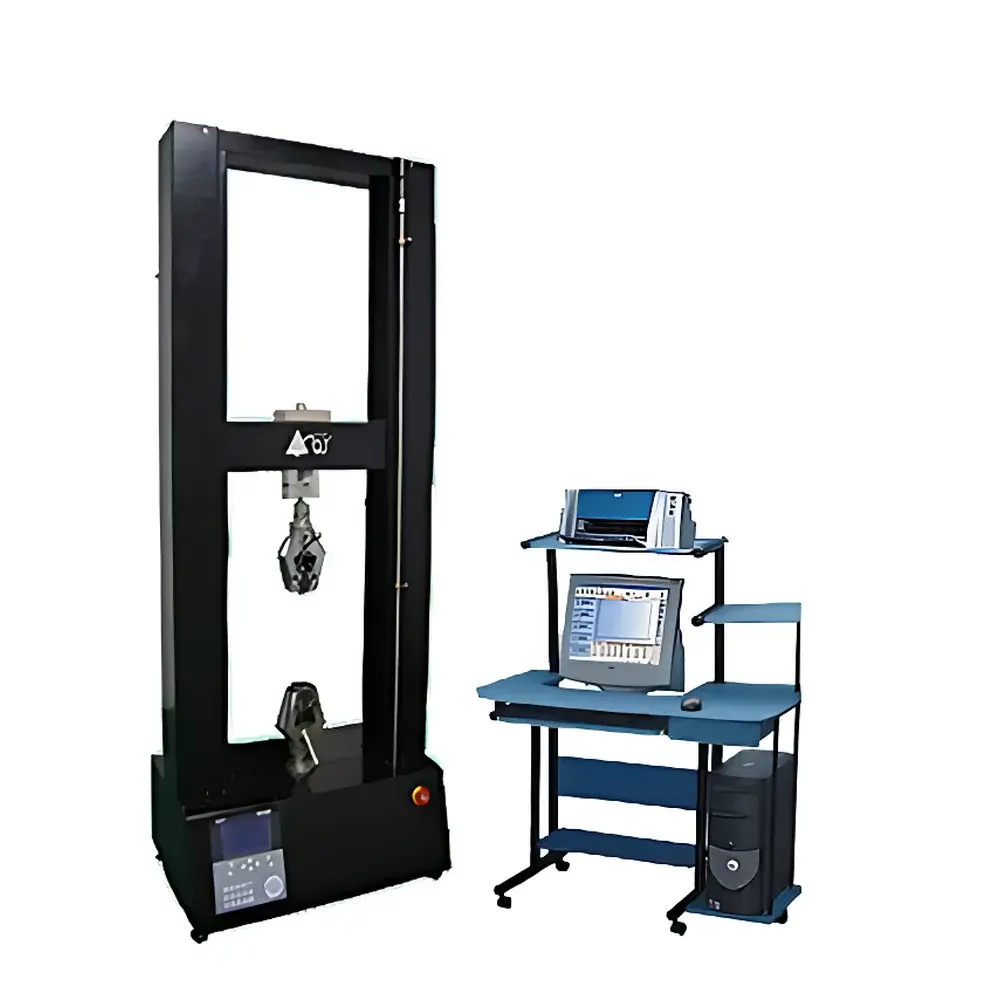
QJ211 Universal Tensile and Compression Testing Machine by Qingji
| Max Load | 30 kN |
|---|---|
| Load Cell Accuracy | 0.01% |
| Measuring Accuracy | < ±0.5% |
| Control System | Windows-based PC control |
| Valid Test Width | ~420 mm |
| Stroke | ~800 mm |
| Speed Range | 0.001–500 mm/min |
| Speed Accuracy | ±0.5% |
| Stroke Accuracy | ±0.5% |
| Displacement Accuracy | ±0.5% |
| Safety Features | Electronic stroke limit, emergency stop |
| Unit Weight | ~140 kg |
Overview
The QJ211 Universal Tensile and Compression Testing Machine is a precision-engineered electromechanical system designed for static mechanical property evaluation of metallic, polymeric, composite, elastomeric, and textile materials. Based on the principle of controlled uniaxial force application and real-time displacement feedback, it complies with fundamental test methodologies defined in ISO 6892-1 (tensile testing of metals), ASTM E8/E8M, ASTM D638 (plastics), ISO 527, ISO 178 (flexural testing), and ISO 1133 (melt flow index correlation). The machine integrates a high-stiffness dual-column frame, servo-controlled AC motor drive, and a calibrated load cell to deliver repeatable force application across its full 30 kN capacity range. Its modular design supports interchangeable fixtures—such as wedge-action grips, compression platens, bend supports, and peel fixtures—enabling standardized execution of tensile, compression, flexure, peel, tear, shear, puncture, and low-cycle fatigue tests under ambient conditions.
Key Features
- High-resolution load measurement with 0.01% full-scale load cell accuracy, traceable to national metrological standards
- Dynamic real-time display of force, displacement, strain, and test speed via integrated digital controller and synchronized Windows-based software interface
- Adjustable crosshead speed from 0.001 to 500 mm/min, maintaining ±0.5% speed fidelity across the entire range per ISO 5893
- Effective test width of 420 mm and vertical stroke of 800 mm accommodate standard specimen geometries per ASTM and ISO dimensional requirements
- Dual-safety architecture: programmable electronic stroke limits plus hardware-level emergency stop circuitry compliant with IEC 60204-1
- Robust cast-iron base and reinforced steel columns ensure minimal frame deflection (< 0.02 mm/kN) during high-load testing
- Modular fixture mounting system compatible with ISO 26203-compliant grip interfaces and DIN 51221 alignment standards
Sample Compatibility & Compliance
The QJ211 accommodates specimens conforming to ISO 6892-1 Type 2, ASTM E8 sub-size, ASTM D638 Type I–V, ISO 527-2, and ISO 178 beam configurations. It supports flat, round, and dog-bone geometries up to 40 mm wide and 15 mm thick. All test routines adhere to GLP-aligned data integrity protocols: audit trails record operator ID, timestamp, parameter changes, and calibration events. Raw force-displacement datasets are stored in vendor-neutral CSV and XML formats, enabling third-party analysis and regulatory submission. The system meets essential requirements of ISO/IEC 17025 for testing laboratories and supports validation documentation packages aligned with FDA 21 CFR Part 11 for electronic records and signatures.
Software & Data Management
The proprietary Windows-native software provides full test configuration, real-time curve visualization (force vs. displacement, stress vs. strain), and post-test analysis—including yield point detection (0.2% offset method), modulus calculation (tangent/secant), ultimate tensile strength, elongation at break, and energy absorption (area under curve). Users may perform multi-curve overlay, axis scaling, point annotation, and export to PDF or Excel. All data files include embedded metadata: test standard reference, environmental conditions (optional sensor input), operator ID, and instrument serial number. Software version history, change logs, and user permission levels (admin/operator/viewer) support internal QA audits and external accreditation reviews.
Applications
- Mechanical qualification of structural alloys and weld joints per ASME BPVC Section II
- Quality control of polymer extrusions, injection-molded parts, and fiber-reinforced composites
- Validation of adhesive bond strength in automotive trim assemblies (peel and shear modes)
- Evaluation of medical device component ductility and failure thresholds (ISO 14243-3)
- Research-grade characterization of hydrogels, elastomers, and soft biomaterials under quasi-static loading
- Teaching laboratory implementation for materials science curricula requiring ASTM/ISO-aligned pedagogy
FAQ
What international standards does the QJ211 support out-of-the-box?
The system includes pre-configured test templates for ISO 6892-1, ASTM E8, ASTM D638, ISO 527, ISO 178, and ISO 1133, with customizable pass/fail criteria and reporting formats.
Is the load cell factory-calibrated and traceable?
Yes—each unit ships with a NIST-traceable calibration certificate valid for 12 months; optional annual recalibration services include uncertainty budgets per ISO/IEC 17025.
Can the software generate 21 CFR Part 11-compliant reports?
The software supports electronic signatures, audit trail export, and locked report generation—configurable to meet FDA-regulated environments when deployed with validated IT infrastructure.
What maintenance intervals are recommended for long-term accuracy?
Load cell verification every 6 months, mechanical alignment check annually, and firmware/software updates applied per vendor release notes to maintain compliance with evolving standard revisions.
Does the system support high-temperature or environmental chamber integration?
Yes—the QJ211 features standardized signal and power interfaces compatible with third-party temperature chambers (−70 °C to +300 °C) and humidity control systems, with synchronization of environmental data into test records.



