
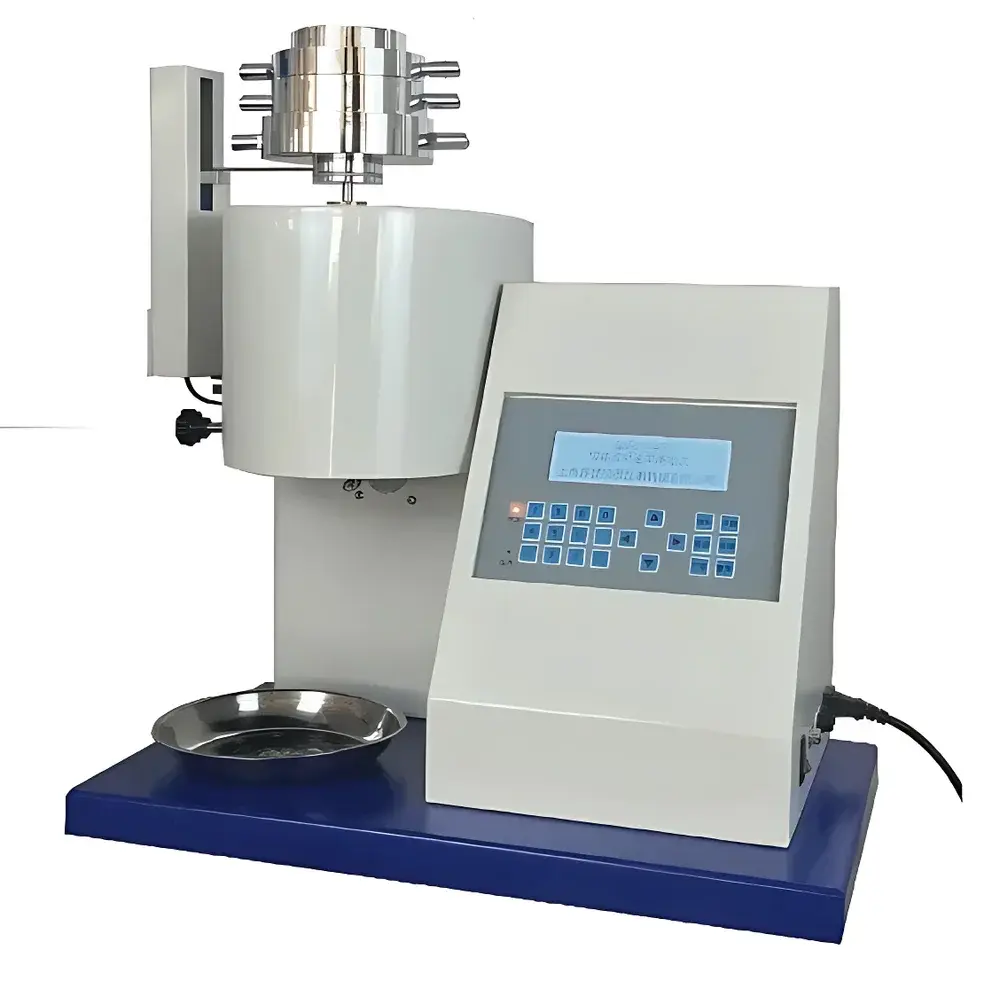
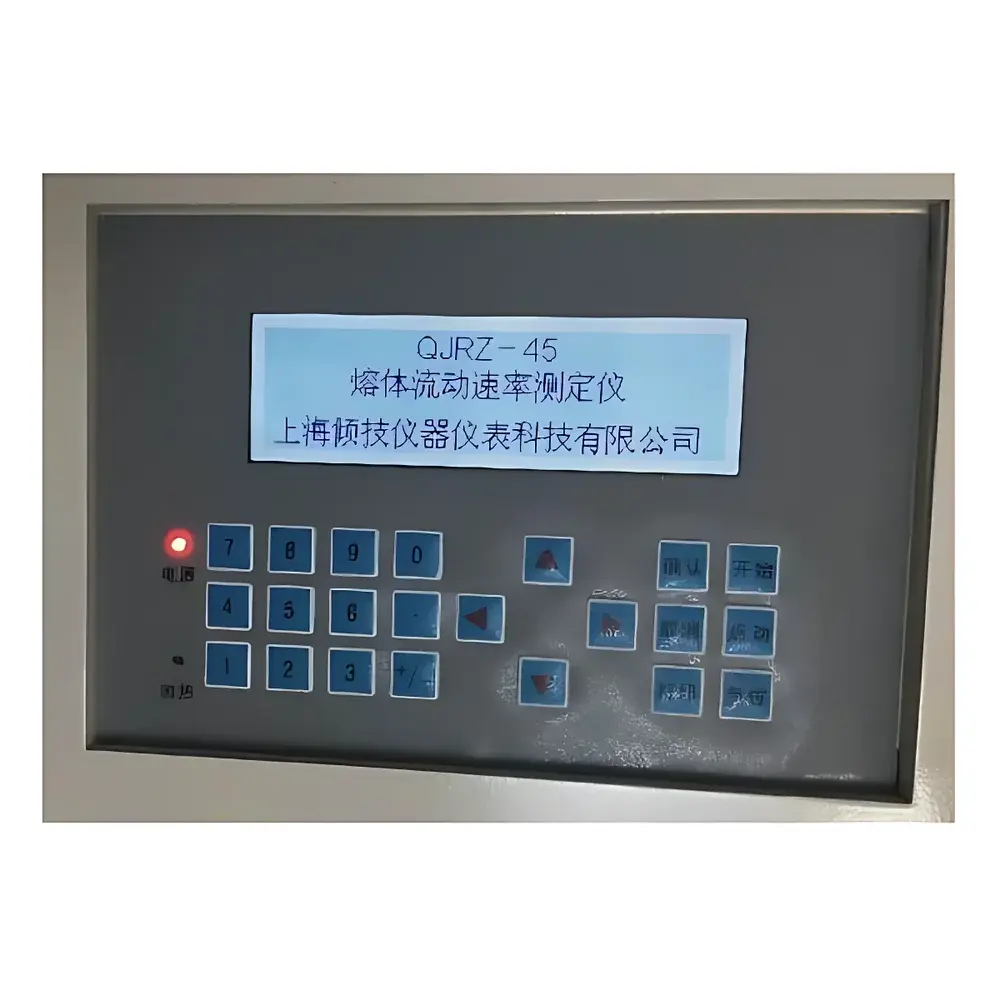
Qinji QJRZ-45 Melt Flow Indexer (MFI Tester) for Thermoplastic Polymers
| Brand | Qinji |
|---|---|
| Model | QJRZ-45 |
| Origin | Shanghai, China |
| Temperature Range | 50–450 °C |
| Temperature Stability | ±0.5 °C |
| Temperature Resolution | 0.1 °C |
| Barrel Diameter | Φ9.55 mm ± 0.025 mm |
| Die Orifice Diameters | Φ2.095 mm ± 0.005 mm and Φ1.180 mm ± 0.010 mm |
| Power Supply | AC 220 V, 50 Hz |
| Dimensions (W×D×H) | 250 mm × 400 mm × 500 mm |
| Net Weight | 35 kg |
| Compliance | GB/T 3682, ISO 1133 |
Overview
The Qinji QJRZ-45 Melt Flow Indexer is a precision gravimetric instrument engineered for the standardized determination of melt mass flow rate (MFR) and melt volume flow rate (MVR) of thermoplastic polymers under defined temperature and load conditions. Based on the principle of extrusion rheometry—where molten polymer is forced through a standardized capillary die under controlled axial force—the QJRZ-45 delivers reproducible, traceable flow data essential for quality control, material specification verification, and process consistency monitoring in polymer manufacturing and R&D laboratories. It operates in strict accordance with ISO 1133-1 (determination of MFR) and ISO 1133-2 (determination of MVR), as well as GB/T 3682, ensuring global method equivalence and regulatory acceptability across supply chains serving automotive, medical packaging, construction, and consumer goods sectors.
Key Features
- Thermally stabilized heating system with PID-controlled furnace, maintaining temperature stability within ±0.5 °C across the full operational range (50–450 °C) and resolution of 0.1 °C for precise thermal conditioning of high-melting engineering resins such as polycarbonate, polyphenylsulfone, PEEK, and fluoropolymers.
- Dual-standard capillary die set included: precision-ground dies with nominal orifice diameters of Φ2.095 mm ± 0.005 mm (standard for most commodity plastics) and Φ1.180 mm ± 0.010 mm (for higher-viscosity or low-flow materials), both conforming to ISO 1133 dimensional tolerances.
- Calibrated barrel assembly with internal diameter Φ9.55 mm ± 0.025 mm, manufactured from high-temperature alloy steel to resist thermal deformation and maintain dimensional integrity during extended testing cycles.
- Integrated digital timer and manual/automatic cut-off mechanism enabling accurate 10-minute (or user-defined) extrudate collection intervals per ASTM D1238 and ISO 1133 protocols.
- Robust mechanical architecture with vibration-damped base and ergonomic loading port, designed for long-term stability in production QC environments and routine laboratory use.
- No external PC dependency for basic operation; all critical parameters—including temperature setpoint, dwell time, load selection (e.g., 2.16 kg, 5.00 kg, 10.00 kg), and test duration—are configured via front-panel keypad with LCD display.
Sample Compatibility & Compliance
The QJRZ-45 supports a broad spectrum of thermoplastic materials, including but not limited to polyethylene (PE), polypropylene (PP), acrylonitrile-butadiene-styrene (ABS), polyoxymethylene (POM), polystyrene (PS), polyamide (PA6, PA66), polyethylene terephthalate (PET), and high-performance polymers such as polyetherimide (PEI) and polyaryletherketone (PAEK). Its wide temperature range (50–450 °C) accommodates both low-melting commodity resins and high-decomposition-threshold engineering thermoplastics. All test procedures comply with ISO 1133 Parts 1 and 2, GB/T 3682, ASTM D1238, and JIS K 7210. The instrument’s thermal calibration protocol aligns with ISO/IEC 17025 requirements for accredited testing laboratories, supporting GLP documentation workflows and audit-ready calibration records.
Software & Data Management
While the QJRZ-45 operates autonomously, optional USB-connected data logging firmware enables timestamped export of temperature profiles, cut times, and mass measurements to CSV format for integration into LIMS or statistical process control (SPC) platforms. All stored test logs include operator ID, sample ID, test date/time, temperature setpoint, applied load, die configuration, and calculated MFR/MVR values. The firmware supports 21 CFR Part 11-compliant user access control when deployed with validated third-party laboratory software, fulfilling FDA-regulated environments’ requirements for electronic record integrity, audit trails, and electronic signatures.
Applications
- Raw material acceptance testing per supplier specifications and internal QC release criteria.
- Batch-to-batch consistency verification in compounding, extrusion, and injection molding operations.
- Correlation studies between MFR/MVR and mechanical properties (e.g., tensile strength, impact resistance) during polymer formulation development.
- Stability assessment of polymer melts under thermal shear stress, including degradation monitoring via sequential MFR measurements.
- Supporting technical documentation for ISO 9001, IATF 16949, and AS9100-certified quality management systems.
- Training and method validation in academic polymer science laboratories and vocational technical centers.
FAQ
What standards does the QJRZ-45 fully support?
It complies with ISO 1133-1 (MFR), ISO 1133-2 (MVR), GB/T 3682, ASTM D1238, and JIS K 7210. Calibration certificates are issued against NIST-traceable reference standards.
Can the QJRZ-45 measure both MFR and MVR?
Yes—MFR is determined gravimetrically using analytical balance input; MVR is derived by dividing MFR by the melt density (ρ), which may be entered manually or imported from material databases.
Is die interchangeability supported without recalibration?
Yes—the dual-die holder is mechanically indexed to ensure repeatable alignment; no recalibration is required when switching between the Φ2.095 mm and Φ1.180 mm dies, provided both meet ISO 1133 dimensional certification.
What maintenance is required for long-term accuracy?
Routine cleaning of the barrel and die with brass brushes and high-purity solvents after each polymer type change; annual verification of temperature uniformity and die geometry by an accredited service provider is recommended.
Does the instrument support automated load application?
No—the QJRZ-45 uses manual dead-weight loading per ISO 1133 requirements; however, optional calibrated weight sets (2.16 kg, 5.00 kg, 10.00 kg, 21.60 kg) are supplied with certificate of calibration.





