
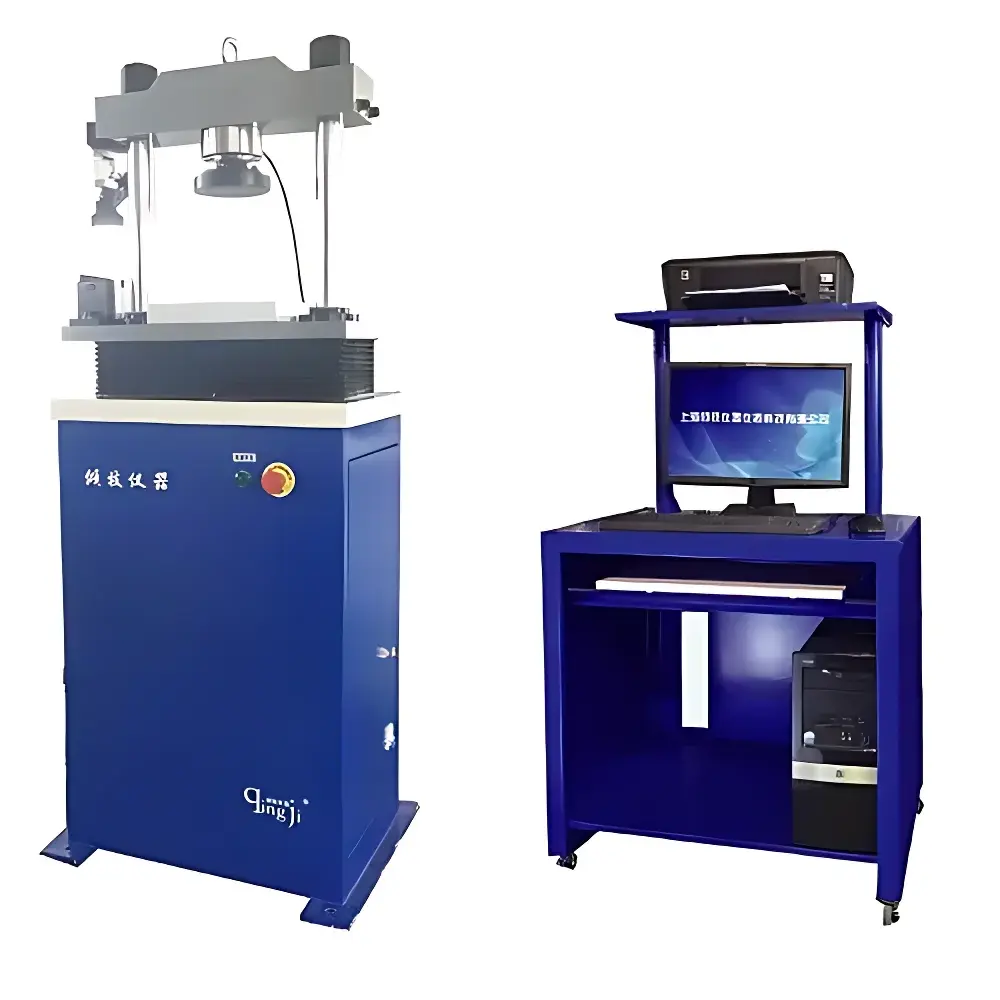
QJYL872 Universal Compression and Flexural Testing Machine
| Origin | Shanghai, China |
|---|---|
| Manufacturer Type | Authorized Distributor |
| Origin Category | Domestic (China) |
| Model | QJYL872 |
| Price | USD 4,200 (FOB Shanghai) |
| Max. Compressive Load Capacity | 300 kN |
| Max. Flexural Load Capacity | 10 kN |
| Loading Rate Range (Compression) | 0–10 kN/s |
| Loading Rate Range (Flexure) | 0–0.075 kN/s |
| Relative Indicated Error | ±0.5 % |
| Compliance Standards | GB/T 17671–1999, GB 13544–2000, GB/T 50081–2002 |
Overview
The QJYL872 Universal Compression and Flexural Testing Machine is a dual-mode mechanical testing system engineered for high-reproducibility evaluation of compressive and flexural strength in construction materials. It operates on the principle of controlled quasi-static axial loading using a servo-controlled hydraulic actuation system, with force transduction via precision-calibrated load cells and displacement measurement via linear variable differential transformers (LVDTs). Designed specifically for cementitious systems—including cement mortars, concrete cubes, fired clay bricks, and autoclaved aerated concrete (AAC) blocks—the instrument delivers traceable, standards-compliant results required for quality assurance in precast production, ready-mix batching plants, third-party inspection laboratories, and academic research facilities. Its modular frame architecture accommodates interchangeable test fixtures without recalibration, enabling rapid transition between compression and three-point bending configurations per ISO 679, ASTM C109/C348, and EN 196-1.
Key Features
- Robust dual-load-capacity design: 300 kN maximum compressive force and 10 kN dedicated flexural capacity—ensuring structural integrity during high-force brick or concrete cube testing while maintaining resolution for low-load mortar beam flexure.
- Precision hydraulic loading system with closed-loop rate control: Adjustable compression loading rates from 0 to 10 kN/s and flexural rates from 0 to 0.075 kN/s, programmable in discrete steps to meet incremental ramp requirements specified in GB/T 50081–2002 and ASTM C39.
- High-accuracy force measurement: Dual-range load cell with ±0.5 % relative indication error across full scale—certified per JJG 139–2014 (Chinese national verification regulation for material testing machines) and traceable to NIM (National Institute of Metrology, China).
- Integrated safety interlocks: Automatic emergency stop triggered by overtravel, overload (>105 % FS), or hydraulic pressure anomaly—compliant with GB/T 2611–2007 general technical requirements for testing machines.
- Compact footprint (1200 × 800 × 2100 mm) and tool-free fixture mounting—optimized for space-constrained QC labs and field-deployable metrology units.
Sample Compatibility & Compliance
The QJYL872 supports standardized specimen geometries defined in major national and international standards. For compression testing, it accommodates 150 mm × 150 mm × 150 mm concrete cubes (GB/T 50081–2002), 40 mm × 40 mm × 160 mm cement mortar prisms (GB/T 17671–1999), and solid/hollow clay bricks per GB 13544–2000. In flexural mode, it executes three-point bending on 40 mm × 40 mm × 160 mm cement mortar beams with support span of 100 mm—fully aligned with ISO 679 Annex A and EN 196-1 Clause 8. Optional accessories include spherical seating assemblies (per ASTM C109), hardened steel platens (HRC ≥ 58), and alignment jigs meeting ISO 7500-1 Class 1 accuracy requirements. All test procedures are documented to support GLP audit readiness and internal QA record retention.
Software & Data Management
The system includes embedded firmware with real-time force–displacement curve acquisition at ≥100 Hz sampling rate and local storage of ≥1,000 test records. Export formats include CSV and PDF reports compliant with ISO/IEC 17025 documentation requirements. Optional PC-based software (QTest Suite v3.2) provides advanced features: automated standard-specific test sequencing (e.g., GB/T 17671–1999 Mode B loading profile), statistical analysis (mean, SD, CV%), pass/fail flagging against limit thresholds, and electronic signature-enabled report generation satisfying FDA 21 CFR Part 11 principles for audit trail integrity. Raw data files retain metadata including operator ID, calibration certificate ID, environmental temperature/humidity logs, and machine serial number.
Applications
- Compliance testing of Portland cement mortar and concrete per Chinese National Standards (GB) and ISO 679.
- Quality control of load-bearing masonry units—including fired clay bricks, concrete blocks, and fly ash bricks—under compressive stress.
- Evaluation of flexural tensile strength in cement-based repair mortars and polymer-modified overlays.
- Prequalification testing of prefabricated structural elements such as hollow-core slabs and lightweight aggregate panels.
- Academic research on strength development kinetics in alkali-activated binders and geopolymer systems.
- Third-party certification services supporting CE marking, CCC (China Compulsory Certification), and export documentation for ASEAN and Middle East markets.
FAQ
Does the QJYL872 comply with ISO/IEC 17025 requirements for accredited testing laboratories?
Yes—the instrument’s metrological performance, calibration traceability, and data handling protocols align with ISO/IEC 17025:2017 Clauses 6.4 (Equipment) and 7.7 (Results Reporting). Calibration certificates include uncertainty budgets and reference to NIM standards.
Can the machine perform split tensile (Brazilian) tests on cylindrical concrete specimens?
No—the QJYL872 is configured exclusively for uniaxial compression and three-point flexure. Split tensile testing requires a specialized fixture and load train geometry not supported by this model.
Is remote diagnostics or firmware update capability available?
Firmware updates are performed locally via USB interface; remote diagnostic support is provided through secure TeamViewer sessions under signed NDA, subject to client network policy approval.
What is the recommended recalibration interval?
Annual recalibration is advised per GB/T 2611–2007 and internal QA policy; however, verification checks using certified reference load standards should be conducted before each daily shift.
Are digital signatures and audit trails enabled by default in the reporting software?
Electronic signature functionality and time-stamped audit logs are activated only when QTest Suite is deployed with validated user access controls and password-protected administrator privileges—consistent with 21 CFR Part 11 Subpart B implementation guidelines.



