
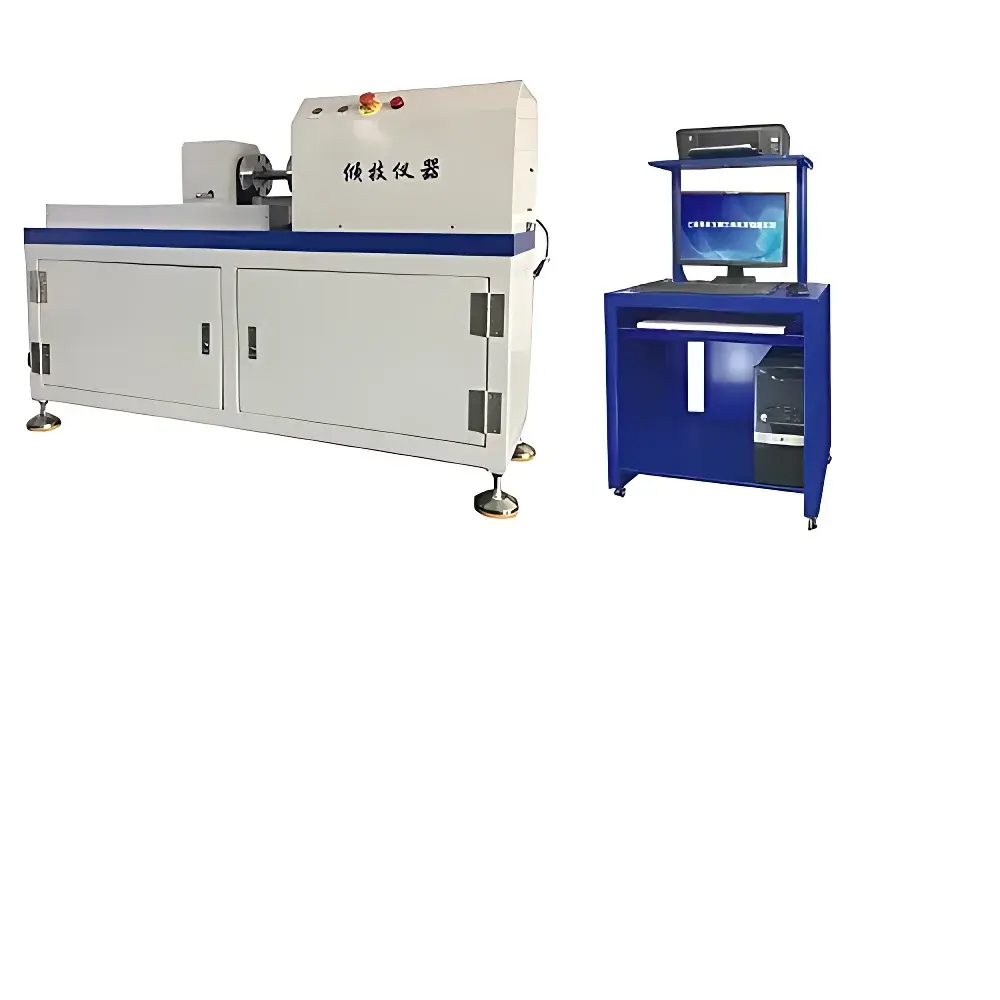
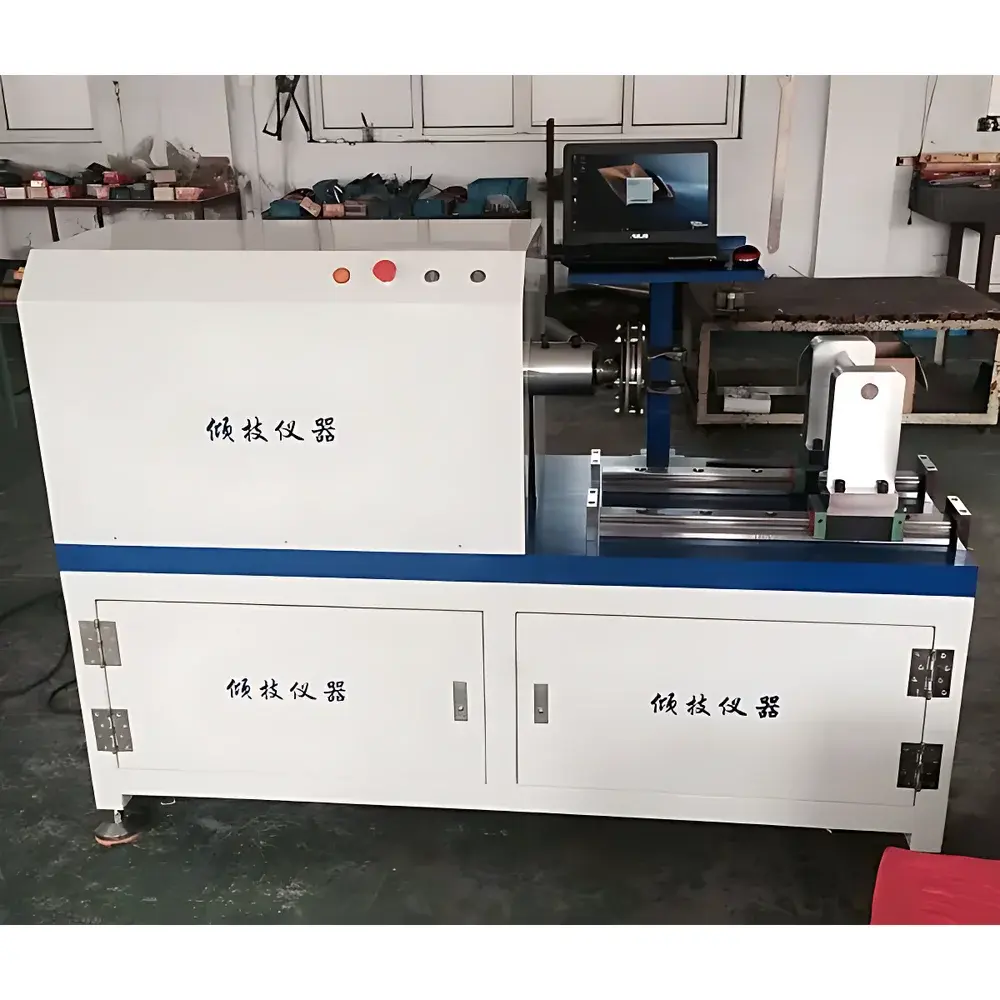
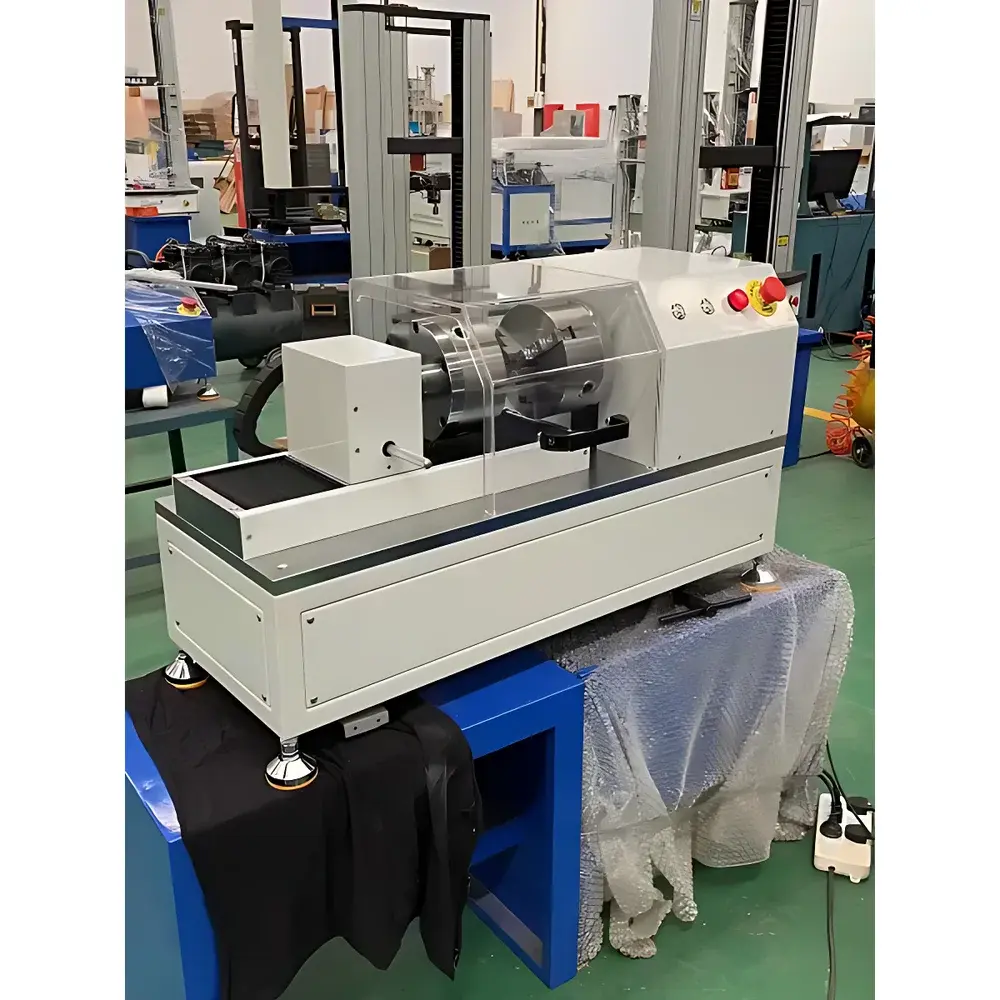
Qinji QJNZ Series Torsion Testing Machine
| Brand | Qinji |
|---|---|
| Origin | Shanghai, China |
| Manufacturer Type | Authorized Distributor |
| Product Origin | Domestic (China) |
| Model | QJNZ Series |
| Price Range | USD 4,900 – 7,000 (FOB Shanghai) |
| Max Torque Capacity | 10,000 N·m |
| Torque Measurement Range | 50–5,000 N·m |
| Torque Resolution | 1/350,000 full scale (no range switching) |
| Angular Displacement Measurement Range | 0 to ±100,000° (4-digit digital display) |
| Angular Resolution | ±0.001° |
| Angular Accuracy | ±0.009° |
| Torque Measurement Accuracy | ±0.5% of reading |
| Angular Measurement Accuracy | ±0.5% of reading |
| Rotational Speed Range | 0.01–1,000 °/min (infinitely variable) |
| Speed Accuracy | ±0.2% of set value |
| Gauge Length (distance between chucks) | 1,500 mm |
| Specimen Clamping Diameter Range | Φ8–Φ40 mm (expandable with optional fixtures) |
| Overall Dimensions (L×W×H) | 2,800 × 4,700 × 1,250 mm |
| Net Weight | 1,500 kg |
Overview
The Qinji QJNZ Series Torsion Testing Machine is a high-capacity, microprocessor-controlled electromechanical system engineered for precise static and quasi-static torsional characterization of metallic and non-metallic materials, structural components, and mechanical assemblies. It operates on the principle of controlled angular displacement actuation via a high-torque servo motor, coupled with dual-sensor feedback loops for simultaneous high-fidelity measurement of applied torque and angular deformation. Designed in strict accordance with Chinese national standards GB/T 9370–1999 (Methods for Tensile Testing of Metallic Materials — Torsion Test), GB/T 239–1999 (Torsion Testing of Metallic Wires), and JJG 269–1981 (Verification Regulation for Torque Measuring Instruments), the QJNZ series delivers metrologically traceable results suitable for quality assurance, R&D validation, and regulatory documentation in industrial and academic laboratories.
Key Features
- High-torque capacity up to 10,000 N·m with overload protection and real-time torque limiting logic
- Full-scale torque resolution of 1/350,000 without range switching—ensuring consistent precision across the entire 50–5,000 N·m operational window
- Dual-axis angular encoder system delivering ±0.001° resolution and ±0.009° absolute angular accuracy over ±100,000° range
- Infinitely variable rotational speed control from 0.01 to 1,000 °/min, with speed stability maintained within ±0.2% of setpoint
- Modular chuck system accommodating specimens from Φ8 mm to Φ40 mm diameter; custom jaw sets available for larger or non-circular cross-sections
- Integrated thermal management and rigid C-frame architecture minimizing frame deflection and ensuring long-term repeatability (±0.5% torque and angular measurement uncertainty)
- Compliance-ready firmware supporting audit trails, user-level access control, and electronic signature capability per FDA 21 CFR Part 11 requirements when paired with validated software configuration
Sample Compatibility & Compliance
The QJNZ platform supports standardized test specimens defined in ISO 7800, ASTM E143, and GB/T 239, including round bars, wires, shafts, fasteners, and torsion springs. Optional accessories extend functionality to hollow tubes, composite laminates, and biomedical implants under torsional loading. All mechanical and electrical subsystems comply with CE marking directives (2014/30/EU EMC Directive and 2014/35/EU Low Voltage Directive) and meet IP20 environmental protection rating. Calibration certificates are provided traceable to CNAS-accredited national metrology institutes, and verification reports align with JJG 269–1981 periodic inspection protocols.
Software & Data Management
Control and analysis are executed via Qinji’s proprietary TorsionLab v3.2 software, built on virtual instrumentation architecture (NI LabVIEW-based engine). The application provides real-time closed-loop control modes—including torque-controlled, angle-controlled, and rate-controlled profiles—as well as automated sequence programming for multi-step tests (e.g., pre-load → ramp → hold → reverse torsion). Raw data streams (torque, angle, time, temperature if equipped) are acquired at ≥1 kHz sampling rate and stored in HDF5 format for interoperability with MATLAB, Python (Pandas/H5Py), and third-party LIMS platforms. Reporting modules generate PDF/Excel outputs compliant with ISO/IEC 17025 documentation requirements, including uncertainty budgets, calibration history, and GLP/GMP-compliant electronic signatures.
Applications
- Determination of shear modulus (G), proportional limit torque, yield torque, ultimate torsional strength, and fracture angle per ASTM E143 and GB/T 9370
- Quality conformance testing of drive shafts, steering columns, torsion bars, and valve actuators in automotive and aerospace supply chains
- Validation of adhesive bond integrity in hybrid joints subjected to torsional peel stresses
- Characterization of viscoelastic torque relaxation behavior in polymer rods and elastomeric couplings
- Calibration reference for secondary torque standards in metrology labs accredited to ISO/IEC 17025
- Teaching and research applications in mechanical engineering curricula covering torsion mechanics and material constitutive modeling
FAQ
What standards does the QJNZ series comply with?
The system meets GB/T 9370–1999, GB/T 239–1999, and JJG 269–1981. Optional calibration packages support ISO 6789–2 and ASTM E2504 traceability.
Can the machine perform cyclic torsion fatigue testing?
Standard configuration supports static and quasi-static tests only. High-cycle torsional fatigue requires optional servo-hydraulic upgrade and dedicated fatigue control module (QJNZ-FAT variant).
Is remote diagnostics and software update supported?
Yes—TorsionLab v3.2 includes secure TLS-encrypted remote access for technical support and over-the-air firmware updates, subject to customer network policy approval.
What maintenance intervals are recommended?
Preventive maintenance is scheduled every 12 months or after 2,000 operational hours, including encoder recalibration, bearing lubrication, and load cell verification using certified torque standards.
Does the system support integration into an existing MES or QMS environment?
Via OPC UA server interface and RESTful API endpoints, the QJNZ exports structured test metadata and result summaries directly to SAP QM, ETQ Reliance, and similar enterprise quality systems.



