
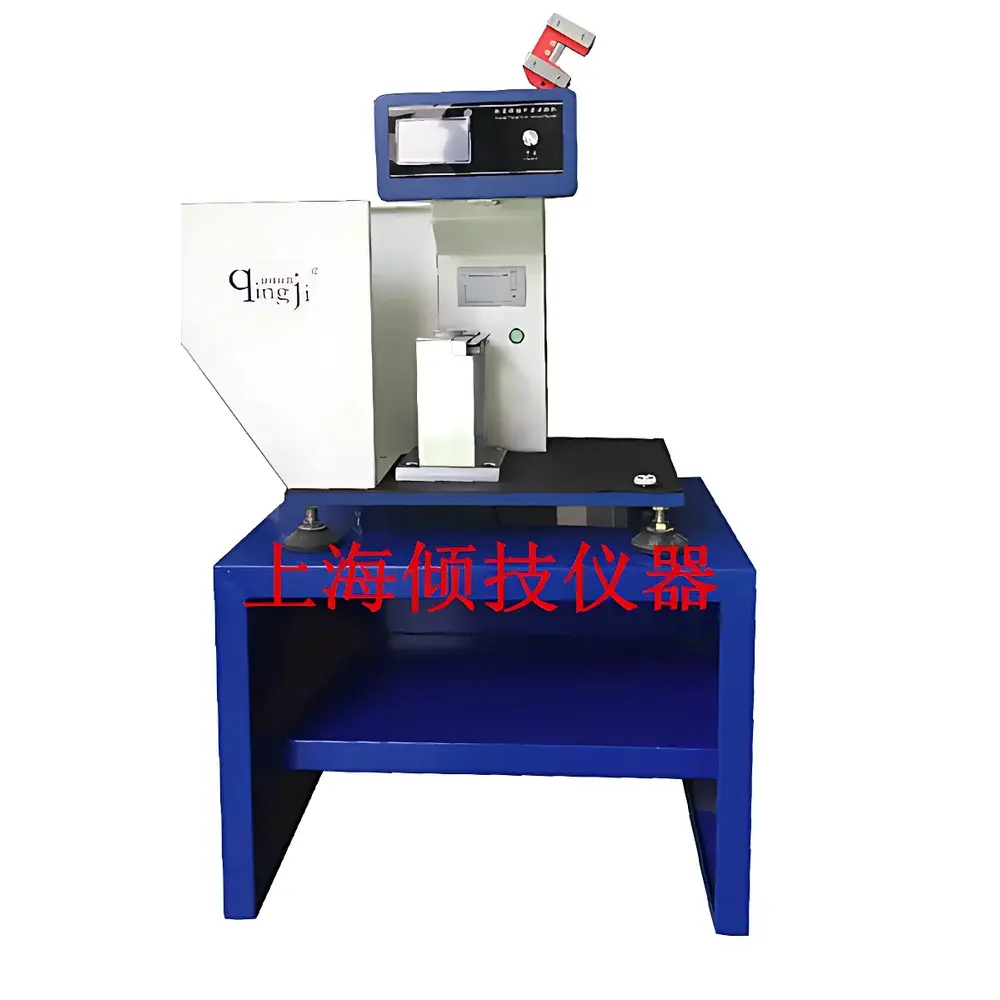
QJBCJ Advanced Notched Izod/Charpy Impact Tester for Non-Metallic Profiles
| Origin | Shanghai, China |
|---|---|
| Manufacturer Type | Authorized Distributor |
| Origin Category | Domestic (China) |
| Model | QJBCJ |
| Price | USD 2,800 (FOB Shanghai) |
| Impact Energy Range | 5 J, 7.5 J, 15 J, 25 J, 50 J |
| Impact Velocity | 2.9 m/s |
| Pendulum Pre-Lift Angle | 160° |
| Distance from Pendulum Axis to Specimen Center | 230 mm |
| Anvil Radius (Clamp Edge) | 1 mm |
| Impact Blade Angle | 30° |
| Impact Blade Tip Radius | 2 mm |
| Support Span Options | 40 mm, 60 mm, 70 mm, 95 mm |
| Dimensions (L×W×H) | 280 × 250 × 500 mm |
| Net Weight | 50 kg |
| Compliant Standards | GB/T 1043, ISO 179-1, ISO 9854-1, DIN 8078, DIN 53453 |
Overview
The QJBCJ Advanced Notched Izod/Charpy Impact Tester is a precision-engineered mechanical testing system designed specifically for evaluating the impact resistance and fracture toughness of non-metallic structural profiles—including rigid plastic pipes, extruded sections, reinforced nylon composites, fiber-reinforced polymer (FRP) tubes, ceramic rods, cast stone specimens, and electrically insulating materials. Operating on the classical pendulum impact principle, the instrument measures energy absorption during brittle or ductile fracture under standardized notched-beam loading conditions. Its dual-mode capability supports both Izod and Charpy configurations through interchangeable fixtures and calibrated pendulum assemblies, enabling direct comparison with international material certification benchmarks. The tester’s robust cast-iron base, low-friction bearing shaft, and optically aligned release mechanism ensure high reproducibility (< ±1.5% CV per ASTM D256 repeatability criteria) across repeated tests—critical for quality control in polymer extrusion, composite manufacturing, and building material certification labs.
Key Features
- Modular pendulum system with five calibrated impact energy levels (5 J, 7.5 J, 15 J, 25 J, 50 J), each verified traceably to national metrology standards
- Precision-machined hardened steel impact blade (30° included angle, 2 mm tip radius) and anvil (1 mm edge radius) meeting ISO 179-2 dimensional tolerances
- Adjustable support span configuration (40 mm, 60 mm, 70 mm, 95 mm) to accommodate diverse cross-sectional geometries—from thin-walled tubing to multi-ribbed architectural profiles
- Optical pendulum angle sensor and mechanical latch release ensure consistent 2.9 m/s impact velocity and 160° pre-lift positioning
- Stable granite-finished base and vibration-damped mounting platform minimize energy loss during specimen fracture
- Compliance-ready design with documented traceability to GB/T 1043, ISO 179-1:2019, ISO 9854-1:2019, DIN 8078, and DIN 53453 test protocols
Sample Compatibility & Compliance
The QJBCJ accommodates irregularly shaped specimens up to 15 mm in thickness and 120 mm in length—including hollow-section PVC conduits, co-extruded ABS trims, pultruded FRP channels, and mineral-filled polypropylene profiles. Its adjustable clamping jaws and modular anvil sets allow secure fixation without deformation-induced stress concentration. All mechanical dimensions—including support span, notch depth, and blade alignment—are validated against ISO 179 Annex B verification procedures. Test reports generated using this system satisfy regulatory submission requirements for CE marking (EN ISO 179), FDA-compliant medical device packaging validation (per ISO 11607-2), and construction product declarations under EN 13501-1. Full compliance documentation—including factory calibration certificates, uncertainty budgets, and standard reference material (SRM) test records—is provided with each unit.
Software & Data Management
While the QJBCJ operates as a manual mechanical tester, it integrates seamlessly into digital QA workflows via optional USB-connected digital angle encoder and energy readout module (sold separately). Raw angular displacement data can be exported in CSV format for post-processing in MATLAB, Python (SciPy), or Minitab. All hardware configurations adhere to GLP principles: pendulum calibration logs, operator ID stamps, and environmental condition tags (temperature/humidity) are manually recorded in accordance with ISO/IEC 17025:2017 Clause 7.7. For regulated environments, the system supports 21 CFR Part 11-compliant electronic recordkeeping when paired with validated LIMS platforms such as LabWare or Thermo Fisher SampleManager.
Applications
- Quality assurance of extruded thermoplastic profiles in automotive interior trim and building façade systems
- R&D evaluation of notch sensitivity in bio-based composites and recycled polymer blends
- Batch release testing for electrical conduit materials per UL 651 and IEC 61386 specifications
- Failure analysis of brittle fracture in ceramic-lined industrial piping under low-temperature service conditions
- Academic research on strain-rate dependence of fracture energy in nano-reinforced epoxy matrices
- Third-party certification testing for CE-marked plastic window frames and rail infrastructure components
FAQ
Does the QJBCJ meet ASTM D256 requirements?
Yes—the geometry, energy calibration, and procedural sequence fully align with ASTM D256 Type A (Izod) and Type U (Charpy) test methods when configured with appropriate fixtures and specimen conditioning per Section 7.
Can it test specimens with non-rectangular cross-sections?
Yes—custom anvil inserts and lateral support blocks are available to stabilize circular, oval, or multi-planar profiles while maintaining standardized load application points.
Is ISO 179-1:2019 traceable calibration included?
Each unit ships with a UKAS-accredited calibration certificate covering pendulum moment of inertia, blade geometry, and energy scale linearity, valid for 12 months from date of shipment.
What maintenance is required for long-term accuracy?
Annual verification of bearing friction torque, blade wear inspection (using optical profilometry), and recalibration of support span gauges per ISO 179-2 Clause 9.2 are recommended.
Do you supply certified reference materials for routine verification?
Yes—NIST-traceable polycarbonate and PMMA reference bars (certified impact energy ±0.5%) are available under separate order code QJBCJ-SRM-01.



